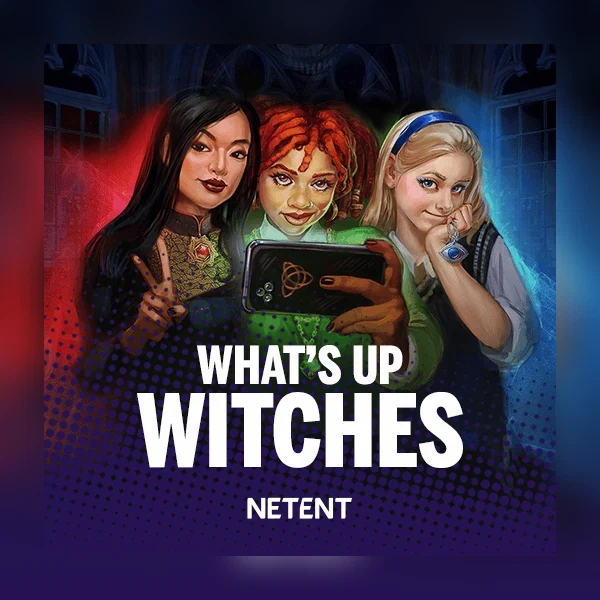
What’s Up? Witches builds its identity around a spell system that changes groups of symbols into Wilds. Grimoires on a horizontal row activate spells, and ordinary grimoires can set off a left-to-right chain while a Super Grimoire activates all visible spells at once. Free Spins switch the focus to multipliers and a randomly selected Magic Orb effect. The contrast between spatial spell activation in the main game and multiplier management in the bonus gives this witches’ tale two distinct rule sets to follow.
What’s Up? Witches at a glance
| Provider | NetEnt |
|---|---|
| Genre / theme | Fantasy |
| Game type | Video slot |
| Reels / grid | 6 reels; row pattern 4-6-6-6-6-4 |
| Reference RTP | 96.03% |
| Volatility | 9.9 (catalog scale) |
| Payout mechanic | Ways wins; fixed ways count not stated |
| Maximum win | 10,180× bet |
| Release date | 21 May 2026 |
| Main features | Grimoires activate spell patterns that convert affected symbols to Wilds; four or five Scatters award Free Spins with multipliers and one randomly selected Magic Orb effect per spin. |
RTP and stake limits can vary by version and market. Check the information screen in the game you open. Maximum win is a ceiling, not an expected result.
A six-reel ways layout with spells across the field
The listed layout has six reels with a 4-6-6-6-6-4 row pattern and ways wins; the catalog does not provide a fixed ways count. Nine spell types can appear during an initial spin, with up to three spells on the reels in one spin. A Grimoire appears on the horizontal reel. A normal Grimoire activates spells on the adjacent reel to its position, and any spells within an activated spell’s area can trigger a chain reaction. The spell occupying the Grimoire’s reel activates first, followed by other spells from left to right. A Super Grimoire activates every spell on the reels simultaneously, regardless of position. Only one Grimoire can appear in the play area.
Each spell defines its own footprint: some change only their own tile, others affect adjacent positions, a full row or column, a plus shape, or all positions in one direction. Activated spell positions and symbols within their effect become Wilds, except Scatters and the horizontal reel. The resulting Wilds can gain a multiplier when affected by spells, rising to ×2 and then at most ×3. On a ways win, multiplier Wild values multiply the number of winning ways passing through them; multiple multiplier values multiply together. The rules also compare an all-Wild combination with a symbol combination for ways beginning with Wilds, paying the higher eligible result, while an all-Wild win requires a six-symbol path from the leftmost to rightmost reel. Spell coverage therefore changes both which symbols can connect and how many ways receive a multiplier.
Free Spins move from spell coverage to multiplier control
Four or five Scatters anywhere in the main-game reels award ten or fifteen Free Spins on a 5-reel, 5-row play area. Multipliers from ×1 through ×100 can land during the bonus. Each spin can also activate one of nine Magic Orb effects at random. They do not all do the same thing: Doubler raises three multipliers, Collector gathers two to six, Upgrader increases three by one, and Compressor combines a line of multipliers into a single value at the last position on that line. Generator places three multipliers on empty positions; Sweeper collects and removes all ×1 values; and +3 Spins extends the feature. Adder and Convertor alter existing values, with Convertor copying the highest among a selected position and its orthogonal neighbours across five positions. The shared purpose is to redistribute or change the multiplier field, but some effects consolidate values while others create more positions to use.
The reference record lists a 96.03% RTP, volatility 9.9 and a maximum payout of 10,180 times the bet. These exact-title catalog values may differ by operator configuration. The maximum win probability is not given. Multipliers can reach large stated values, but the rules provide no frequency information for their arrival or for a particular spell chain, so the figures should not be treated as a forecast of bonus outcomes.
Two phases, two kinds of uncertainty
In the main game, the value of a Grimoire depends on what spells appear nearby and how their areas overlap. A normal Grimoire can create a sequence in which a spell waits for its turn rather than immediately converting every overlapping position; a Super Grimoire removes that positional restriction by activating all spells at once. During Free Spins, the randomness shifts to the Magic Orb selection and the multipliers placed on the reels. A spell-generated Wild can multiply ways in the initial phase, while bonus tools can collect, compress or clear multiplier values. This split gives each mode a distinct job, but it also means the game’s headline mechanic is not one continuous feature with a single shared progression.
Strengths and weak points
Strengths
Spell footprints and Grimoire placement give Wild creation specific spatial rules, while the separate Magic Orb tools make multiplier management more varied than simply collecting values unchanged.
Weaknesses
Nine spell patterns, chain order, Wild eligibility and nine randomly selected Orb effects create a large rule set. The catalog gives no odds for a particular spell arrangement or multiplier result.
Our Editor’s View
What’s Up? Witches is most distinctive when its spells overlap. Grimoire placement determines whether activation is local and chained or global and simultaneous, while each spell’s footprint changes the Wild coverage in a different shape. Those conversions can affect both ways formation and multiplier application, giving the initial spin a spatial puzzle quality. Free Spins then replace that puzzle with a changing multiplier field, where Magic Orb effects can add, combine, upgrade or remove values. The boundary is that this is a two-part design rather than a single progression: spell interactions govern the main game, while bonus multipliers arrive and are manipulated through a separate set of random effects. Readers who enjoy systems with explicit spatial rules and varied modifier tools will have plenty to parse; players wanting a compact trigger-to-feature loop may find the number of spell patterns and orb outcomes difficult to hold in mind. Related review: Spell Master’s Wild-generating spells.
Related slot reviews
Warlords – Crystals of Power™
Shared theme: Fantasy
Mythic Maiden
Shared theme: Fantasy
Jack and the Beanstalk
Shared theme: Fantasy