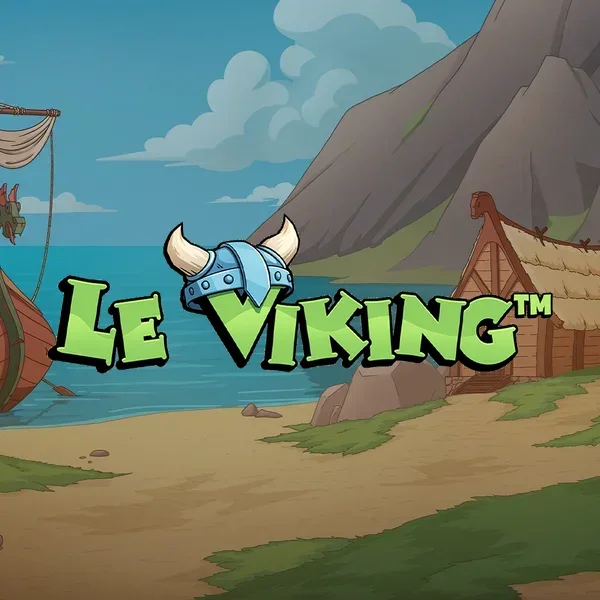
Le Viking is built around stored grid state rather than a conventional line of symbol matches. Six Coins of any kind can start Raid Spins, where lives refill when useful symbols land and the Coins, Diamonds and Clovers stay in place. The eventual result depends on a staged reveal: coin values appear first, then Clover multipliers act, and only then are the cash values totalled.
Le Viking at a glance
| Provider | Hacksaw Gaming |
|---|---|
| Genre / theme | Fantasy |
| Game type | Video slot |
| Main features | Raid Spins use three refilling lives and sticky cash symbols; four scatter tiers add persistent Grid Multipliers, Clover effects and one-use Cauldron collections. |
RTP and stake limits can vary by version and market. Check the information screen in the game you open. Maximum win is a ceiling, not an expected result.
Raid Spins preserve the board
Landing six Coins simultaneously in the base game opens Raid Spins with three refilling lives. Only dead symbols, Coins, Diamonds and Clovers appear in that mode. Every respin spends one life, but any Coin, Diamond or Clover restores the count to three; three consecutive dead-only spins end the feature. Coins, Diamonds and both Clover types are sticky throughout, so each successful landing adds to a persistent layout rather than replacing earlier pieces.
Values are not revealed until the mode ends. Bronze Coins can show 0.2x to 4x the bet, Silver 5x to 20x, Gold 25x to 100x, and Diamonds 150x, 250x or 500x. Green Clovers then multiply adjacent Coins and Diamonds; Gold Clovers multiply all of them. The same listed Clover values run from x2 to x20. Because reveals precede Clover activation, their location matters: a Green Clover reaches only neighbours, whereas a Gold Clover is global. The final prize adds the resulting Coin and Diamond values.
Free spins add collection and fixed multipliers
Three scatters begin Berserk Free Spins with three lives. The scatter positions become sticky x2 Grid Multipliers, and Coin, Diamond and Clover symbols also stick until a Magic Cauldron collects them or the feature ends. A Cauldron activates Grid Multipliers and Clovers in its area of effect, then gathers visible Coins, Diamonds and earlier Cauldrons into itself. Each Cauldron can collect only once. Any non-dead symbol refills the lives; a Heart increases the maximum by one, up to five.
The other scatter tiers keep this core system but increase the starting grid multipliers: four scatters give four x3 positions in Valkyrie, five give five x5 positions in Ragnarök, and six give six x10 positions in Journey to Valhalla. That final mode also removes Bronze and Silver Coins. At feature end, remaining values are revealed, multipliers activate, and the total is assembled. Magic Cauldrons cannot land on multiplier positions, and Hearts stop appearing once the life cap is reached.
A clear sequence, limited configuration data
The feature’s tension comes from growing the board before its geometry affects the final calculation. Three dead-only Raid Spins end that mode; free spins start with three lives and can raise the cap only to five. Raid Clovers wait until coin reveals, while free-spin Cauldrons collect during play and values resolve at the end.
The official page omits grid dimensions, line count, RTP, volatility, maximum win and exact release date. Vikings offers a contrast through its shield and hotspot features.
Strengths and weak points
Strengths
The end-of-mode reveal keeps the calculation legible: coin type sets a value range, Clover placement defines reach, and the free-spin cauldron gives collection a precise one-use role.
Weaknesses
Raid Spins can stop after three dead-only rounds, while values stay unknown until resolution. In free spins, a three-life loop and a five-life ceiling constrain how long the board can grow.
Our Editor’s View
Le Viking rewards attention to where symbols settle and when each layer acts. Raid Spins are a survival-and-collection round whose final arithmetic waits until the lives run out; the four free-spin tiers instead begin with stronger fixed multiplier positions and add a Cauldron that collects the stored symbols. These are detailed rules, but they do not establish the chance of reaching any tier or the overall return. The reviewer can describe the state transitions and their restrictions, while the missing paytable configuration prevents a sound numerical comparison. Players who prefer visible sequences may appreciate the order of operations; those wanting immediate settled values may find the delayed reveal less transparent during the feature itself.
Related slot reviews
Elf Bingo
Shared theme: Fantasy

Potion Wizard
Shared theme: Fantasy

Leprechaun’s Gold Streak
Shared theme: Fantasy