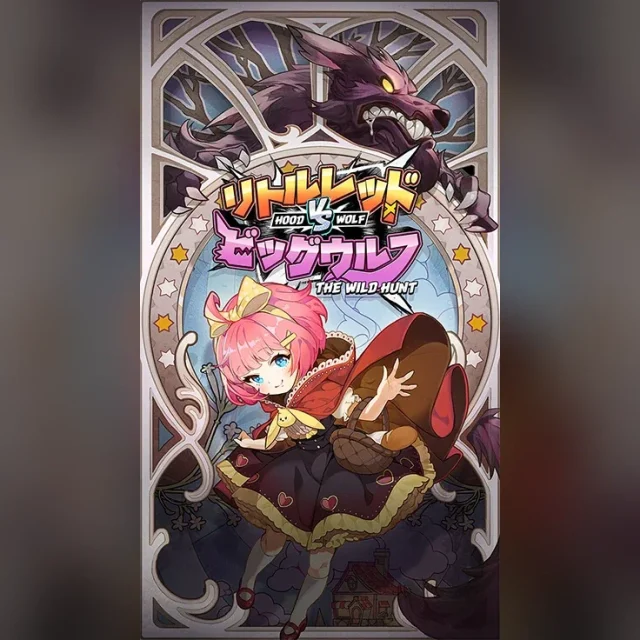
Hood vs Wolf turns Red Riding Hood into a tug of war above five reels. Power symbols move one character’s score forward and the other’s backward. Reaching 18 awards that character’s feature, where three rounds of rock-paper-scissors determine how many free spins are won. The two sides then use framed positions differently.
Hood vs Wolf at a glance
| Provider | PG Soft |
|---|---|
| Genre / theme | Fantasy |
| Game type | Video slot |
| Reels / grid | 5 reels; 3 rows |
| Reference RTP | 95.39% |
| Volatility | Medium |
| Payout mechanic | 30 lines |
| Maximum win | 4000x the bet |
| Release date | 17 September 2018 |
| Main features | Power-symbol difference moves Hood/Wolf score to 18; three Janken rounds award 5 spins per win; Wolf and Hood use different Wild frames. |
RTP and stake limits can vary by version and market. Check the information screen in the game you open. Maximum win is a ceiling, not an expected result.
Thirty lines under a moving score
The ordinary game has five reels, three rows and 30 fixed paylines. Wilds substitute for most symbols but not Rock, Paper, Scissors or either character’s Power symbol. The Power symbols can count as their corresponding Hood or Wolf symbols for line wins. That gives them an ordinary payout role alongside their battle role. Rock, Paper and Scissors appear only on reels two or four under the rules. The line layout itself is not fully transcribed in the extracted paytable, so there is no reason to assign a particular shape to one of the 30 lines without the in-game diagram.
At the end of a spin, Hood and Wolf Power symbols are counted in the battle bar. If Hood has more on the reels, her score increases by the difference while Wolf’s decreases by the same amount; a Wolf majority reverses the movement. This is a net contest, not two independent meters that always rise. A tie gives no stated advantage. When either score reaches 18, that side’s feature is awarded. The main spin can therefore matter both as a line result and as a push toward a particular bonus, while later power symbols can reverse earlier progress.
The side that wins changes the free spins
A Rock, Paper or Scissors pair on reels two and four can award a Mini Janken prize to the winning symbol. The familiar relation applies: Scissors beats Paper, Paper beats Rock, and Rock beats Scissors. At score 18, the awarded Hood or Wolf Feature also plays three rounds of that choice against the opposing character. Each round the player wins grants five free spins, so the number of successful rounds governs the starting award. The rules do not promise three wins or a fixed 15 spins just because the feature has begun.
The Wolf Feature places one frame at a random reel position on every awarded free spin. If a Wild, Hood, Basket or Flower lands inside it, three to eight Wilds replace random symbols on the reels, including the framed symbol. The Hood Feature instead uses five random frames per spin; Wolf, Claws or Tail symbols landing in a frame turn into Wilds in those positions. The contrast is meaningful: Wolf has fewer frame opportunities but can spread several random Wild replacements from a qualifying hit, while Hood has more frames and local transformations. Neither rule says framed positions remain sticky across spins.
The useful comparison and its limits
The English sheet lists 95.39% theoretical overall RTP and medium session volatility. Its feature-hit table gives Mini Janken 4.44% and each character feature 0.44% in the published model; those are not session guarantees. The official feature overview states a 4,000x theoretical maximum. The score battle is the game’s strongest idea because opposite power counts can undo progress, making the route to a chosen side dynamic. Its limitation is that even after reaching 18, free-spin length depends on winning the subsequent three choice rounds. The frame rules then add another condition before extra Wilds appear.
Red Riding Hood provides a fairy-tale comparison. Hood vs Wolf should be judged for its opposed score and asymmetrical character bonuses, not for a generic wolf theme.
Strengths and weak points
Strengths
Opposing power symbols create a readable tug of war, and the Hood and Wolf free spins use genuinely different frame rules rather than cosmetic character swaps.
Weaknesses
A side must reach 18 before its feature begins, then Janken wins determine spin count. Frames only change symbols when their specified targets land inside them.
Our Editor’s View
Hood vs Wolf asks which character reaches 18 through the net Power-symbol difference. That score leads into three choice rounds and one of two Wild-creation rules. Each side uses frames differently, so the 30-line base game is only the starting layer. The path to useful free spins has several conditions, and no Janken win is promised. Readers who enjoy a contested progress display with meaningfully different sides have a reason to explore it; others may find the route to a sizable award indirect.
Related slot reviews
Elf Bingo
Shared theme: Fantasy
Potion Wizard
Shared theme: Fantasy
Leprechaun’s Gold Streak
Shared theme: Fantasy