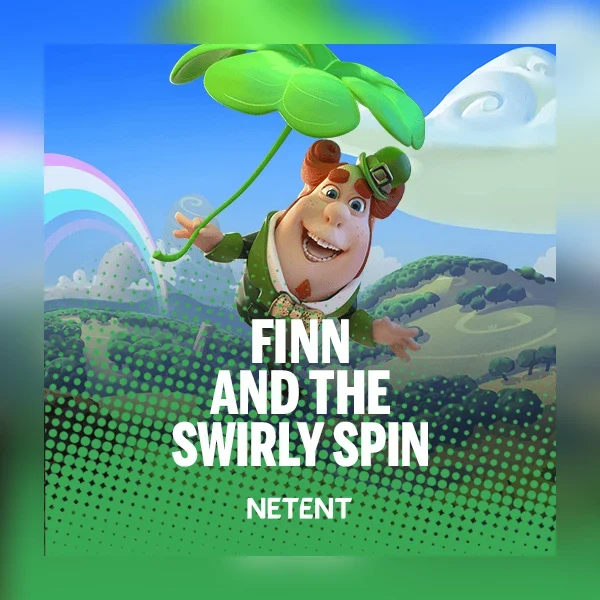
Finn and the Swirly Spin puts its central idea in the board itself: symbols occupy numbered spaces and move along a spiral route when a cluster win clears. That path also carries a Free Spins Key from the lower-left position toward the centre. Because the key survives the main game and the collected-key meter persists between sessions, a cascade can advance a feature state as well as rearrange symbols. The result is a cluster slot whose bonus is built through movement rather than a conventional scatter threshold.
Finn and the Swirly Spin at a glance
| Provider | NetEnt |
|---|---|
| Genre / theme | Fantasy |
| Game type | Video slot |
| Reels / grid | 5×5 grid |
| Reference RTP | 96.62% |
| Volatility | 4.4 (catalog scale) |
| Payout mechanic | Cluster wins; line count not applicable/stated |
| Maximum win | 300× bet |
| Release date | 23 November 2017 |
| Main features | Cluster wins move symbols along a numbered spiral; a persistent key advances to the centre to unlock one of four key-priced Free Spins modes. |
RTP and stake limits can vary by version and market. Check the information screen in the game you open. Maximum win is a ceiling, not an expected result.
A numbered route through the grid
The official record describes a 5×5 layout with 25 independent symbol spaces and cluster wins. When winning symbols are destroyed, the remaining symbols shift from higher-numbered positions to the next lower-numbered space, following the marked arrow direction. This is the Swirly Spin mechanic: symbols do not simply drop vertically into the nearest gap, so following the numbered path is essential to understanding what may participate in the next evaluation.
Wilds add a second consequence to a cluster. A win containing a Wild causes that contributing Wild to explode and destroy symbols immediately above, below, left and right of it. A win without a Wild creates one. These rules mean a Wild can broaden the effect of a winning cluster by clearing its orthogonal neighbours, while a non-Wild win seeds a Wild for subsequent play. Random Features may also be awarded after the initial spin and before wins are paid. Starfall adds randomly placed Wilds; Dragon Destroy is eligible only when no win exists and removes a random number of symbols; Irish Luck, also requiring no initial win, adds a random horizontal or vertical line of one symbol type; Magic Transform upgrades all spades and hearts, with each suit’s destination selected separately. They intervene at different board states, not as interchangeable versions of the same effect.
The key’s position opens a choice
The Free Spins Key begins at the bottom-left and cannot disappear during the main game. As wins and symbol movement occur, it progresses toward the centre. Once Avalanches are complete, a key in the central position activates Free Spins and increments a key meter. The meter does not reset when the game closes, so collected keys remain available on a later return. That persistence changes the meaning of the feature: one key arrival can unlock a mode now, while the saved total can make other modes selectable in a future feature choice.
Four modes trade spin count for a different Random Feature. Star Bar gives seven spins and requires one key; Lava Lair gives three spins and requires four, with a Sticky Wild replacing the key; Lucky Mug offers four spins for nine keys and works similarly to Irish Luck; Golden Pot grants two spins for sixteen keys and uses Magic Transform. Only one mode is selected for the initial Free Spins game; after it ends, play returns to the main game. The differing entry costs make the choice a real constraint, and the short two-spin Golden Pot should not be read as equivalent in duration to Star Bar merely because both carry a named feature.
Configuration and limits
The saved official record lists 96.62% RTP, volatility 4.4 and a maximum payout of 300× bet. It labels wins as clusters and lists a 5×5 grid; it does not supply a fixed ways or line count. These values describe the recorded title, not the likelihood of a key reaching the centre or a particular Random Feature appearing. No maximum-win probability is provided. The core rules are unusually explicit about spatial movement and key persistence, but the source gives no odds for those events, leaving frequency uncertain.
Strengths and weak points
Strengths
The spiral movement links cluster resolution to key progress, and the persistent key meter gives later feature choices a clear accumulated resource rather than a one-spin trigger alone.
Weaknesses
Four modes require different key totals and award different spin counts, while Random Features have separate conditions. The saved record supplies no probabilities for these routes or for reaching a preferred mode.
Our Editor’s View
Finn’s defining strength is that the grid’s motion does more than refresh a cluster. The spiral route changes which symbols approach one another, Wilds can clear neighbouring positions, and the key advances through the same process until it reaches the centre. Persistent keys then give the player a longer-term choice among four modes with different costs and spin counts. Mirror Mirror’s re-spin progression offers a different fantasy sequence, while Finn’s route is tied to numbered spaces and a key meter that survives beyond one feature. That combination makes the game’s progression easy to describe but less conventional than a simple scatter bonus. Its main trade-off is complexity: movement directions, Wild clearing, four conditional Random Features and a key balance all matter, while the recorded rules do not say how often a chosen route occurs. Players who enjoy tracking positions and planning around accumulated feature access may find the design distinctive; anyone looking for a quick, standardized Free Spins round may find the modes and prerequisites harder to compare.
Related slot reviews
Warlords – Crystals of Power™
Shared theme: Fantasy
Mythic Maiden
Shared theme: Fantasy

Jack and the Beanstalk
Shared theme: Fantasy