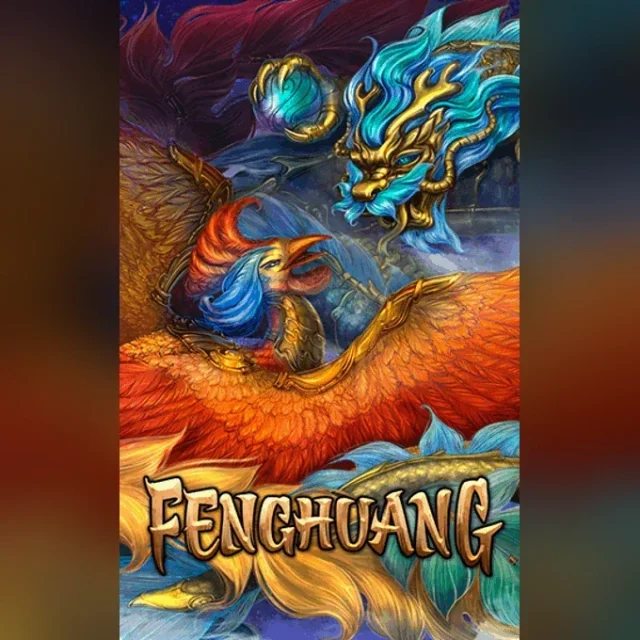
Fenghuang turns its mythic bird-and-dragon pairing into a spatial feature. A Bird begins on reel 1 and a Dragon on reel 5; during the event, they move toward each other, and a same-row collision creates a 2×3 Wild. That rule gives the bonus a visible objective rather than an abstract counter. The standard game’s 5×3 board and 28 lines form a conventional frame, but the feature asks the reader to watch symbol position and row alignment as the two figures converge.
Fenghuang at a glance
| Provider | Habanero |
|---|---|
| Genre / theme | Asian |
| Game type | Video slot |
| Reels / grid | 5×3 |
| Volatility | MEDIUM |
| Payout mechanic | 28 Lines (20 Coins) |
| Maximum win | x560 the bet |
| Main features | Bird on reel 1 and Dragon on reel 5 trigger the event; they move inward, and same-row collision makes a 2×3 Wild; Free Games continue until none remains on screen; wins pay both directions during Free Games. |
RTP and stake limits can vary by version and market. Check the information screen in the game you open. Maximum win is a ceiling, not an expected result.
Twenty-eight lines beneath the theme
Habanero lists a five-reel, three-row layout with 28 lines. The source identifies the line count but does not provide symbol values, line diagrams or the exact direction for ordinary wins, so those details should not be supplied from a neighboring title. Within that framework, the Bird and Dragon have a specific role in the Free Games event. Their starting reels are opposite ends of the board, which makes movement and eventual alignment central to understanding the feature rather than decorative animation.
The source says a Bird on reel 1 and Dragon on reel 5 trigger the event. It does not specify whether both must appear on the same spin or describe any additional Scatter condition, so the trigger should be repeated in the published form without adding a threshold. In the event, the Bird moves right and the Dragon moves left. The 5×3 geometry means they approach across the reel columns while retaining row positions that determine whether the special collision can occur.
Collision creates the expanding Wild
When Bird and Dragon land in the same row and collide, they form a 2×3 Wild. This is the feature’s decisive transformation: two moving symbols become a Wild covering two reels and all three rows. It changes a small part of the board into a substantial block of Wild positions, but the summary does not say how the new Wild is evaluated for wins, how long it remains, or whether any win is guaranteed when it appears. It is therefore accurate to describe the collision and its dimensions, but not to promise a resulting payout.
Birds and Dragons may reappear, and Free Games continue until none remains on screen. This gives the feature a persistence condition linked to symbol presence, while the collision condition separately determines when the 2×3 Wild is created. Line wins can pay in both directions during Free Games, so evaluating a result from either edge applies within the bonus. The source does not explain whether the created Wild counts as a Bird or Dragon for the continuation test, or exactly when symbols disappear. These omissions prevent a full turn-by-turn reconstruction, but the core logic is clear: movement creates a chance to collide, and continued presence of the special symbols keeps Free Games going.
Published configuration
For the standard version, Habanero lists Medium volatility, RTP configurations of approximately 86%, 92%, 94%, 96% and 98%, and a maximum multiplier of x560. The operator’s selected configuration determines the applicable RTP. The x560 figure is a ceiling rather than a likely outcome. The official page does not state a release date, and it does not publish collision frequency, the complete paytable or the detailed timing of symbol persistence.
Why row alignment matters
Fenghuang’s strongest feature is that the collision rule can be pictured precisely. Opposite-side symbols travel inward; row alignment transforms them into a two-reel-wide, three-row Wild. That ties movement, position and the resulting board change together. The bonus also has a stated continuation condition, and two-way line wins remain available during Free Games. Those interacting rules give readers a concrete way to understand what the Bird and Dragon are doing beyond simply appearing as themed symbols.
The trade-off is that the public description leaves several operational details unresolved. It does not tell us how often matching rows occur, what happens to a collision after its Wild is formed, or whether the Bird and Dragon can reappear before all special symbols leave the screen. Medium volatility and an x560 cap do not answer those questions. Readers who enjoy features built around visible spatial targets may find the structure easy to follow, but anyone comparing feature frequency or expected value needs the selected game’s full rules and RTP configuration rather than the short official overview alone.
Strengths and weak points
Strengths
The opposing movement gives Free Games a visible objective, and a same-row collision has a precisely stated result: a 2×3 Wild across the board.
Weaknesses
The official summary omits collision frequency, Wild persistence and symbol removal timing, so players cannot reconstruct the full bonus sequence or estimate its reach.
Our Editor’s View
Fenghuang makes its central feature unusually easy to visualize: Bird and Dragon approach from opposite ends, row alignment matters, and a collision produces a Wild spanning two reels and all three rows. That clarity is supported by a separate Free Games continuation rule and two-way line wins during the bonus. The remaining uncertainty lies in the transitions between those steps—particularly the lifetime of the created Wild and the exact role of reappearing symbols. Those are meaningful limits because they affect how a player reads each subsequent board. The game is a natural choice for readers who enjoy movement-based features with a visible target; those who want a precise frequency or payout analysis should consult the live rules and verify the operator’s RTP setting rather than treating the x560 maximum as representative.
Related slot reviews

Caishen Wins
Shared theme: Asian
Ganesha Fortune
Shared theme: Asian

Thai River Wonders
Shared theme: Asian