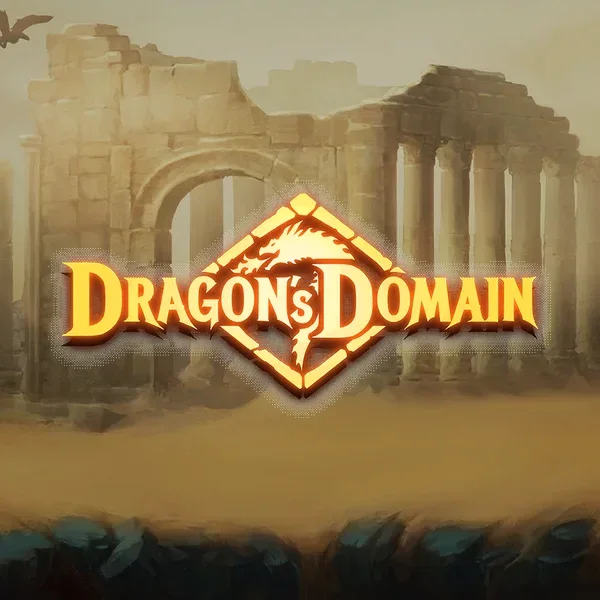
Dragon’s Domain combines all-scatter wins with cascading symbols, then lets Dragon symbols act after the ordinary win sequence has settled. Its Charred Land Wild multipliers have limited charges, but cascades increase their values and Dragonfire can replenish their charges. The central interaction is therefore a cycle of winning, charging up, and clearing positions with a Dragon’s cross-shaped blast. Two bonus games separate that multiplier loop from a special egg-collection board.
Dragon’s Domain at a glance
| Provider | Hacksaw Gaming |
|---|---|
| Genre / theme | Adventure & Exploration |
| Game type | Video slot |
| Reels / grid | 6 reels, 5 rows |
| Maximum win | 10000x the bet |
| Main features | Cascades raise charged Charred Land Wild multipliers; Dragonfire clears in a cross and can refill charges. Dragon’s Lair preserves Wilds; The Hatchery collects hit Dragon Eggs. |
RTP and stake limits can vary by version and market. Check the information screen in the game you open. Maximum win is a ceiling, not an expected result.
Charges and cascades shape Charred Land
Hacksaw describes a six-reel, five-row game with all-scatter wins and cascades. Charred Land symbols substitute for paytable symbols and arrive with three charges. When one participates in a win, it loses a charge before the next cascade. Each symbol cascade increases every Charred Land multiplier currently on the grid by 1. If several are involved in a win, their values are added before being applied to that win. Available starting values are 2×, 3×, 4×, 5× and 10×.
This creates a tension between using a Wild for a current win and preserving its remaining charges. A cascade raises its multiplier, but participation in a win consumes a charge. The page says the values are added together for a win, so two 3× Charred Land symbols would contribute a combined 6× multiplier under that stated rule; it does not say they compound with each other. Dragonfire adds another state change after the board settles. Dragon symbols activate when no more wins occur and breathe in a cross pattern from their position, removing regular paying symbols they hit. A hit on Charred Land refills its charges. Gold Dragons also carry a multiplier from 2× to 10× and multiply the value of any Charred Land they hit. Red Dragon behavior beyond its Dragonfire clear is not detailed as a multiplier mechanic on the page.
The bonuses change what the board contains
Three FS scatters trigger Dragon’s Lair with ten free spins. Charred Land multipliers persist between spins as long as they retain charges, giving the main game’s charge economy more continuity. Additional scatters can award two spins for two symbols or four for three. Four FS scatters instead start The Hatchery with ten spins. Only non-paying symbols, Dragon Eggs and Dragons appear there. Eggs are bet-based cash prizes collected when Dragonfire hits them; a Gold Dragon multiplies an egg by its own value before collection. Green Eggs list values of 1, 2, 5 and 10; Red Eggs 20, 30 and 40; Golden Eggs 50, 100 and 200. The final collected values are multiplied by the bet.
In The Hatchery, a non-paying symbol hit by Dragonfire is removed and triggers a cascade, so the blast can clear space for further symbols while collecting an egg it reaches. That is a different objective from sustaining charged Wilds: the bonus grid has no regular paying symbols, and eggs only count when Dragonfire reaches them. The page does not give the frequency of egg values, Dragon positions or Gold multipliers, nor does it explain a separate retrigger rule for this feature. Those absences prevent treating the listed values as likely outcomes.
A high ceiling is not a forecast
The provider states a maximum win of 10,000 times the bet. That is a stated cap, not a typical payout. RTP, volatility, numeric payline count and exact release date are not given on the same detail page. The all-scatter description also does not state a threshold in this summary, so the installed paytable is needed to see the exact award geometry. A comparison based on the headline maximum alone would miss how the game’s outcomes depend on cascades, remaining charges, Dragon placement and the cross pattern.
Our editor sees the best design idea in the way Dragonfire links the base feature’s defensive and offensive sides: it can restore a Charred Land charge while removing ordinary paying symbols, and a Gold Dragon can further multiply a struck Wild. Dragon’s Lair extends that resource state across free spins; The Hatchery redirects the same blast toward collectible eggs. The constraints are concrete—three starting charges, charge loss when a Wild wins, and collection only when a blast reaches an egg. These make the mechanics understandable, although public odds and return data remain necessary for any mathematical judgment.
Strengths and weak points
Strengths
Charred Land’s charge loss and Dragonfire refill make symbol survival meaningful; the Gold Dragon adds a defined multiplier interaction, while The Hatchery reuses blasts for egg collection.
Weaknesses
A winning Wild spends a charge, and an egg must be hit by Dragonfire to count. RTP, volatility, hit rates and exact all-scatter thresholds are not stated.
Our Editor’s View
Dragon’s Domain has a coherent interaction at its center: cascades increase Charred Land values, winning with one consumes a charge, and Dragonfire may restore those charges after the grid settles. Gold Dragons add a separate multiplier when they hit a Charred Land. The Hatchery then repurposes the blast to collect eggs rather than paying symbols. Our editor likes that the two bonuses reinterpret the same board-clearing action. The 10,000× maximum is only a ceiling, however, and no public RTP or feature probabilities accompany it. A reader can follow the rules, but cannot infer how frequently the full chain occurs.
Related slot reviews
Viking’s Plunder
Shared theme: Adventure & Exploration
Scopa
Shared theme: Adventure & Exploration
Totem Towers
Shared theme: Adventure & Exploration