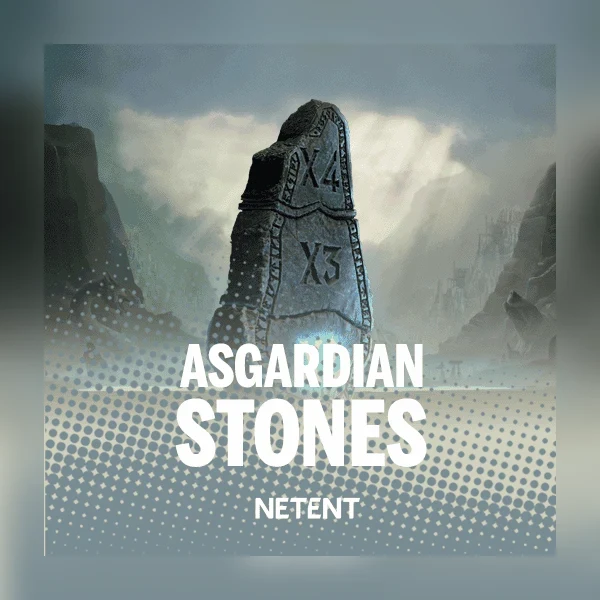
Asgardian Stones builds its appeal around scale and repetition. A conventional line win can begin an Avalanche, but the symbols that fall afterward may be oversized blocks, and those blocks can interact with gaps left by earlier wins. A separate 3×3 Bonus Wheel can remain in view through that sequence, so its coin result is evaluated only after the Avalanches stop. This is a 5-reel, 3-row, 20-line game whose most distinctive question is how a changing board affects a bonus already waiting on it.
Asgardian Stones at a glance
| Provider | NetEnt |
|---|---|
| Genre / theme | Fantasy |
| Game type | Video slot |
| Reels / grid | 5 reels × 3 rows |
| Reference RTP | 96.31% |
| Volatility | 4.7 (catalog scale) |
| Payout mechanic | 20 lines |
| Maximum win | 1,000× bet |
| Release date | 22 February 2018 |
| Main features | Line wins start Avalanches; 2×2 or 3×3 Colossal blocks can crush rows, while the Bonus Wheel resolves after cascades and retains its multiplier through subsequent Avalanches. |
RTP and stake limits can vary by version and market. Check the information screen in the game you open. Maximum win is a ceiling, not an expected result.
Lines give way to a falling board
The official description lists five reels, three rows and 20 lines. A winning bet line starts an Avalanche: its winning symbols disappear, the remaining play continues with symbols falling into position, and another evaluation follows. That matters because the next event is not an unrelated spin. Empty spaces created by a win can affect how a later Colossal block settles, giving the cascade a spatial consequence beyond simply replacing symbols.
Colossal versions of symbols are 2×2 or 3×3 blocks and may be only partly visible depending on the reel landing. They can appear in the main game and Free Spins, although the main-game Wild is excluded from the Colossal treatment. Only one Colossal symbol can be visible at once. During an Avalanche, if a Colossal symbol lands, ordinary symbols fill any remaining empty positions. The block can also trigger Colossal Crush: after the first Avalanche, it may randomly crush extra rows beneath itself. If earlier wins have left empty positions under it, it drops and crushes the row below, repeating until it reaches the bottom or no qualifying space remains. The feature therefore depends on board state, not simply on the block’s size.
The wheel waits for the cascade
A Bonus Wheel is itself a 3×3 symbol block and can land fully or partly visible on the last three reels, both in the base game and Free Spins. The game resolves all Avalanches and win evaluations before the wheel stops. It can award coin wins, Free Spins, or both. Unlike regular symbols it is not removed after paying, so its evaluation does not start another Avalanche.
The interaction with Colossal Crush is the important wrinkle. Coin values on the wheel are multiplied by the Crush multiplier. If another Avalanche follows, that multiplier is not reset; should it rise again, the wheel’s coin values increase further. The final coin award is evaluated when the Avalanche sequence ends. This makes timing and persistence meaningful: a wheel may already be present while the board continues to resolve, and its eventual value can reflect later multiplier growth. In Free Spins, play uses the triggering bet and coin value. A Colossal Wild may appear; when it contributes to a win it splits into ordinary 1×1 Wilds, while winning Wilds explode and non-winning ones remain for subsequent Avalanches until no wins continue.
Configuration and what it cannot tell us
NetEnt’s saved catalog record lists a 96.31% RTP, volatility 4.7 and maximum payout of 1,000× bet for this standard title. Those numbers describe the listed edition; they do not measure the chance of reaching a particular cascade or wheel result. No maximum-win probability is recorded. The official material also gives no separate Free Spins trigger count in the preserved rules, so this review does not infer one from the feature name. The strengths are the way Colossal blocks alter a continuing board and the wheel’s delayed evaluation; the cost is that several events must resolve in sequence before the round’s outcome is clear.
Strengths and weak points
Strengths
Colossal blocks can respond to spaces left by wins, while the Bonus Wheel waits through later Avalanches and can retain multiplier growth. The two systems make board changes matter beyond one evaluation.
Weaknesses
A cascade can involve line wins, falling blocks, conditional row crushing and a delayed wheel result. The preserved rules do not quantify how often these pieces overlap or how likely the maximum is.
Our Editor’s View
Asgardian Stones makes its large symbols part of the rules rather than decoration. Wins open space, Colossal blocks can fall into that space, and Crush can continue downward when the board provides room. At the same time, a visible Bonus Wheel waits through the cascade, preserving the chance for its coin values to benefit from multiplier growth before settlement. This creates a satisfying connection between the main board and the bonus result: earlier wins can shape where a block settles, while later Avalanches can change what the wheel pays. For a cascading contrast, Great Ghosts!’ expanding rows change the board itself, whereas this game makes a falling Colossal block and delayed wheel depend on the empty spaces left behind. The limitation is equally concrete. A player has to track the normal line evaluation, the state beneath a Colossal symbol, the Crush multiplier and a wheel that resolves after the chain. Those who enjoy cascading games with board-dependent feature interactions may find the sequence rewarding to follow; players who prefer each spin to resolve in one simple step may find the delayed outcome less immediate.
Related slot reviews

Warlords – Crystals of Power™
Shared theme: Fantasy

Mythic Maiden
Shared theme: Fantasy
Jack and the Beanstalk
Shared theme: Fantasy