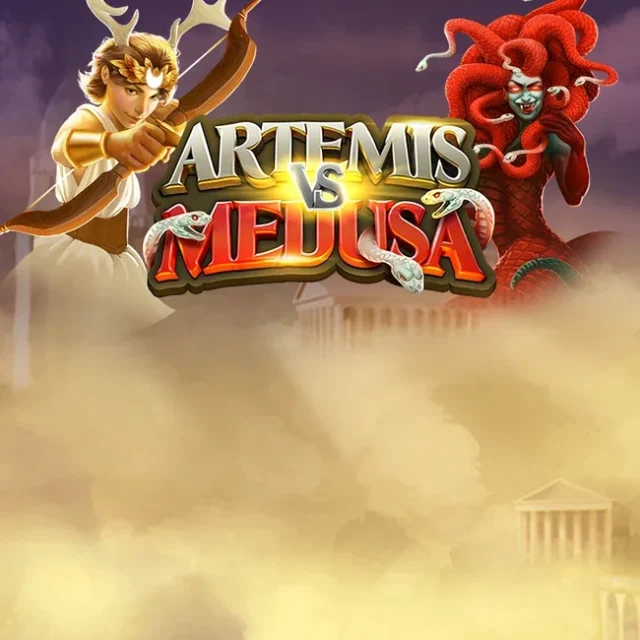
Artemis vs Medusa frames its bonus as a contest with a defined stopping point. The Unlimited Battle Freespins continue until Artemis either retreats or destroys the last monster, so the feature’s duration depends on how the meter changes rather than a fixed spin count in the published rules. Before that battle, Monster Bounty Coins can sit inside medium symbols during the base game; a framed Artemis on the final reel collects the coins and pays a bounty. The two loops are related by the characters, but each has its own condition and payoff.
Artemis vs Medusa at a glance
| Provider | Quickspin |
|---|---|
| Genre / theme | Action & Combat, Greek Mythology |
| Game type | Video slot |
| Main features | Base-game bounty coins are collected by a framed Artemis on the last reel; three Scatters start a battle that ends on retreat above 15 or when the last monster is destroyed. |
RTP and stake limits can vary by version and market. Check the information screen in the game you open. Maximum win is a ceiling, not an expected result.
Coins hide inside ordinary symbols
Monster Bounty Coins can appear inside any medium symbol, and only in the base game. Their value is therefore not presented as a separate coin landing on an otherwise empty position: it is attached to a medium symbol already occupying the reels. To collect the coins, the game requires an Artemis symbol with a golden frame to land on the last reel. When that condition is met, all Monster Bounty Coins currently present are collected and a Bounty payout is awarded.
The payout depends on two stated inputs: the value of the medium symbol from which a coin originated and the number of coins on the reels. The published rules give no coin-value table or exact calculation, so a numerical example would be invented. What can be said is that collection is conditional on a specific final-reel symbol and aggregates the coins then present; it is not described as an automatic award whenever a coin-bearing medium symbol appears.
A battle measured by monsters
Three Bonus Scatter symbols trigger Unlimited Battle Freespins. The feature lasts until the Artemis–Medusa battle resolves. Its meter updates according to the monster symbols accumulated. Whenever one or more Artemis symbols land, all accompanying medium Monster symbols are added to the meter. For every Artemis symbol that lands, one monster type is removed from the meter, starting with the lowest value, and a bounty is awarded.
This creates a push and pull rather than a simple win counter: medium monsters can add to the measured field, while Artemis symbols remove monsters in value order and produce bounty awards. The notes do not establish a one-for-one arithmetic formula between every accompanying monster and every Artemis, so it is safer to describe the documented operations than to suggest a guaranteed net decrease. Multiple Artemis symbols can each remove a type according to the rule, but no further priority rule for simultaneous symbols is recorded.
There are two explicit endings. If the meter exceeds 15, Artemis retreats and the free spins end. The feature also ends if Artemis destroys the last monster. The threshold is strictly above 15, not at 15; and removing the final monster is a separate terminal condition. That distinction is central to the title’s battle premise: progress can end through an overfull meter as well as through clearing the opposition. Quickspin does not state an initial spin count, retrigger rule or what happens to unused spins at either ending.
What the published rules leave open
No reel layout, payline or ways count, RTP, volatility, maximum win or release date appears in Quickspin’s description. Nor does it explain the exact value mapping for monster types or the coin payout formula. Those are material omissions for anyone comparing versions or trying to estimate a feature’s possible range; they should remain unanswered until the exact casino configuration supplies them.
The design is best understood through its conditional transitions. A last-reel framed Artemis collects base-game coins; three Scatters begin the battle; landed Artemis symbols remove the lowest-valued monster types; and either the meter crossing 15 or the final monster’s defeat ends the feature. That specificity gives the battle a clearer identity than a generic free-spin round, but the undisclosed arithmetic means readers can understand the rules’ shape without knowing their numeric balance.
Strengths and weak points
Strengths
The battle has two explicit end states, and the meter operations explain how monster accumulation and Artemis removals shape the feature’s progress.
Weaknesses
Without monster values, starting spins or coin math, players cannot estimate the battle’s length or compare its bounty awards; the missing layout and RTP also limit configuration comparisons.
Our Editor’s View
Artemis vs Medusa makes the bonus’s uncertainty visible as a changing monster meter, then gives it two different conclusions: retreat beyond the threshold or victory after the last monster is removed. The base-game bounty coins add a separate collection puzzle tied to a framed Artemis on the final reel, with coin count and source-symbol value affecting the award. These conditions are concrete enough to follow, but the official description omits the starting spin count, numeric monster values, configuration and payout formula. That makes this a thematic rules concept rather than a fully quantified one in the public notes. It should suit readers who like features with a state to monitor; players who want to compare RTP or model the bonus should first inspect the operator’s exact game information.
Related slot reviews

Double O Dollars
Shared theme: Action & Combat

Zeus
Shared theme: Greek Mythology
Zeus 2
Shared theme: Greek Mythology