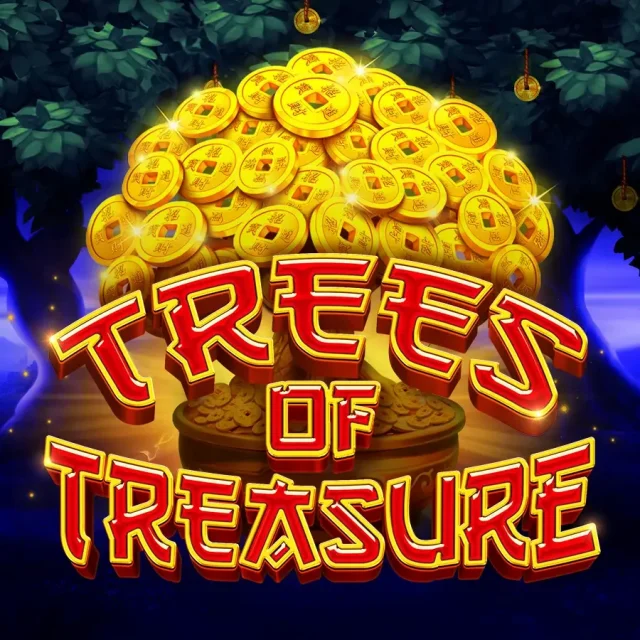
Trees of Treasure centres its 5 x 3 Lines board on this interaction: the triggering scatter count sets money-symbol values before sticky symbols drive a three-respin hold round. Sticky money symbols and a reset on every new arrival make remaining opportunities and collected positions easy to read. At the same time, the board can stall with empty cells, and a stronger starting range does not guarantee enough new symbols to reset respins. Trees of Treasure follows this exact sequence; its theme alone does not explain the result.
Trees of Treasure at a glance
| Provider | Pragmatic Play |
|---|---|
| Genre / theme | Animals |
| Game type | Video slot |
| Reels / grid | 5 x 3 |
| Reference RTP | 96.1% |
| Volatility | High |
| Payout mechanic | Lines |
| Maximum win | 15000x the bet |
| Release date | 5 February 2024 |
| Main features | scatter count sets the value range for money symbols in a hold-style respin round. Three or more scatters trigger Money Respins. The bonus starts on an empty board with three respins; landed money symbols remain, and each new money symbol resets the remaining count. |
RTP and stake limits can vary by version and market. Check the information screen in the game you open. Maximum win is a ceiling, not an expected result.
How Trees of Treasure evaluates the board
Trees of Treasure records high volatility, 96.1% RTP and a 15000x maximum for the version released on 2024-02-05. For Trees of Treasure, RTP describes a long-run configuration and volatility supplies broad mathematical context. The Trees of Treasure ceiling marks capacity. In Trees of Treasure, it predicts neither a normal award nor the next result.
scatter count sets the value range for money symbols in a hold-style respin round. Three or more scatters trigger Money Respins. The bonus starts on an empty board with three respins; landed money symbols remain, and each new money symbol resets the remaining count. Read together, those rules explain the order of events in Trees of Treasure. A trigger opens or modifies the feature, the board then has to produce the stated matching condition, and only a completed evaluation creates an award. Visual progress should therefore not be mistaken for a settled payment.
Following the feature in the right order
A practical reading of Trees of Treasure starts with the Lines evaluation on its 5 x 3 board. Next, identify which special symbol or counter has actually changed and whether that change persists, resets or expires. Finally, check whether the altered state participates in the paying combination. This sequence keeps temporary opportunities distinct from results already credited.
Sticky money symbols and a reset on every new arrival make remaining opportunities and collected positions easy to read. The design works best when its on-screen feedback shows why one event affected the next. For an accurate comparison, Trees of Treasure should be judged against titles with a similar Lines model, not against a sequel or another game that merely shares part of its theme or title.
Limits behind the published numbers
The board can stall with empty cells, and a stronger starting range does not guarantee enough new symbols to reset respins. That limitation is especially important beside the advertised 15000x ceiling. Trees of Treasure does not disclose feature frequency through its maximum-win figure, and the volatility label cannot predict a short session. Where an operator supplies several approved configurations, the information panel for that installed build remains the deciding source.
Strengths
Sticky money symbols and a reset on every new arrival make remaining opportunities and collected positions easy to read. The confirmed rules give Trees of Treasure a recognisable mechanical identity beyond its artwork.
Weaknesses
The board can stall with empty cells, and a stronger starting range does not guarantee enough new symbols to reset respins. This dependency can leave visible feature progress without a corresponding final award.
Our Editor’s View
Trees of Treasure earns attention for the triggering scatter count sets money-symbol values before sticky symbols drive a three-respin hold round. Sticky money symbols and a reset on every new arrival make remaining opportunities and collected positions easy to read. The defining trade-off in Trees of Treasure is equally specific: The board can stall with empty cells, and a stronger starting range does not guarantee enough new symbols to reset respins. For Trees of Treasure, the confirmed sequence matters alongside 96.1% RTP, high volatility and the 15000x ceiling. No listed Trees of Treasure figure predicts an individual outcome.