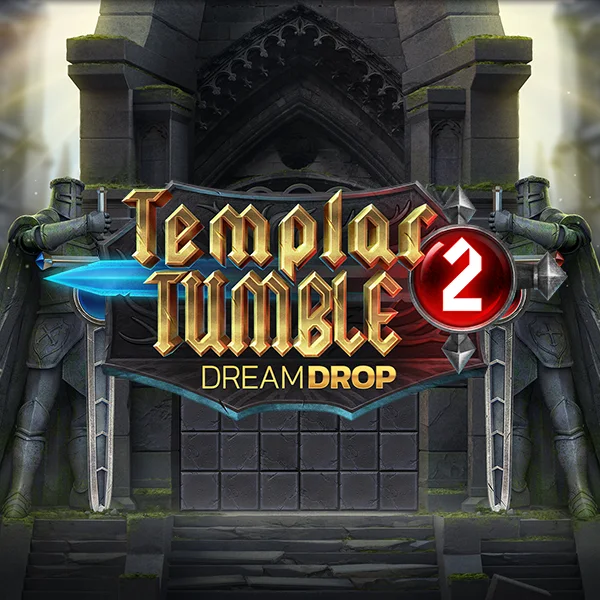
Templar Tumble 2 Dream Drop has a more layered premise than its cathedral-and-crusade artwork suggests. In the base game, symbols and blockers can carry red or blue frames, associated respectively with multipliers and Mystery symbols. Every five marked symbols destroyed activates a deeper feature level and feeds a collection metre that transfers to Free Spins. The bonus is explicitly ten spins and applies red and blue collections on each spin, while a separate Jackpot Spin can trigger randomly. The official page leaves the grid and probability data blank, but the available rule chain is substantial.
Templar Tumble 2 Dream Drop at a glance
| Provider | Relax Gaming |
|---|---|
| Genre / theme | Jackpot |
| Game type | Video slot |
| Main features | Red marks bring multipliers and blue marks Mystery symbols; every 5 marked symbols destroyed deepen a collection transferred to 10 Free Spins; Jackpot Spin triggers randomly. |
RTP and stake limits can vary by version and market. Check the information screen in the game you open. Maximum win is a ceiling, not an expected result.
Red and blue marks give destruction two jobs
The confirmed base-game distinction is simple but useful. Red-framed symbols and blockers bring multipliers; blue-framed ones bring Mystery symbols. That means a marked object is not merely visual decoration on the tumble screen: its colour identifies the kind of effect attached to it. The source does not define the numerical multiplier values, the possible Mystery outcomes, the board size or the exact destruction sequence. It would therefore be wrong to claim a fixed multiplier ladder or a particular symbol transformation. What is established is a two-colour rule in which destruction can advance different kinds of effect.
Every five marked symbols destroyed activate deeper levels of the feature. This gives the base game a stated collection rhythm: marked symbols must be removed in groups of five to deepen the system. Relax does not say whether red and blue marks share one counter, whether a level resets, or what each deeper level awards immediately. Even with those omissions, the rule makes tumbles matter beyond their individual wins. Destroying marked pieces contributes to a metre, so a successful sequence can build a resource that is relevant after the current board is gone.
The collection crosses into ten Free Spins
The official description says the collection metre is transferred to Free Spins, and that the reward for the base-game progress is ten free spins. During those spins, red and blue collections are applied on every spin. The relationship is the strongest part of the design: the bonus does not begin from a completely fresh state, because it receives the collection created by marked-symbol destruction. That makes the base-game goal legible before entry. The source does not state how the collections are applied, whether they change during the ten spins, or whether another collection can extend the feature.
This transfer also explains why the two frame colours matter in both stages. Red points toward multiplier behaviour and blue toward Mystery-symbol behaviour in the base game; the bonus then applies the corresponding collections repeatedly. It does not prove that every Free Spin receives both effects, that effects stack without limit, or that blockers are present in the feature. Those missing conditions are a concrete constraint. The reader can see a documented carry-over structure, but cannot turn the ten-spin award into a forecast of multiplier or Mystery frequency.
A random Jackpot Spin remains separate
Templar Tumble 2 Dream Drop also includes a randomly triggered Jackpot Spin. That confirms a separate jackpot route, not a guaranteed consequence of filling the metre or receiving ten Free Spins. The page supplies no trigger rate, jackpot values, RTP, volatility, reel configuration, paylines, exact release date or verified standard maximum win. the earlier Tumble comparison can help readers compare the broad tumble theme, but it should not be taken as proof that its feature rules or jackpot terms apply here.
The strength of this title is the visible hand-off from coloured marks and five-symbol destruction groups to an inherited Free Spins collection. Its weakness is that the rulebook stops before the value-bearing details: multiplier amounts, Mystery definitions, collection reset behaviour and the Jackpot Spin conditions remain absent. The design is easier to follow than to evaluate numerically, which is a genuine trade-off for a game with several linked systems.
Strengths and weak points
Strengths
Red multiplier and blue Mystery marks give base-game destruction distinct purposes, while every five marked symbols deepen a collection that transfers into the documented ten Free Spins.
Weaknesses
Multiplier values, Mystery outcomes, counter resets, feature updates and Jackpot Spin conditions are not published, so the transferred collection cannot show how much the ten-spin round is worth.
Our Editor’s View
Templar Tumble 2 Dream Drop has a credible mechanical spine: coloured marks affect the tumble stage, removing five marked symbols deepens a collection, and that collection crosses into ten Free Spins where red and blue effects apply again. That is a more meaningful connection than a theme-only bonus. The random Jackpot Spin adds a separate possibility without explaining its probability. For players who enjoy a visible progress metre feeding a later round, the structure is appealing and understandable. For players who need to compare risk, the missing multiplier table, reset rules, jackpot terms, RTP and volatility are too important to ignore; the live game rules should decide the final verdict.
Related slot reviews

Joker Treasure Exclusive
Shared theme: Jackpot

Fortune Yuri 500
Shared theme: Jackpot

Bison Fortune Coins
Shared theme: Jackpot