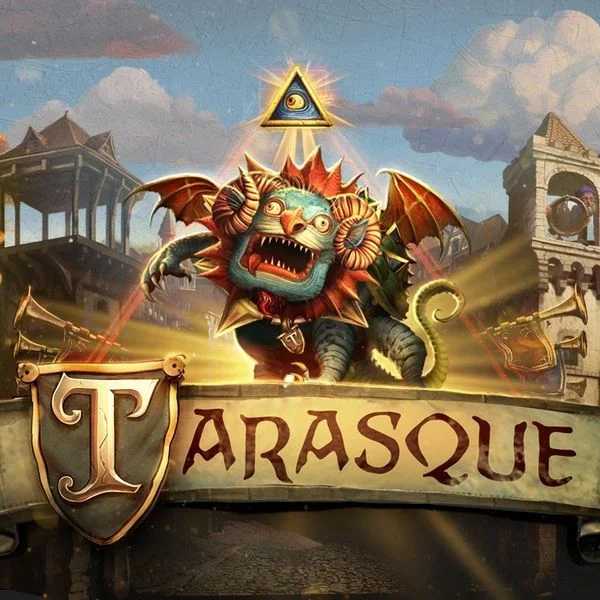
Tarasque is a grid slot built around changing clusters rather than a stated line count. Its 8×8 board pays in clusters, and a Morph selects one symbol each spin to transform an entire cluster into a nearby symbol. Wins also charge a five-stage feature meter; each stage activates one of four effects, with intensity rising by feature level. A beast Wild enters when the first progressive feature triggers, devouring neighboring winning symbols before regurgitating what it has consumed.
Tarasque at a glance
| Provider | Print Studios |
|---|---|
| Genre / theme | Fantasy |
| Game type | Video slot |
| Reels / grid | 8×8 grid |
| Reference RTP | 96.32% |
| Volatility | 4 / 5 |
| Maximum win | 20,000x the bet |
| Release date | 22 February 2024 |
| Main features | An 8×8 cluster grid morphs one symbol each spin; wins charge a five-stage meter whose four possible features add up to 24 Wilds, remove low symbols, add up to 45 morphing symbols, or grow the beast to 4×4. |
RTP and stake limits can vary by version and market. Check the information screen in the game you open. Maximum win is a ceiling, not an expected result.
Morphing clusters and the beast
The 8×8 grid uses cluster pays. Rather than inventing a minimum cluster size or adjacency rule, the review can rely on what the source does say: the Morph chooses one symbol per spin and transforms an entire cluster into a nearby symbol, potentially producing chain reactions of growing cluster wins. A transformation can make a cluster align with a neighboring symbol type, and the resulting growth may produce further wins. The official copy does not explain whether the Morph acts before or after initial wins are evaluated, how “nearby” is defined, or how many transformations can happen in a chain. Another cluster grid with evolving symbols can be explored in Reactoonz.
The Tarasque itself wakes as soon as the first progressive feature triggers. It acts as a Wild and devours neighboring winning symbols; the climax is its regurgitation of all consumed symbols, with potential for full-screen victories. The page does not say whether the beast remains active through every subsequent stage, how many symbols it can consume, or when regurgitation occurs relative to cascades. “Potential” is important: a full-screen result is presented as an opportunity, not a guaranteed outcome. No guaranteed multiplier or fixed number of consumed symbols is stated.
Five stages, four possible feature effects
Every win charges the feature meter, which has five stages. Each level triggers one of four distinctive features, and the page says the features escalate in intensity according to the level. The four named effects change the board in different ways. Wild Spikes spreads up to 24 Wilds across the grid. Blazing Gaze removes all low-paying symbols in a number of cascades. Mage’s Morph adds up to 45 morphing symbols. Bulking Beast lets the Tarasque grow as large as 4×4.
What remains unclear is whether a stage’s particular feature is selected randomly, how each of the four effects maps to each meter level, whether the meter resets after a feature, and how its stages persist between rounds. The official page also includes detailed statistical snippets, but the visible return figures do not form a simple, clearly labeled standard configuration summary. They should not be substituted for a standard RTP or interpreted as universal probabilities without clarification.
Configuration and scope
The listing gives a standard RTP of 96.32%, volatility of 4 out of 5 and a 20,000× maximum win, with a release date of February 22, 2024. A separate Bonus Buy RTP range is shown as 96.46%–97.02%; it remains distinct from the standard value. The described board is 8×8 and uses cluster pays, so there is no invented paylines count. No conventional reel-and-row layout is supplied beyond the explicitly named grid dimensions.
The exact source also presents a statistics block with several return-of-round figures and separate Buy 1 through Buy 5 data. Those figures are not folded into the standard RTP or a generalized odds claim here, because their labels and context differ from the headline configuration values. The maximum payout is not an expected result. Volatility does not establish the chance of reaching a meter stage. Readers can understand the principal transformations, but a full mathematical account would require clearer timing, selection and configuration documentation.
Strengths and weak points
Strengths
The four progressive effects change distinct board properties, and charging the five-stage meter through wins ties ordinary cluster results to visibly different feature states.
Weaknesses
The source does not map feature selection to meter stages or explain Morph timing and beast persistence, while its extra return statistics lack context for a simple standard comparison.
Our Editor’s View
Tarasque’s strongest design idea is that it treats the grid as material that keeps changing: a symbol can morph a cluster, a win advances a feature meter, and the beast can consume neighboring wins before returning symbols to the board. The main drawback is incomplete sequencing. The rules do not map feature selection to meter stages or explain how the beast, cascades and Morph interact. Players who enjoy cluster boards with several transformation systems will have a lot to watch; readers who want an exact resolution model or a clear probability table will need more than the published overview provides.