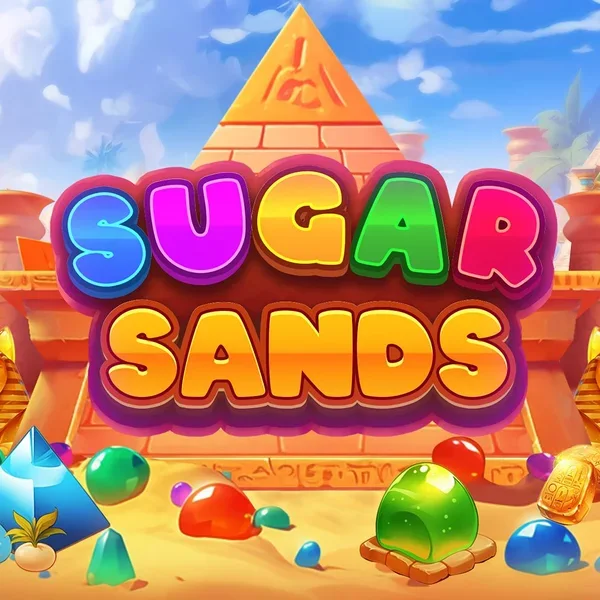
Sugar Sands puts an unusual Egyptian-candy theme around a 7-by-7 zigzag grid, then makes the empty spaces left by cluster wins part of the next decision. Groups of five or more matching symbols clear and refill; repeated clears can turn selected cells into multipliers. The feature becomes more persistent in free games, and a second bonus mode uses a different multiplier progression. The design’s identity is therefore not just its setting, but the way cascade history is tracked at particular positions.
Sugar Sands at a glance
| Provider | Skywind Group |
|---|---|
| Genre / theme | Ancient Egypt, Candy |
| Game type | Video slot |
| Reels / grid | 7×7 |
| Reference RTP | 96.5% |
| Volatility | High |
| Payout mechanic | Cluster pays |
| Maximum win | 25,000x the bet |
| Release date | 26 June 2025 |
| Main features | Clusters cascade; cleared cells can become Hotspots. Standard Free Games preserve doubling Hotspots; Super Free Games use persistent trebling Hotspots. |
RTP and stake limits can vary by version and market. Check the information screen in the game you open. Maximum win is a ceiling, not an expected result.
A cluster grid that keeps changing
The secondary review describes a 7×7 zigzag layout with wins formed by adjacent clusters of at least five matching symbols. Winning symbols disappear and replacements fall into the open cells; if another qualifying group forms, the sequence continues until a cascade produces no win. This differs from evaluating one fixed line pattern: the relevant question is whether enough matching symbols connect on the changing grid. Scatters and Super Scatters are excluded from ordinary clears.
A cleared cell can acquire a Hotspot role. If a later winning cascade clears symbols from that same position, its multiplier grows; a winning cluster touching Hotspots receives the corresponding multiplier contribution, and touches to more than one Hotspot can add those values. In the base game the Hotspots reset when the spin ends. That boundary matters: the mechanic rewards a chain inside one spin, not a permanent meter carried through unrelated base spins.
Two bonus routes, two persistence profiles
Three to seven regular Scatters award 10, 12, 15, 20 or 30 Free Games respectively. Hotspots operate during that feature, and their multipliers persist across cascades rather than resetting after a non-winning drop. The source says three or more Scatters during Free Games add five games. This makes the bonus a longer accumulation window than the base spin, although it does not guarantee a cascade or a payout on any individual round.
The Super Free Games route requires at least three regular Scatters together with the Super Scatter in the base game. Its starting award follows the same 10-to-30 range. Here persistent Hotspots start at 3x and triple on subsequent qualifying clears, with the described cap at 2,187x; standard Free Games instead start at 2x and double up to 1,024x. If both bonus types qualify simultaneously, the secondary rules say the Super version takes priority. The distinction is a genuine rule change, not merely a brighter presentation.
A vivid mash-up with meaningful caveats
The exact-game review identifies candy-shaped Egyptian symbols, including pyramids, ankh imagery and a burial-mask design, against a cartoon desert setting. The stronger editorial point is the connection between theme and grid: symbols are easy to distinguish, which is useful when evaluating clusters across a large board.
The feature description offers concrete ceilings, but it does not establish that Hotspots will build in a typical round or explain every possible interaction between simultaneous clusters. The review reports high volatility and a 25,000x maximum, while also noting RTP variants of 96.5%, 94.5% and 86%. I use 96.5% as the single displayed reference here; operators may use another configuration. A reader should check the active game’s information panel rather than treating the reference as universal.
Strengths and weak points
Strengths
Hotspots give each cascade a positional consequence, and the two free-game modes make persistence and multiplier growth operate under clearly different rules.
Weaknesses
The 7×7 grid can make cluster evaluation visually busy, while reported RTP configurations vary and high volatility does not ensure that Hotspots develop during a session.
Our Editor’s View
Sugar Sands is most compelling when a cascade revisits a cleared position: Hotspots turn the grid into a positional puzzle, while bonus rounds preserve and build that state. Regular and Super Free Games differ in growth rate and cap; the base game resets Hotspots after each spin. The 7×7 cluster format suits players who enjoy tracking cascade consequences. High volatility and multiple RTP options make the advertised ceiling uncertain; 96.5% is one listed option, not universal.
Related slot reviews
Lost
Shared theme: Ancient Egypt

Sugar Pop
Shared theme: Candy

Legend of the Nile
Shared theme: Ancient Egypt