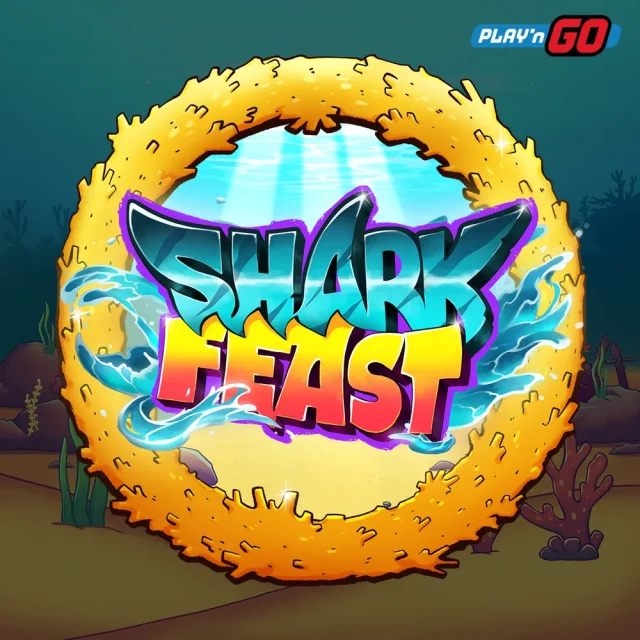
Shark Feast is a six-reel grid game set at an underwater festival, built around clusters, cascades and Chomp Multipliers. Wins can clear symbols and refill the board, while Bubble and Crunch! helpers alter it in different ways. Free Spins keep the cascade system but make multipliers sticky between spins, changing the bonus from a sequence of separate boards into a more persistent grid state.
Shark Feast at a glance
| Provider | Play’n GO |
|---|---|
| Genre / theme | Animals |
| Game type | Grid slot |
| Reels / grid | 6-reel grid; row count not stated |
| Payout mechanic | Cluster pays; 8 or more matching symbols anywhere on the grid |
| Release date | 18 June 2026 |
| Main features | 8+ symbol clusters cascade; 12 Chomp Multiplier positions reset each base spin. Bubble converts symbols, Expansion Bubble affects matching symbols, Crunch! clears 3×3. Three to five Scatters start 7/8/10-spin modes with sticky multipliers and upgrades. |
RTP and stake limits can vary by version and market. Check the information screen in the game you open. Maximum win is a ceiling, not an expected result.
Clusters keep the grid in motion
Play’n GO identifies Shark Feast as a Grid Slot; its announcement describes a six-reel scatter-pays setup. Matching clusters of eight or more symbols anywhere on the grid create wins. Winning symbols disappear and replacements fall, allowing cascades to continue until no further win or Helper Symbol appears. A spin can therefore pass through several grid states, although another cascade is never assured.
Twelve locked Chomp Multiplier positions sit in the middle of the grid. Wins add multipliers to involved positions, and those values can upgrade through tiers. The page does not list the values or upgrade schedule. It does specify that they grow during the spin and reset when it ends, so a base-game cascade may build a temporary multiplier state, but it will not carry into the next spin.
Helpers alter symbols and clear space
Bubble symbols turn into paying symbols and reveal Chomp Multipliers in their positions. Expansion Bubble applies the same symbol and multiplier across matching symbols on the grid. Those transformed symbols may then form clusters and cascade, linking the helper to the game’s ordinary win process. The rules do not say which symbol is selected for conversion, so the outcome should not be assumed in advance.
Crunch! clears a 3-by-3 area around its position and adds or upgrades Chomp Multipliers where it hits, but it does not count as a win itself. The clear can open space for later cascades, while multiplier changes may affect subsequent wins at those positions. In Free Spins, Mega Crunch! expands the blast area, though the exact larger dimensions are not specified. Its effect is therefore a board change that may set up a later result, not a direct payout.
Three, four or five Scatters trigger one of three Free Spins modes: Jelly Fish Festival starts with seven spins, Deep Sea Fiesta with eight, and Aqua Beat Carnival with ten. More Scatters also activate more upgrades, though the exact mapping is not published. During the feature, Chomp Multipliers stay sticky between spins and Scatters are replaced by Lucky Voucher symbols that add spins. Mega Lucky Voucher adds two extra spins instead of one.
A persistent bonus with meaningful limits
The Free Spins package may also include Only Expansion Bubble, which replaces the regular Bubble symbol. Together with Mega Crunch! and Mega Lucky Voucher, it makes the higher Scatter triggers more upgraded, while the starting spins rise from seven to eight or ten. Sticky multipliers are the key change from the base game: positions can retain their values across bonus spins, rather than resetting after each one. The official page does not give the full Scatter-to-upgrade mapping, so the broad progression is known but not every mode’s exact configuration.
The game’s strength is how its parts connect: cluster wins clear space, cascades refill it, helpers transform or remove symbols, and multiplier positions respond to winning activity. Free Spins make this process more persistent and vouchers can extend it. The limitation is that the public description omits RTP, volatility, maximum win and Chomp Multiplier values. It explains how the grid changes, but not how frequently long cascades or large multiplier states occur.
Strengths and weak points
Strengths
Cluster clears, cascades, symbol helpers and positional multipliers form a connected grid system. Free Spins give that system continuity through sticky multipliers, while Scatter count changes starting spins and which named upgrades are available.
Weaknesses
Multiplier tiers, detailed Scatter-to-upgrade mapping and statistical settings are not published in the official description. The grid may evolve through several cascades, but the rules cannot establish how frequent or valuable those sequences are.
Our Editor’s View
Shark Feast suits players who enjoy grid games shaped by symbol removal and cascades. Bubble, Expansion Bubble and Crunch! modify the board differently, while Chomp Multipliers connect those changes to winning positions. Free Spins add continuity through sticky multipliers, and the Scatter count sets the starting mode and upgrade level. Missing multiplier values and statistical settings leave the scale and frequency uncertain. The mechanics are detailed, but the public numerical profile is incomplete.
Related slot reviews
Safari Sam
Shared theme: Animals
Under The Sea
Shared theme: Animals
The Exterminator
Shared theme: Animals