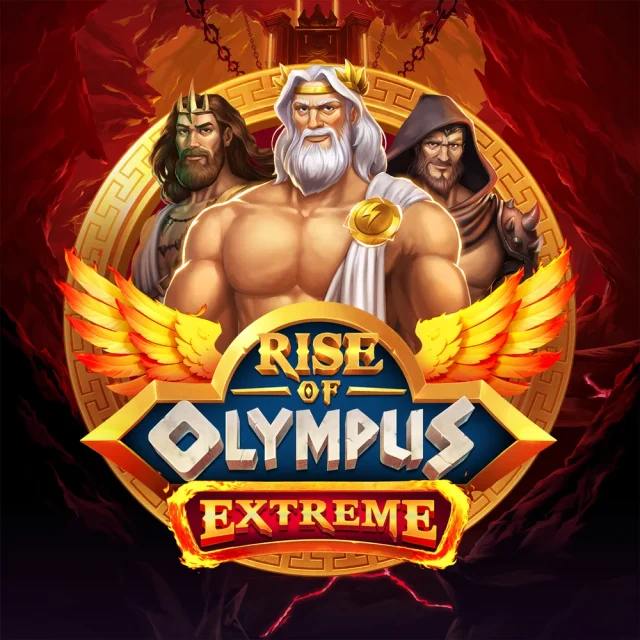
Rise of Olympus Extreme orders its divine interventions around Hades, Poseidon and Zeus on a 5×5 cluster grid. A god acts before the rotation advances, while Free Spins introduce a chosen god and a multiplier that can grow.
Rise of Olympus Extreme at a glance
| Provider | Play’n GO |
|---|---|
| Genre / theme | Greek Mythology |
| Game type | Video slot |
| Reels / grid | 5 x 5 |
| Reference RTP | 96.2% |
| Volatility | 10/10 |
| Payout mechanic | Cluster pays |
| Maximum win | 50000x the bet |
| Release date | 4 September 2025 |
| Main features | As the gods take turns unleashing their wrath through powerful abilities, players will witness epic transformations, explosive clear-outs, and the chance to charge a mighty meter. With the right combination of symbols and divine favour, that power is released in the game’s signature feature – the Wrath of Olympus. Dare to channel one god’s strength during Free Spins and push your luck as the multiplier grows. With the right blessings, the gods may even clear the grid, granting a divine reward worthy of legends. Poseidon calls forth 1 or 2 Wilds onto the grid. The gods rotate in the fixed order: Hades, Poseidon, then Zeus – with each taking the stage after their power has been used. Wrath of Olympus Each god symbol in a winning combination charges a three-part meter:. |
RTP and stake limits can vary by version and market. Check the information screen in the game you open. Maximum win is a ceiling, not an expected result.
What the regular game asks you to read
Rise of Olympus Extreme is a 5×5 cluster grid with an ordered divine rotation. In practical terms, the regular result should be read from the documented layout and win model before any special animation is given extra meaning. Hades, Poseidon and Zeus act in a fixed order; Poseidon can add one or two Wilds, and Free Spins can grow a multiplier through a chosen god This is a useful starting point because it separates an observed game rule from an attractive but non-binding display.
The documented feature route
The divine rotation runs from Hades to Poseidon to Zeus, advancing after a god uses a power. Poseidon’s contribution is one or two Wilds, which can alter the cluster arrangement before the rotation moves on. That visible order helps explain whose intervention is next. During Free Spins, the chosen god and growing multiplier add another layer, but knowing the order does not determine the next cluster result.
Where the mechanic can stop or change direction
The fixed rotation helps explain what comes next, while the 10/10 volatility means the path to a strong multiplier remains far from even. That limitation is not a defect in the description; it is the part of the structure that keeps the feature from being read as a promise. A reader can follow the state on screen, but the next qualifying symbol, cascade, wheel result or re-spin still has to occur.
Recorded configuration for this version
The saved reference for the standard Rise of Olympus Extreme release lists 96.2% RTP, 10/10 volatility, 5 x 5, Cluster pays, and a maximum win of 50000x. It records the release date as 2025-09-04. These are configuration facts, not estimates of a session; the live help panel remains the sensible check where an operator offers alternative settings.
Strengths and weak points
Strengths
The fixed divine order makes interventions easier to follow, and Poseidon’s Wild additions give one clear example of how a god changes the cluster board.
Weaknesses
The 10/10 volatility rating signals substantial unevenness in results. A known god rotation does not make useful clusters or a strong bonus multiplier predictable.
Our Editor’s View
Extreme’s ordered rotation is a meaningful distinction for readers comparing Olympus games. It gives the powers a visible sequence without making the resulting clusters orderly or reliable. The free-spin multiplier adds another reason to follow the feature as it develops, but the high volatility remains a practical limitation. This is a structure for readers comfortable with uncertain outcomes around a known sequence, rather than a basis for expecting regular progress toward a large award. Related review: Rise of Olympus 100.
Related slot reviews
Zeus
Shared theme: Greek Mythology
Zeus 2
Shared theme: Greek Mythology
Mighty Medusa
Shared theme: Greek Mythology