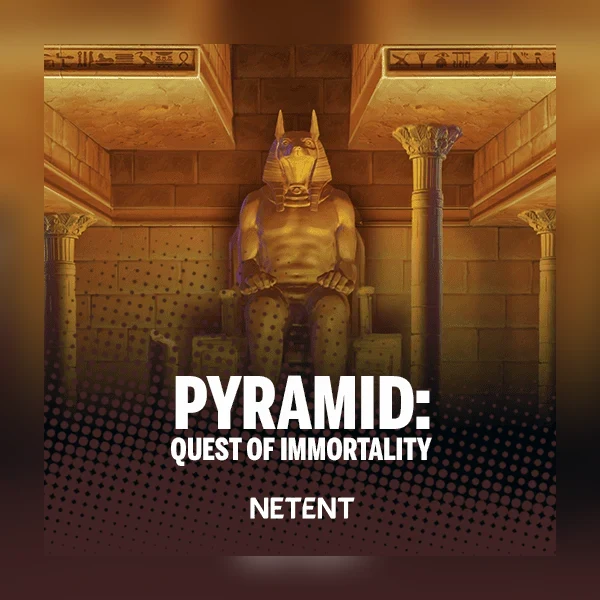
Pyramid: Quest for Immortality™ builds its Egyptian adventure around falling symbols rather than conventional reel stops. The five-reel field has a 5×5 outline with rows arranged 3, 4, 5, 4 and 3, producing up to 720 ways. A winning way starts an Avalanche: winning symbols disappear, new symbols fall into the gaps, and another evaluation follows. Successive winning Avalanches can raise a multiplier, making the continuation rule the heart of the game.
Pyramid Quest for Immortality at a glance
| Provider | NetEnt |
|---|---|
| Genre / theme | Ancient Egypt |
| Game type | Video slot |
| Reels / grid | 5×5 (3,4,5,4,3) |
| Reference RTP | 96.48% |
| Volatility | 4.7 |
| Payout mechanic | Up to 720 ways |
| Maximum win | 1700x bet |
| Release date | 22 January 2015 |
| Main features | Wins start Avalanches; after every three successive winning Avalanches the multiplier rises by 1 to x10 and stays at x10 until the chain ends. |
RTP and stake limits can vary by version and market. Check the information screen in the game you open. Maximum win is a ceiling, not an expected result.
A 720-way pyramid-shaped field
NetEnt lists a 5×5 reel space with the 3-4-5-4-3 row profile and up to 720 ways to win. Symbols fall into position instead of spinning, and a bet-way win starts the Avalanche process. Winning symbols explode and disappear, leaving open spaces for the next drop. This means one paid evaluation can create several subsequent layouts, but the chain continues only while new Avalanches contain at least one bet-way win.
The official description also names Wild substitutions and Wild Generations, but the preserved rule record does not explain their exact formation or exceptions. Those names should not be expanded into invented behaviour. The verified mechanical core is the Avalanche sequence and its multiplier interaction: the board changes after wins, and each new drop is checked for another qualifying way.
How the Avalanche multiplier grows
The Avalanche Multiplier increases by one after every three successive Avalanches that contain at least one bet-way win. It can rise to a maximum of x10. The multiplier remains at its maximum for subsequent Avalanches until no more wins occur. In other words, the count is based on successful consecutive drops, not simply the number of symbols removed from the first layout. A chain that stops before three qualifying Avalanches does not reach the next step.
This creates a direct interaction between persistence and value. Continuing Avalanches provide more opportunities to reach the next multiplier level, while the win condition also keeps the chain alive. Once no more wins appear, the sequence ends and the preserved rules do not describe the multiplier as carrying to the next paid spin. The round-by-round reset is therefore the safe reading: the feature is a temporary chain, not a permanent account balance.
Configuration and comparison
The saved NetEnt figures list RTP 96.48%, volatility 4.7 and maximum payout 1,700x bet. The 720-way profile is confirmed, as is the 0.10 to 200 bet range. The official record does not give Avalanche-trigger probabilities, Wild Generation rules or the likelihood of reaching x10. For a comparison with another ancient-Egyptian review, Book of Dead uses expanding symbols during Free Spins rather than a falling-symbol chain. Pyramid’s listed cap and multiplier ceiling should be read alongside the missing continuation probabilities, not as a forecast of typical outcomes.
Strengths and weak points
Strengths
The 720-way pyramid field and falling-symbol chain make each continued win consequential, with a precise three-Avalanche step and x10 ceiling for the multiplier.
Weaknesses
Wild Generations are named but not specified in the source, and no probabilities show how often chains reach x10 or how the 1,700x maximum is approached.
Our Editor’s View
Pyramid: Quest for Immortality is most distinctive when the board keeps rebuilding itself. A qualifying way removes symbols, the spaces refill, and three consecutive successful Avalanches raise the multiplier by one until x10. That makes the value of a spin dependent on whether the next drop still contains a win, a clearer causal structure than a bonus name alone conveys. The limitation is incomplete documentation around Wild Generations and event probabilities, so the preserved official page cannot show how often a chain reaches its ceiling. Players who prefer cascading layouts and visible progression will understand the appeal; readers wanting a predictable bonus recipe will need more specific current rules.
Related slot reviews

Coins of Egypt
Shared theme: Ancient Egypt

Mercy of the Gods
Shared theme: Ancient Egypt

Golden Wheels of Egypt
Shared theme: Ancient Egypt