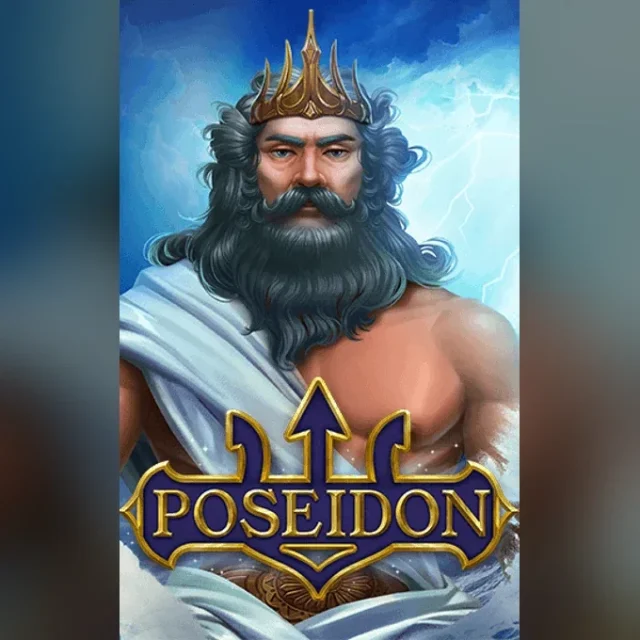
Poseidon is built around a repeating board-reset loop: symbols pay anywhere, winning groups disappear, and new symbols fall into cleared spaces. One paid spin can therefore contain successive win checks rather than a single fixed-line result. The Greek sea-god theme supplies the Wild and Trident Scatter; the cascade loop connects these symbols to the bonus and Poseidon Smash.
Poseidon at a glance
| Provider | Habanero |
|---|---|
| Genre / theme | Greek Mythology |
| Game type | Video slot |
| Reels / grid | 5 reels × 5 rows |
| Volatility | High |
| Payout mechanic | Pay anywhere; Scatter (20 Coins) |
| Maximum win | 1,094× bet |
| Release date | 15 October 2024 |
| Main features | All symbols pay anywhere; cascades continue while new wins occur. Up to 30 Free Games, optional Buy Feature or Super Bet, and Poseidon Smash. |
RTP and stake limits can vary by version and market. Check the information screen in the game you open. Maximum win is a ceiling, not an expected result.
A five-by-five board without paylines
Habanero specifies a 5×5 grid where all symbols pay anywhere. It lists the Scatter threshold as 20 coins, but gives no ordinary payline count. The page marks volatility High, lists RTP configurations of 86%, 92%, 94%, 97% and 98%, and gives a 1,094x maximum. These settings and the ceiling do not show how often cascades occur.
The official overview says cascades continue while new wins occur. A secondary exact-game review supplies the omitted threshold: eight or more matching symbols anywhere, after which they clear and replacements fall. If no new group forms, that chain ends. The threshold is secondary reporting, not a figure stated on Habanero’s short summary.
Scatters, Free Games and the Smash
Habanero confirms up to 30 Free Games, Buy Feature and Super Bet. A secondary game account specifies three, four or five Tridents for 15, 20 or 30 games, with retriggers possible. It says Smash can occur at the end of bonus cascades, removing low-paying symbols for another drop. These details come from the third-party account, not the official summary.
The two clearing actions differ. A regular cascade follows a qualifying win: those symbols vanish and replacements fall. Smash, according to the secondary source, separately removes lower-paying symbols and may open another drop. Habanero only promises Smash for bigger rewards; it gives no timing or trigger probability, so the secondary timing should not be presented as an official rule.
Configuration and practical fit
The five official RTP options make a local configuration check essential; one secondary listing’s individual return cannot be assumed for every operator. High volatility and the 1,094x maximum reveal neither hit rate nor average chain length. Poseidon is best assessed through its documented rules, not one third-party numerical profile.
Waves of Poseidon offers a useful contrast: its review centers on a side reel and a multiplier that accumulates while locked, whereas Habanero’s Poseidon emphasizes board-wide wins and cascades. The games therefore show different kinds of progress. The sea-creature symbols keep the board legible, but random cascades can still be long or short without player control.
Strengths and weak points
Strengths
Pay-anywhere groups and cascading replacements make the resolution of a spin easy to follow, while Smash introduces a distinct symbol-clearing event rather than another multiplier counter.
Weaknesses
The official page omits the match threshold and detailed Smash sequence, the RTP varies across five listed configurations, and neither cascade length nor feature frequency is disclosed.
Our Editor’s View
Poseidon suits readers who want a board that can change repeatedly after one wager, with a clear distinction between ordinary cascades and Smash. Wins clear, new symbols fall, and the chain stops when no group forms. The caveat is source and configuration discipline: trigger counts come from a secondary account, RTP varies, and the maximum multiplier says little about ordinary outcomes. Check the active game information and treat the bonus as an uncertain extension of a random cascade system.
Related slot reviews
Rise of the Sun God
Shared theme: Greek Mythology
Medusa II
Shared theme: Greek Mythology
Legend of Perseus
Shared theme: Greek Mythology