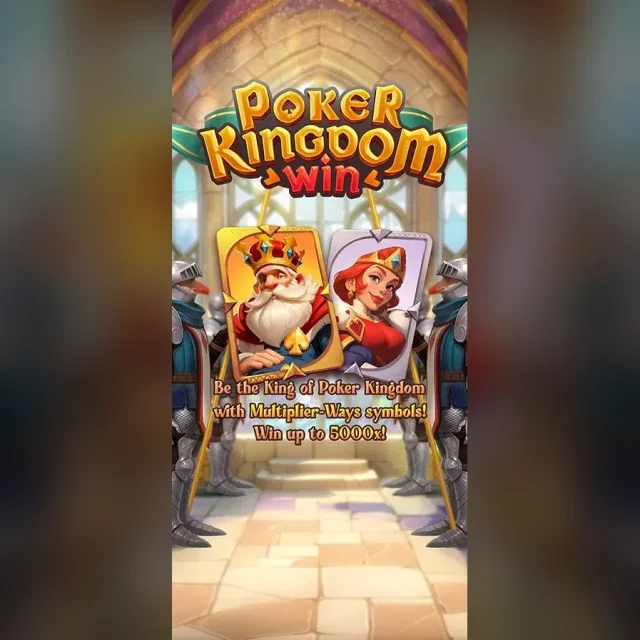
Poker Kingdom Win borrows its visual language from a royal card tournament, but its core is a video slot rather than a poker hand simulator. The unusual mechanic is a Multiplier-Ways symbol that can remain after contributing to a win. In the next round it gains one value, then its new parity determines whether it becomes a Wild or a randomly selected symbol. A single symbol therefore links one result to the next, while also introducing a transformation rule that is easy to misread if described simply as a growing multiplier.
Poker Kingdom Win at a glance
| Provider | PG Soft |
|---|---|
| Genre / theme | Game Shows & Board Games |
| Game type | Video slot |
| Reels / grid | 5 reels × 3 rows |
| Reference RTP | 96.74% |
| Volatility | High |
| Payout mechanic | Increasing ways; count not stated |
| Maximum win | 5,000x the bet |
| Main features | A Multiplier-Ways symbol involved in a win stays on the reels and increases by 1 next round; even value transforms to Wild, odd value to a random symbol. |
RTP and stake limits can vary by version and market. Check the information screen in the game you open. Maximum win is a ceiling, not an expected result.
A 5×3 slot, not a poker table
PG Soft describes five reels and three rows with sticky symbols and increasing ways. The available summary does not give an exact initial ways count or full paytable. The poker story—King Carlos V, opposing teams and a tournament—sets the scene, but no decision-making poker rules are described. Players are observing reel outcomes and symbol transformations, not choosing cards or competing against a dealer. That matters when setting expectations: the card imagery is a theme, not evidence of a skill-based card game. For a theme-only comparison, The Big Deal also uses a casino and card presentation, although its rules are different.
The key symbol is the Multiplier-Ways symbol. If it participates in a win, it remains on the reels and increases its value by one in the next round. The wording ties persistence to participation in a win; it does not say every appearance sticks. Nor does the public description explain whether several such symbols can persist simultaneously or how their values combine. The reliable read is narrow: a winning symbol stays, its value rises by one for the following round, and then an even/odd rule determines its transformation.
The parity transformation
After the increment, an even-valued Multiplier-Ways symbol transforms into a Wild. An odd-valued one becomes a randomly chosen symbol. The distinction creates two different follow-up possibilities: Wild substitution on one parity, or a symbol selected at random on the other. The source does not say whether the randomly selected symbol can be any symbol in the game, whether the transformation applies before the next spin is evaluated, or whether the increased value remains visible after transformation. Those details should not be filled in by inference.
A simple hypothetical illustrates the stated rule without predicting a payout: if a Multiplier-Ways symbol wins while showing a value of 3, it remains and rises to 4 for the next round; because 4 is even, the described transformation is to a Wild. If it instead rises to an odd value, the described outcome is a randomly chosen symbol. This explanation is conditional on the symbol winning in the first place. It does not imply that the next round itself will win or that the symbol can persist indefinitely.
RTP, volatility and limits
The PG Soft catalog lists high volatility, a 96.74% RTP and a 5,000x maximum win. High volatility signals uneven result potential, not a promise that a dramatic feature will arrive on schedule. RTP is a theoretical long-run measure for the listed configuration; the operator may offer another version, so the in-game help screen is the proper place to check the active percentage. The maximum is a ceiling. The public catalog and announcement do not provide a release date, exact ways count, betting range or probabilities for the sticky-symbol rule.
This structure may suit players who like tracking a symbol’s state across consecutive rounds. The trade-off is that its most distinctive interaction depends on a symbol both appearing and being involved in a win before the increment-and-parity step matters. Compared with a more direct free-spin format, the anticipation is localized to this conditional carryover. No source-backed frequency is available, however, so the mechanism should be judged as a design idea rather than as a measure of likely returns.
Strengths and weak points
Strengths
The sticky rule supplies a concrete link between rounds, and the increment followed by an even/odd transformation gives the symbol two distinct next states: Wild on even values or a randomly selected symbol on odd values.
Weaknesses
Only winning Multiplier-Ways symbols are documented as remaining. The ways count, random-symbol pool and persistence after transformation are unstated, while high volatility offers no assurance the conditional sequence will occur often.
Our Editor’s View
Poker Kingdom Win’s strongest design choice is that it gives a symbol a short, documented lifecycle: a qualifying win makes it sticky, the value rises by one in the next round, and parity determines whether the symbol becomes a Wild or a random symbol. That sequence creates continuity without making the game a poker simulation. The boundaries are equally clear: the catalog leaves the exact ways count and several resolution details unstated, and high volatility can make the conditional mechanic feel intermittent. It is a better fit for readers interested in symbol-state changes than for anyone expecting card decisions or predictable feature frequency.
Related slot reviews

POKER WIN 2
Shared theme: Game Shows & Board Games
Mahjong Ways 2
Shared theme: Game Shows & Board Games

Return To The Feature
Shared theme: Game Shows & Board Games