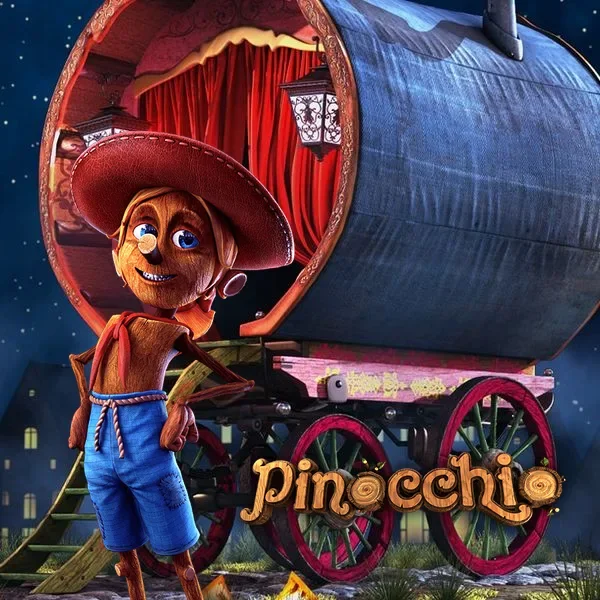
Betsoft’s Pinocchio uses the familiar storybook setting as more than decoration: its multiple story levels carry different feature ideas. Fairy Re-Spins and Pinocchio Wandering Wilds are named on the game page, while the official launch announcement describes distinct School and Stage worlds. Crucially, the announcement says wins are doubled in the secondary worlds; it does not say that every ordinary base-game win is doubled. That separation between worlds gives the game its main mechanical identity and keeps its special rule tied to the context where it applies.
Pinocchio at a glance
| Provider | Betsoft |
|---|---|
| Genre / theme | Fantasy |
| Game type | Video slot |
| Reels / grid | 5 reels |
| Reference RTP | 96.53% |
| Volatility | Low |
| Payout mechanic | 15 |
| Release date | 18 December 2015 |
| Main features | Story levels include Fairy Re-Spins and Wandering Wilds; School and Stage worlds add distinct Wild features, with wins doubled in secondary worlds. |
RTP and stake limits can vary by version and market. Check the information screen in the game you open. Maximum win is a ceiling, not an expected result.
A storybook slot with five reels
The standard game uses five reels and 15 paylines. Betsoft lists a 32.05% hit rate, low volatility and 96.53% RTP. These are configuration figures for this title, not a guarantee about a particular session. The source records the game page’s release date as 18 December 2015; a later news announcement in 2017 concerns a launch announcement and should not be mistaken for the date shown by the current game page.
The fairy-tale presentation gives the slot a clear narrative frame, but the evidence available here does not spell out every symbol value or ordinary line settlement. The reliable way to describe its base game is therefore through the five-reel, 15-payline structure and the transitions into its story levels. Treating the special world rules as universal would blur the distinction the official materials make.
Features change with the story setting
The game page names Fairy Re-Spins and Pinocchio Wandering Wilds across multiple story levels. Those features suggest that the reel action can be revisited and that a Wild symbol can move through play, but the page summary does not define every trigger, counter or stopping condition. It would be speculation to assign a fixed number of respins or claim that a Wandering Wild must travel a particular number of columns.
The official news announcement gives more specific context for two worlds. In the School setting, Scatter Wild Books are described; in the Stage setting, a Dancing Wild reel appears. The announcement also states that all wins are doubled in the secondary worlds. This is a consequential distinction: the multiplier-like rule is attached to those worlds, so it should not be extended to standard base spins without evidence. The feature set is thus organized around changing scenes, with each named world contributing a different visual or reel element.
The available account does not give an exact transition trigger or explain how long each world lasts. Nor does it document a maximum win. The game has identifiable feature vocabulary and a clear world-specific doubling rule, but a reader should not mistake those selected details for a complete rulebook. That boundary is especially important where a special payout condition could otherwise be described too broadly.
Configuration and comparison
The 96.53% RTP, low-volatility label and 32.05% hit rate are the published standard-game figures. They characterize the stated configuration, not a promise of frequent wins or a particular result. The maximum win is not disclosed in the supplied official information.
For another fantasy-themed release, Power of Merlin Megaways offers a useful contrast: Pinocchio’s mechanics are organized around story settings and world-specific rules, while the comparison title foregrounds a different fantasy feature structure.
Strengths and weak points
Strengths
Distinct story settings give the features context: Books, a Dancing Wild reel, Fairy Re-Spins and Wandering Wilds make the changing worlds mechanically recognizable.
Weaknesses
The summaries do not establish transitions, feature duration, exact triggers or a maximum win, so the world sequence cannot be mapped completely from the published overview.
Our Editor’s View
Pinocchio is a good fit for players who like a recognizable story world to shape the mechanics as well as the artwork. Its best-supported details are the multiple levels, Fairy Re-Spins, Wandering Wilds, the School’s Scatter Wild Books and the Stage’s Dancing Wild reel. The rule that all wins double in secondary worlds is the most important qualification, because it belongs to those settings rather than every spin. The limitation is that the public summaries stop short of explaining transitions, feature duration and a maximum payout. That leaves the game’s broad structure understandable while several operational details remain open. Its appeal rests on the changing storybook scenes and their distinct feature identities, not on a fully documented sequence of triggers.
Related slot reviews
Enchanted
Shared theme: Fantasy
Once Upon A Time
Shared theme: Fantasy
Genie’s Fortune
Shared theme: Fantasy