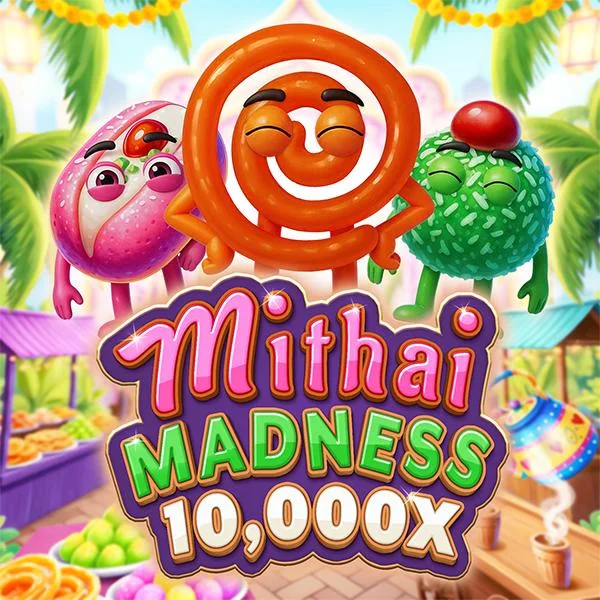
Mithai Madness 10000X borrows the colour and abundance of an Indian sweets counter, but its gameplay distinction is more structural than decorative. Cascading base-game wins lead into a coin-and-pot bonus family with seven variants grouped around connecting values, collecting them, or chasing jackpot awards. The base is a conventional fixed-line entry point; the bonus is where the title’s menu of outcomes gives the game its character. That makes the main question less “what does a sweet symbol do?” and more “which kind of pot interaction has this round selected?”
Mithai Madness 10000X at a glance
| Provider | Microgaming |
|---|---|
| Genre / theme | Food & Drink |
| Game type | Video slot |
| Reels / grid | 5 reels × 3 rows; feature grid can expand to 5 × 5 |
| Reference RTP | 96.2% |
| Volatility | High |
| Payout mechanic | 20 fixed paylines |
| Maximum win | 10,000× the bet |
| Release date | 29 July 2026 |
| Main features | Base-game wins cascade; seven Hold & Win variants use Connectors, Collectors or Jackpots, with sticky Coins and grids expanding up to 5×5. |
RTP and stake limits can vary by version and market. Check the information screen in the game you open. Maximum win is a ceiling, not an expected result.
A compact fixed-line starting point
The listed base configuration is five reels by three rows with 20 fixed paylines. A winning combination clears and allows symbols to cascade, so one paid spin can continue through successive drops while another win forms. This is a familiar mechanism, but here it serves as a bridge toward the bonus rather than a complicated ruleset of its own. The official description confirms the cascade and the pot-based bonus family; the exact-title information source provides the base dimensions and fixed-line count.
Mithai Madness keeps the main play pattern legible: fixed paylines define the starting format, and the cascade rule explains why a spin may not finish after its first result. The sources do not supply enough detail to reconstruct a full symbol-by-symbol paytable here, so no symbol values or payout thresholds are inferred. The more distinctive mechanical detail begins when the game moves from those ordinary wins to its pot feature.
Seven variations on collecting
The official page summarizes three kinds of bonus work—Jackpot, Collector and Connector—and the exact-title description expands these into seven variants. In the Hold & Win round, landed Coins remain in place while unfilled positions respin; the bonus can grow from the original 5×3 layout toward a 5×5 grid. Across the variants, the pot logic changes the relationship between coin values: Connector versions join or link values, Collector versions gather values across the board, and Jackpot versions pursue fixed prize tiers. The sources do not provide a complete per-variant trigger chart or all tier amounts, so those specifics are deliberately left open.
That distinction matters to how the feature should be read. “Seven bonuses” does not mean seven unrelated games; they are variations on a held-coin collection system. The shared respin-and-expansion framework gives the player a common visual task—watching empty positions become filled—while the selected category changes what connections, collection effects or jackpot symbols can contribute. A new Coin also changes the immediate board and can extend the feature’s working space, so the expanding grid adds capacity without guaranteeing that it will fill.
Cascades and pots do different jobs
The cascade feature belongs to the base game: winning symbols disappear and new symbols may form another paid result. The Hold & Win feature instead locks Coins and focuses on the values or pots they represent. Keeping those loops separate prevents a common misreading: a cascade is not itself a pot collection, and a pot interaction is not simply another ordinary line win. The game’s design uses the first to sustain a base spin and the second to create a longer bonus sequence.
Wilds and multiplier effects are also mentioned in the exact-title material, including random multiplier effects and symbols that can remain sticky. Their precise trigger conditions and interactions with each of the seven bonus variants are not set out consistently enough to claim a fixed sequence. The safe assessment is that these effects add ways to alter values, while the named bonus categories establish the more dependable outline of play. Feature-buy availability is reported for some markets, but no price is given here and availability should not be assumed for every operator.
Configuration and the game’s trade-off
The official listing gives 96.20% RTP, High volatility, a 10,000× maximum exposure and a 29 July 2026 release date. The exact-title source notes that operators may use other RTP configurations; players should check the in-game information panel for their version. The design’s appeal is its layered collection logic: a simple fixed-line base opens into an expanding grid and a choice of connected, collected or jackpot-oriented outcomes.
The cost of that variety is that the bonus taxonomy can be difficult to compare without a clear explanation of each variant. The headline seven-count sounds broad, but the published descriptions leave some triggers and prize details unspecified. That is a genuine information limitation, not evidence that every variant behaves identically. The game makes most sense for players willing to learn which pot family is active before assigning meaning to a coin landing.
Strengths and weak points
Strengths
The seven bonus variations retain one understandable held-Coin framework while changing the goal among linking values, collecting them and pursuing jackpot tiers.
Weaknesses
Variant-specific triggers and jackpot amounts are not fully itemized in the available rules, so the seven-mode choice is harder to compare than the shared grid suggests.
Our Editor’s View
Mithai Madness 10000X has a coherent mechanical centre: cascades handle ordinary wins, while a separate expanding Hold & Win board handles coin and pot collection. Its seven versions give that second system several directions without discarding the familiar task of locking landed Coins and watching remaining positions respin. The clearest strength is that the categories describe different value relationships rather than merely different visual skins. Its limitation is equally clear: not every variant’s trigger or prize detail is exposed in the reviewed descriptions, so the advertised breadth cannot be translated into a precise ranking of which mode is most generous. The 96.20% listing and 10,000× cap establish headline context, not likely results. Players who enjoy learning a bonus family’s symbols may appreciate the structure; anyone wanting every outcome spelled out before play should consult the active game’s rules panel first.
Related slot reviews

Cocktail Nights
Shared theme: Food & Drink

The Queen’s Banquet
Shared theme: Food & Drink

Bakery Bonanza
Shared theme: Food & Drink