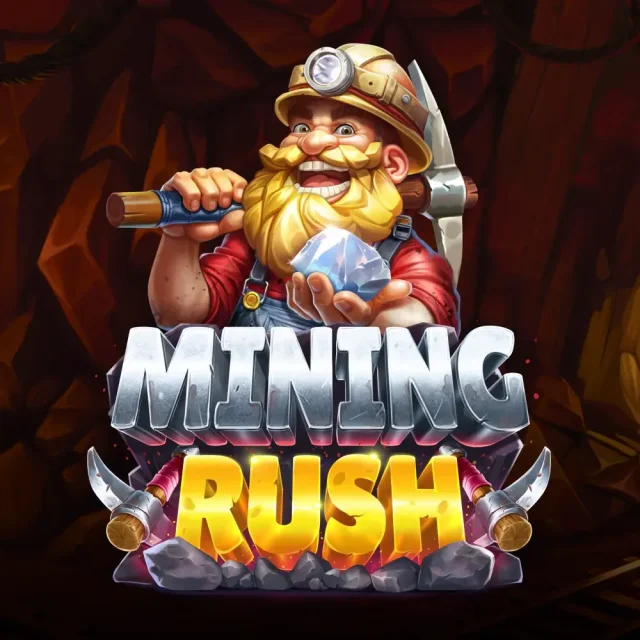
Mining Rush turns dynamite scatters into persistent mines whose level improves after repeated participation in winning tumbles.
Mining Rush at a glance
| Provider | Pragmatic Play |
|---|---|
| Genre / theme | Mining |
| Game type | Video slot |
| Reels / grid | 7×7 |
| Reference RTP | 96.56% |
| Payout mechanic | Cluster pays |
| Maximum win | 10,000x the bet |
| Main features | A winning cluster containing dynamite converts it into a mine. Mines collect progress when they help wins and level up after three points; the official release describes random nugget values up to 1,000x. Three to seven scatters award 8–20 free spins. Existing mine levels carry into the bonus, and every newly created mine adds two spins. |
RTP and stake limits can vary by version and market. Check the information screen in the game you open. Maximum win is a ceiling, not an expected result.
How the core sequence works
A winning cluster containing dynamite converts it into a mine. Mines collect progress when they help wins and level up after three points; the official release describes random nugget values up to 1,000x.
What changes in the feature
Three to seven scatters award 8–20 free spins. Existing mine levels carry into the bonus, and every newly created mine adds two spins.
A mine develops through use
Dynamite is not simply a wild with a larger printed value. It has to participate in a winning cluster before it becomes a mine, and the mine then develops through further involvement in wins. That creates a sequence of conditions: formation, participation and level growth. A newly visible mine is consequently at a different stage from one that has already accumulated progress.
The free-spin rules preserve existing mine levels, giving earlier development a role in the bonus. New mines also extend the round under the stated rule, connecting board development with feature length. Those are separate effects of mine activity. A carried-over level does not itself add the spins associated with creating a new mine, and a longer round still needs suitable clusters to make use of its positions.
Position is the constraint that keeps this system from behaving like a single global multiplier. A developed mine can only matter to a later cluster when the relevant symbols connect through its area. The largest quoted nugget value describes a possible component, not a guaranteed return for building a mine. Mining Rush therefore has a more local form of progression: the board’s occupied cells and their individual histories are central to understanding the feature.
The practical limitation
Persistence improves the opportunity to level a mine, but it does not guarantee that later clusters will connect through its position. For context, Rolling in Treasures uses a different structure within the same catalogue.
Strengths
Mine levels give individual positions a persistent history. Bonus entry preserves development instead of starting every mine from scratch.
Weaknesses
Progress depends on subsequent clusters using the mine’s position. Forming a mine and levelling it are separate conditions.
Our Editor’s View
Mining Rush builds its identity around local progress. Mines are created and developed at particular positions, which is more specific than a multiplier increasing above the whole board. Carrying their levels into free spins gives continuity, but does not remove their dependence on nearby symbols. That tension between persistence and position is the game’s central rule.
Related slot reviews
Mine Blown
Shared theme: Mining

Wild Mining XXXtreme
Shared theme: Mining

Space Miners
Shared theme: Mining