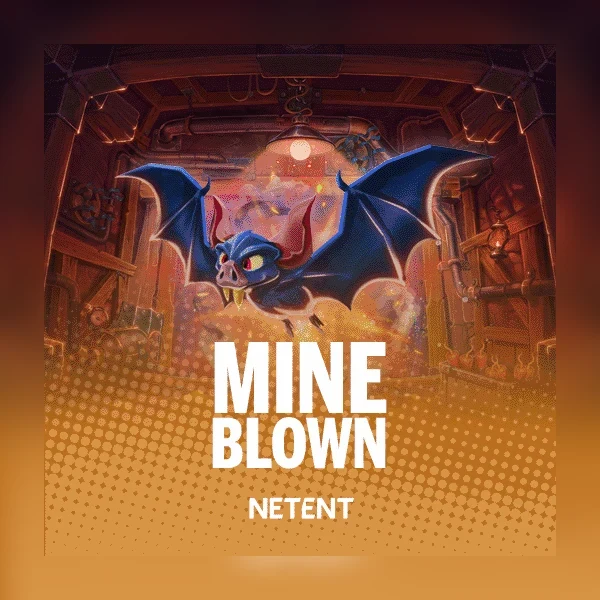
Mine Blown™ separates its two bonus routes by what happens to symbols after an explosion. In the regular game, Dynamite and TNT turn nearby symbols into Wilds; during Bonus Spins, those same blasts reveal Gold and Gem symbols instead. One route locks Wilds for Free Spins, while the other feeds values into a mine cart. The 5×3 line format is compact, but the two triggered features create sharply different board states.
Mine Blown at a glance
| Provider | NetEnt |
|---|---|
| Genre / theme | Mining |
| Game type | Video slot |
| Reels / grid | 5×3 |
| Reference RTP | 96.15% |
| Volatility | 23.92 |
| Payout mechanic | 10 |
| Maximum win | 20,000x bet |
| Release date | 24 October 2024 |
| Main features | Dynamite and TNT create Wilds in the base game but reveal Gems during Bonus Spins; Free Spins lock Wilds, while Bonus Spins collect gem values in a cart. |
RTP and stake limits can vary by version and market. Check the information screen in the game you open. Maximum win is a ceiling, not an expected result.
A ten-line game with explosive Wilds
The base game has five reels, three rows and ten paylines. Random Dynamite may be tossed onto the reels and turns nearby symbols into Wilds when it explodes. A single TNT symbol can land anywhere; its explosion affects itself and adjacent symbols. In the main game, both are Wild-making events. During Bonus Spins their role changes: affected symbols become different Gold or Gem symbols instead. The same blast therefore has a mode-dependent result, which is why the two bonus tracks should not be collapsed into one description.
Two Trigger symbols can award 3x bet if no Bonus symbol lands. Feature entry itself depends on reel positions: Triggers on reels one and three plus a Free Spins symbol on reel five start ten Free Spins, while the same Trigger positions plus a Bonus symbol on reel five start three Bonus Spins. These conditions give each mode a defined symbol pattern rather than a generic scatter count. The summary does not describe any other trigger combination, so none should be inferred.
Locked Wilds or a cart that collects gems
During Free Spins, any Wild that appears locks in place for the duration of the feature. An additional Free Spins symbol awards three more spins. This creates a growing Wild layout, but the official description does not say that every Wild is guaranteed to remain active as a winning substitute on every later spin; it only specifies that the symbol locks in place. The duration ends with the Free Spins round.
Bonus Spins begin with a mine cart worth 3x bet beneath reel three. Gold and Gem symbols landing during the feature are collected, and the accumulated cart value is awarded when the spins end. Undiscovered symbols do not increase its multiplier but can be transformed by Dynamite or TNT into another Gold or Gem type. Gold adds one, Sapphire five, Emerald ten, Ruby twenty-five and Diamond fifty to the cart multiplier. Emerald and Ruby also award one extra Bonus Spin each; Diamond adds three. Those additions can extend the collection window while increasing the cart value, so a symbol may affect both the amount and the remaining feature length.
A useful numerical contrast: a Diamond contributes +50 and grants three extra spins, whereas an Emerald contributes +10 and grants one. Explosions can reveal either from an Undiscovered symbol, but the source supplies no probability for the reveal. The bonus thus has explicit values and extension rules, yet its eventual total depends on random symbol outcomes and whether the trigger positions align.
Configuration and risk
NetEnt lists RTP 96.15%, volatility 23.92 and a maximum payout of 20,000x bet. The volatility figure is unusually high; it signals a risk profile and should not be softened into a promise of exciting or frequent bonus play. The source does not publish trigger or gem probabilities. A mine cart’s listed increment values make the feature easy to calculate once symbols land, but they do not tell a reader how often high-value gems or extended rounds occur.
For a related mining comparison, Fire in the Hole 2 uses xBomb Wilds while its Lucky Wagon feature depends on enhancers and coins. Mine Blown instead gives two distinct modes: locked Wilds in Free Spins or a cart whose multiplier is built from specific gems. That difference helps explain the game’s structure, while the local rules and RTP setting remain useful checks before comparing it with another version.
Strengths and weak points
Strengths
The two bonuses have distinct jobs: Free Spins retain Wild positions, while gem values and extra-spin awards make the cart feature’s accumulation rules concrete.
Weaknesses
At volatility 23.92, feature access and gem values remain hard to assess because trigger and reveal odds are not provided alongside the 20,000x ceiling.
Our Editor’s View
Mine Blown’s clearest strength is the separation between its bonus systems. Free Spins preserve Wild positions, while Bonus Spins convert explosions into collectible gem types and let certain gems extend the round. The cart’s starting 3x value and each gem’s exact increment make outcomes legible once the feature is underway. The downside is a very high listed volatility of 23.92 and no public trigger or gem odds; precise values do not make the route to them predictable. The 20,000x ceiling is a maximum, not a typical result. This is best suited to readers interested in contrasting a persistent Wild board with a value-collecting bonus. Those comparing risk should pay particular attention to the active RTP and local feature rules, since the official page does not quantify the chance of entering either mode.
Related slot reviews

Wild Mining XXXtreme
Shared theme: Mining

Space Miners
Shared theme: Mining
TNT Tumble
Shared theme: Mining