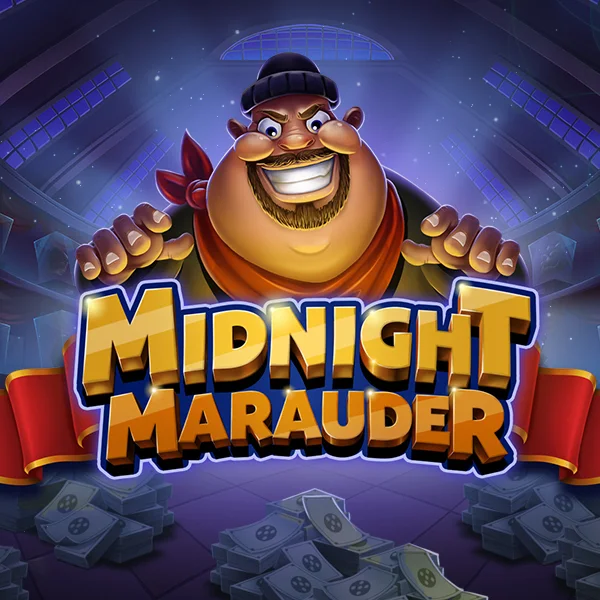
Midnight Marauder turns a bank robbery into a 6×6 reel-area game whose central rule is called Collect and Multiply. Relax Gaming’s official description says the sequence begins with a winning cluster of five matching symbols. Additional nearby symbols of the same kind are collected, then multiplied against one another before the payout is awarded. That gives the title a more specific hook than its heist setting. The source does not verify a line model, RTP, volatility or maximum win, so the review focuses on the observed cluster process and its boundaries.
Midnight Marauder at a glance
| Provider | Relax Gaming |
|---|---|
| Genre / theme | Heist |
| Game type | Video slot |
| Reels / grid | 6×6 |
| Main features | A 6×6 reel area with Collect and Multiply: a winning cluster of five matching symbols collects nearby same symbols, which multiply before the payout. |
RTP and stake limits can vary by version and market. Check the information screen in the game you open. Maximum win is a ceiling, not an expected result.
A 6×6 field built for clusters
the published ClusterBreaker review clarifies the naming contrast: this Midnight Marauder card should be read from its own stated game rules, not presumed to inherit the ClusterBreaker structure. The saved official description places Midnight Marauder on a 6×6 reel area. It does not state whether the game uses ways, paylines or another payout model, so the grid should not be translated into a fixed count. The verified starting point is a winning cluster of five matching symbols. That condition makes adjacency relevant to the feature description: the game is not simply counting identical symbols anywhere in the field. The source says additional same symbols that land nearby are collected, but it does not define the exact neighbourhood, whether symbols arrive by cascade, or how the board refills.
How Collect and Multiply changes a win
The documented sequence has three stages. First, a cluster of five matching symbols starts the mechanic. Next, additional nearby symbols of the same type are collected. Finally, the collected values multiply against one another and award after their payout. The important interaction is that collection changes the calculation before the award is made: nearby matching symbols are not described as separate ordinary wins, but as inputs to a later multiplication step. The official text does not publish the number of collected symbols required, the exact multiplication formula, a cap, or the condition that ends the sequence. Those missing rules are material because they determine whether the mechanic is usually a small enhancement or a rare large swing.
The bank vault and the missing numbers
The 6×6 reel area and five-symbol cluster are the only configuration details verified in the saved capture. RTP, volatility, maximum win, release date, paylines and exact symbol movement remain unknown. The strength is a transparent causal idea: a qualifying cluster creates a collection opportunity, and collection feeds a later multiplier calculation. The limitation is equally direct: without the adjacency rule, collection cap and formula, a reader cannot reproduce the advertised outcome from the description. The live help screen should be treated as essential rather than optional when assessing this title’s risk profile.
Strengths and weak points
Strengths
The 6×6 field and five-symbol starting cluster support a clear three-stage mechanic in which nearby matches are collected before a final multiplication award.
Weaknesses
The adjacency definition, refill behaviour, collection cap and multiplication formula are absent, so the mechanic’s frequency and practical scale cannot be assessed from the source.
Our Editor’s View
Midnight Marauder has a distinctive mechanical centre. Its 6×6 field supplies room for a cluster to begin, nearby matching symbols are gathered into the same event, and the award is calculated only after those values multiply. That is a coherent robbery metaphor because value is accumulated before it is counted. It is also a feature with a sharp information boundary: the source does not explain adjacency, refills, caps or the formula. Our editor would recommend it to readers who enjoy watching a win assemble in stages, but not to anyone seeking a fully quantified profile from the provider listing alone.