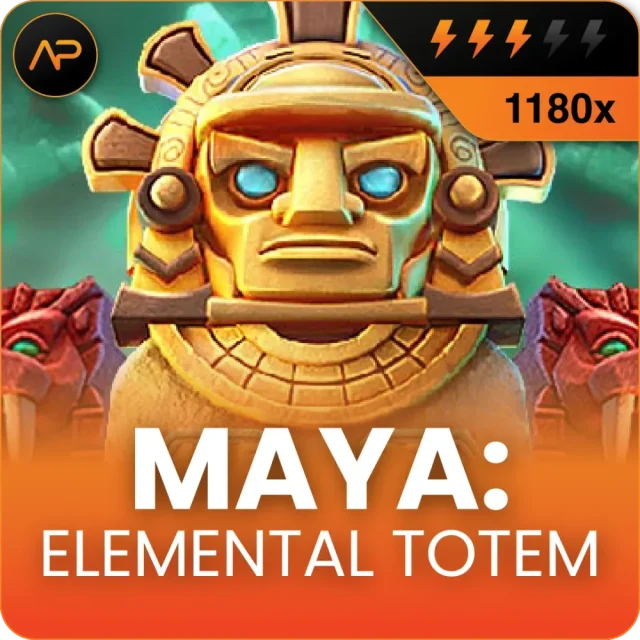
Maya: Elemental Totem blends match-three language with a 5×5 Cluster Pays grid. Its central feature is collecting Totem symbols, while symbol swaps and special-symbol exchanges can change the board and create new connections. The result is a game about both forming clusters and altering what is available to match. The public description confirms these feature families, though it does not publish exact cluster thresholds or explain the swap sequence in detail.
Maya: Elemental Totem at a glance
| Provider | AdvantPlay |
|---|---|
| Genre / theme | Ancient Civilizations |
| Game type | Video slot |
| Reels / grid | 5 reels x 5 rows |
| Reference RTP | 97.31% |
| Volatility | Medium |
| Payout mechanic | Cluster Pays |
| Maximum win | 1,180x the bet |
| Release date | 1 February 2024 |
| Main features | Totem symbols can be accumulated and collected; symbol swapping and special-symbol exchange can change the board; random mysterious symbols are also mentioned. Specific rules are not supplied. |
RTP and stake limits can vary by version and market. Check the information screen in the game you open. Maximum win is a ceiling, not an expected result.
A 5×5 cluster board
The game uses a 5×5 grid and Cluster Pays rather than a stated set of paylines. AdvantPlay calls it a match-three game and describes opportunities for symbol connections. It does not define whether three symbols are always enough, whether they must touch orthogonally, or how a winning group is selected when multiple clusters appear. The precise removal and refill behavior is also omitted. Those are important rules for a cluster slot, so players should consult the paytable rather than infer a conventional match-three puzzle rule. The known foundation is a 25-position board where connected symbol groups drive wins.
Collecting Totems and changing symbols
The official description says players can accumulate and collect mysterious Totem symbols during each round. It does not state what number triggers a reward, whether the collection continues between rounds, or how the Totems affect a payout. Treating them as a meter with a particular threshold would go beyond the available rules. What is confirmed is that collection is a central feature, and the collected symbols can be considered separately from ordinary cluster connections.
Symbol swapping and special-symbol exchange provide a way to change the board. In a cluster format, changing a symbol could alter which groups connect, but the provider does not specify which symbols are eligible, whether the player chooses the positions, or whether the exchange is random. Nor is the timing given: the description does not tell us whether swaps happen before a win is evaluated, after a cluster clears, or as a separate feature event. The safe conclusion is that the game can alter symbols and that this can affect the board state; the exact tactical or payout consequence remains uncertain. Random mysterious symbols are also mentioned, but their identities and effects are not listed.
Configuration
AdvantPlay lists 97.31% RTP, medium volatility and a maximum win of 1,180x for Maya: Elemental Totem, released February 1, 2024. The catalog identifies Cluster Pays. RTP can be configured by an operator, so check the casino’s own paytable for its exact version. Medium volatility does not mean that Totems or symbol swaps appear steadily. The 1,180x amount is a ceiling, not a likely outcome. Without the Totem threshold or symbol-exchange rules, these configuration facts do not tell a player how often a feature changes the board or what it contributes to a result.
Board-changing ideas without a full sequence
Maya: Elemental Totem has a useful mechanical pairing: cluster formation supplies a reason to care about the grid, and symbol changes can alter the connections available. Totem collection adds another progression track. That gives the 5×5 board more to do than simply display static combinations. The limitation is the absence of sequence and threshold detail. There is no verified account of when a swap occurs, how collection pays, or how a round ends. Players interested in a match-three-inspired slot may find the design appealing, but those who want to understand every board interaction should learn the feature rules in the live game first.
Strengths and weak points
Strengths
Totem collection and symbol swapping give the 5×5 cluster board two distinct forms of progression: accumulating special symbols and changing potential connections.
Weaknesses
Cluster adjacency, Totem thresholds, collection persistence and swap timing are not stated, so players cannot determine how the board changes or when collection matters.
Our Editor’s View
Maya: Elemental Totem is organized around a changing cluster board. Totem symbols can be collected, and symbol swaps or special exchanges can change which groups connect. This creates a coherent interaction between collecting and board alteration, while the 5×5 format gives those changes room to matter. The description does not provide the minimum cluster rule, Totem threshold, persistence or timing of swaps, so the mechanics remain an outline rather than a complete sequence. Medium volatility and the 1,180x maximum offer context, not a prediction. It may appeal to players who like puzzle-like symbol changes, provided they check the paytable to see how collection and swaps actually resolve.
Related slot reviews
Rook’s Revenge
Shared theme: Ancient Civilizations

Aztec Respin
Shared theme: Ancient Civilizations

Inca Gems
Shared theme: Ancient Civilizations