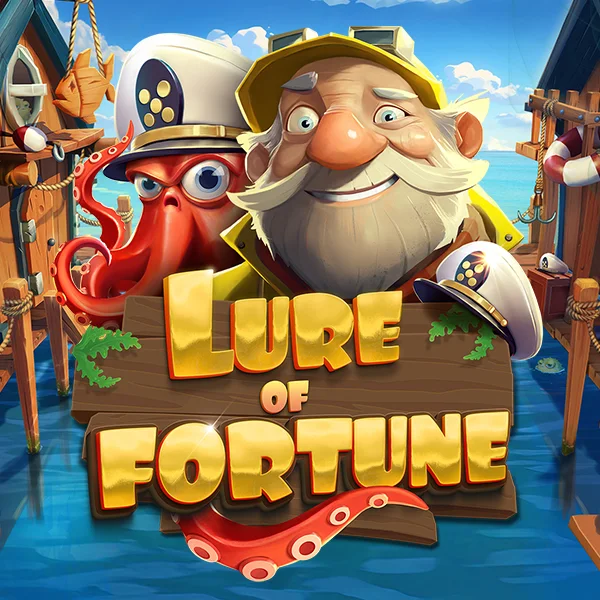
Lure of Fortune turns its fishing voyage into a route through different risk conditions. Relax Gaming’s official page calls the game a Cluster video slot and describes waters ranging from medium to extremely high volatility, alongside multiplier upgrades and three bonus symbols. The central idea is not a fixed line count: fish must be brought closer to the boat, with persistent helpers changing the board’s future possibilities. The public page gives €0.10 minimum stake and market-dependent €200, €50 or €20 maximums, but no exact grid or RTP.
Lure of Fortune at a glance
| Provider | Relax Gaming |
|---|---|
| Genre / theme | Fishing |
| Game type | Video slot |
| Volatility | Medium to extremely high |
| Payout mechanic | Cluster |
| Main features | Cluster wins combine with multiplier upgrades; 3 bonus symbols lead to an underwater route with Persistent Hammer Octopus, Persistent Payer Worm and Persistent Spawner Fish. |
RTP and stake limits can vary by version and market. Check the information screen in the game you open. Maximum win is a ceiling, not an expected result.
Cluster wins on a changing voyage
The official payout mechanic is Cluster, so the base result is built from adjacent matching symbols rather than a published line count. That makes the screen’s geography important: a fish or other symbol must form the qualifying cluster under the game’s help rules, and a visually busy board is not automatically a win. Relax Gaming frames the route as moving between medium and extremely high volatility waters. Those labels describe the broad result profile, not a promise that a particular cluster will arrive or that a route will progress on every spin.
Three bonus symbols and persistent helpers
Three bonus symbols call the player into the underwater adventure. The official description names three persistent helpers: Hammer Octopus, Payer Worm and Spawner Fish. Their persistence is the key interaction. A helper can continue affecting later states instead of disappearing after one isolated result, while multiplier upgrades can increase the value of qualifying cluster outcomes. The source does not publish the exact threshold, duration or order for each helper, so the defensible conclusion is limited to the observed roles: cluster wins, upgrades and persistent assistance work together to bring fish closer to the boat. the Captain Kraken review is a useful nautical comparison, while Lure of Fortune is distinguished by helpers that persist across later states.
Market limits and unknown settings
The exact product page lists €0.10 minimum stake and three maximum-stake figures: €200, €50 and €20. That spread is explicit evidence of market or configuration differences, not a single universal maximum. RTP, reel dimensions, paylines, release date and a numerical maximum win are not published on the page. Lure of Fortune therefore needs an operator help-screen check before a player treats volatility, stake limits or the bonus route as identical across jurisdictions.
Strengths and weak points
Strengths
Cluster evaluation and persistent sea helpers give the fishing theme a mechanical purpose. The player can understand the broad route from a matching group to an upgraded or assisted result without relying on a line-count abstraction.
Weaknesses
The public page does not specify the cluster grid, helper thresholds, persistence duration, RTP or a single maximum stake. The medium-to-extremely-high volatility range also signals materially different result profiles.
Our Editor’s View
Lure of Fortune has its strongest design idea in the persistence layer. Cluster wins establish the ordinary evaluation, while the three named helpers can remain relevant as the fishing route develops; multiplier upgrades then give a reason to watch how a later cluster is formed. The limitation is not hidden: the public description leaves the exact board, trigger threshold and helper rules open. Our editor would suit this game to readers who enjoy tracking a spatial cluster and a continuing state, provided they accept that the extremely high-volatility option can produce uneven sessions and that the local rules decide which market configuration is active.
Related slot reviews
Rabid Randy Gone Fishing
Shared theme: Fishing

Net Gains
Shared theme: Fishing
Cod of Thunder Dream Drop
Shared theme: Fishing