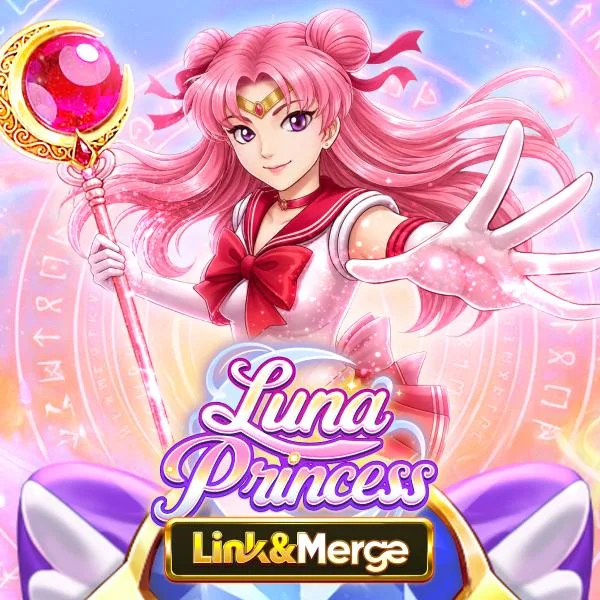
Luna Princess Link&Merge brings together two systems that reward different kinds of attention. In the base game, adjacent matching symbols form clusters and feed a Wild Meter; in the feature, coin values lock in place and merge through repeated respins. The princesses are more than decorative guides, since their appearances correspond to distinct multiplier effects. That structure gives the title a fairytale identity, but its central question is practical: how does a cluster-driven reel game hand off into a coin round without blurring the two?
Luna Princess Link&Merge at a glance
| Provider | Microgaming |
|---|---|
| Genre / theme | Fantasy |
| Game type | Video slot |
| Reels / grid | 6×6 |
| Reference RTP | 96.23% |
| Volatility | Medium |
| Payout mechanic | Cluster pays; five or more adjacent matching symbols, horizontal or vertical |
| Maximum win | 10,000× the bet |
| Release date | 24 June 2026 |
| Main features | Five-symbol horizontal/vertical clusters feed a Wild Meter; princess scatters can trigger a three-respin coin Link&Merge round in which new coins reset the counter and values are collected at the end. |
RTP and stake limits can vary by version and market. Check the information screen in the game you open. Maximum win is a ceiling, not an expected result.
Cluster wins set the base-game rhythm
The play area is a six-by-six grid, and the game uses cluster pays rather than fixed paylines. Five or more matching symbols connected horizontally or vertically form a winning group. That adjacency rule changes how a result is read: a diagonal touch alone does not join two symbols into the same cluster, while a larger connected shape can count as one group rather than several separate line patterns. The grid therefore asks players to scan for connected areas, not just left-to-right sequences.
When a cluster wins, its symbols also contribute to the Wild Meter. Crossing the meter’s thresholds adds Wilds, which can help form later clusters. The meaningful interaction is that an ordinary win can affect the composition of the grid beyond its immediate payout. The available description does not establish every threshold or guarantee that a particular cluster will cross one, so the meter is best viewed as a gradual modifier rather than a fixed reward schedule. That restraint matters: the feature has a visible progression, but the exact pace remains variable.
Three princesses, three multiplier roles
Princess scatters can open the Link&Merge feature, where coin symbols carry values and lock onto a separate board. The round begins with three respins; landing a new coin resets the counter, while empty results use up attempts. Five or more coins connect the Link&Merge sequence, and the accumulated values are collected when the round ends. This gives the feature a comprehensible endpoint: keep finding coins before the respin counter runs out, then resolve the total.
The princesses distinguish the multiplier side of the feature. One leaves a 2× multiplier grid that can upgrade as wins merge, with progression described up to 1,024×. Another applies coin multipliers with a super version described in the 3×–15× range. Marina’s multiplier rises with each merge, with stated limits of 100× and up to 200× for its super form. These are separate behaviors, not one universal multiplier: a static grid that improves, a value applied to coins, and a merge-dependent increase create different paths through the same collection round.
The available rules do not make the princess trigger threshold or the selection process among their effects fully clear. That leaves a meaningful uncertainty about how often a player will see each variation. It is still possible to understand the broad interaction: cluster wins can grow the Wild Meter in the base game, while the princess-led feature changes how locked coin values are enhanced and finally collected.
What the published figures do—and do not—say
An exact-game review lists a 96.23% RTP, Medium volatility, a 6×6 grid, cluster wins and a 10,000× maximum payout; it also gives a 24 June 2026 release date. The provider page was not available in the readable page capture, so those configuration details are attributed to that exact-title listing rather than presented as a provider-confirmed profile. The same listing describes mythical and fairytale imagery, which supports the assigned fantasy classification without forcing a specific real-world culture onto the artwork.
The game’s strongest editorial quality is the division of labor between its systems. Clusters are about connection and meter growth; Link&Merge is about preserving a coin sequence and choosing how to value it. Its limitation is the amount of detail concealed behind the princess variants. Without complete trigger thresholds and selection rules, the design is easier to describe at the level of its three multiplier roles than to forecast from a given spin. Medium volatility does not remove that uncertainty, and a stated maximum is a ceiling, not an expectation.
Strengths and weak points
Strengths
Cluster growth and coin merging feel like distinct phases: one develops Wild potential through connected wins, while the other turns locked values into a timed collection problem.
Weaknesses
The princess trigger and effect-selection details are not fully specified in the accessible rules, making it difficult to know which multiplier path a feature entry will use.
Our Editor’s View
Luna Princess Link&Merge has a more coherent identity than its combination of clusters, Wilds, princesses and coins might suggest. The six-by-six base grid rewards connected shapes and gives winning clusters a secondary role through the Wild Meter; the coin feature then changes the task to keeping a chain alive until values are collected. The three princess effects add useful variation because each approaches multipliers differently. Still, readers should treat the feature’s exact trigger and effect selection as uncertain where the rules do not spell them out. For players who enjoy layered progression and can tolerate that opacity, the game has a distinctive two-stage structure; for anyone who wants every bonus outcome mapped in advance, it is less transparent than its clear grid suggests.
Related slot reviews
Asgardian Rising
Shared theme: Fantasy
Gem Saviour
Shared theme: Fantasy
Hood vs Wolf
Shared theme: Fantasy