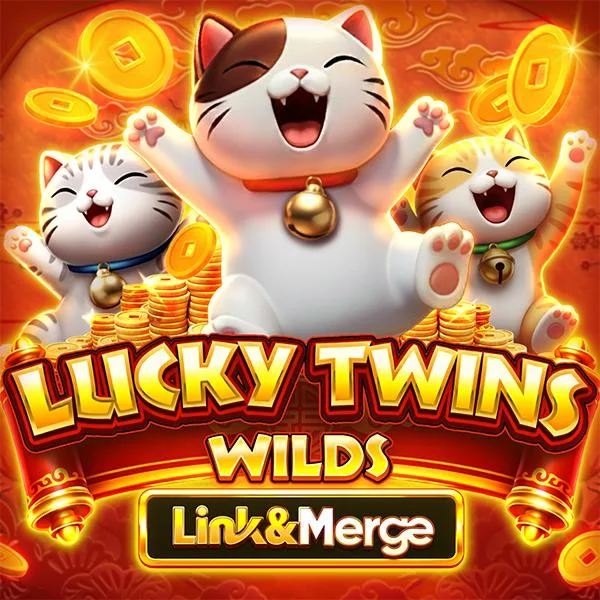
Lucky Twins Wilds Link&Merge makes adjacent-symbol avalanches feed a Lucky Meter. Three touching matches merge and clear; each removed symbol advances the meter. At 25 removals, the board receives extra coins and Wilds. At 50, Overcharge guarantees high-value coins and expanding Wilds. Twin cats are Wilds, while Wild Thunder can add further Wilds or multipliers. The exact Scatter condition and configuration values conflict across the official page, so the review focuses on the verified base-game rules.
Lucky Twins Wilds Link&Merge at a glance
| Provider | Microgaming |
|---|---|
| Genre / theme | Asian |
| Game type | Video slot |
| Reels / grid | 6×5 grid |
| Payout mechanic | Up to 262,144 ways; adjacent pays |
| Release date | 29 April 2026 |
| Main features | Matching neighbours merge during avalanches. Lucky Meter boosts at 25 removals and Overcharges at 50; twin cats expand as Wilds. Wild Thunder adds Wilds or multipliers. Free Spins are confirmed; exact Scatter condition conflicts. |
RTP and stake limits can vary by version and market. Check the information screen in the game you open. Maximum win is a ceiling, not an expected result.
Merges build a sequence
The game uses a 6×5 grid with up to 262,144 ways. Three or more matching symbols touching one another trigger an avalanche and merge into larger blocks; new symbols fall into the gaps, and another cluster can continue the spin. This differs from a simple clear-and-refill because adjacent matches link before the fall. The result depends on the board left behind, and the chain stops when no new winning cluster forms.
The Lucky Meter has fixed thresholds
The meter counts every symbol removed during a spin sequence. At 25 removals it adds coins and Wilds to the current board; 50 removals triggers Overcharge, dropping high-value coins and guaranteeing expanding Wilds. These are concrete progress conditions, but they change the symbols available rather than guaranteeing that a new combination will pay. Twin cats can expand across several positions on a reel. Wild Thunder may convert random positions into Wilds or add multipliers, with no fixed result promised for each activation.
Free Spins details need the installed rules
The official page confirms Free Spins, more active merging, persistent merged symbols and additional Scatter retriggers. Its trigger condition conflicts: one section says Scatters in the same sequence, another describes them landing together. This review therefore does not state the precise trigger or starting-spin count. RTP and volatility also differ between the page’s details and review table. The table and FAQ both give a 10,000x maximum, but verify the exact version before relying on that figure; no progressive jackpot is listed.
Strength and limitation
The meter gives a long avalanche measurable progress, and the 25/50 thresholds have distinct board effects. Merges and Wilds reinforce that same sequence. The trade-off is that meter boosts and random Wild Thunder modifiers cannot ensure another cluster, while conflicting trigger wording makes bonus timing hard to compare. The design suits players who like following visible counters and changing grids, provided they treat progress as an opportunity rather than a payout guarantee.
Strengths and weak points
Strengths
The Lucky Meter has explicit 25 and 50 removal thresholds, each changing the grid in a stated way; merges and cat Wilds support the same avalanche structure.
Weaknesses
Threshold boosts do not guarantee a win, Wild Thunder outcomes are variable, and the official page gives incompatible Free Spins trigger wording and RTP details.
Our Editor’s View
Lucky Twins links three systems through symbol removal: avalanches create merges, removed symbols advance the Lucky Meter, and threshold boosts alter the current board. Wild Thunder and expanding cat Wilds add ways to change connections, while Free Spins extend the feature set. The 25- and 50-symbol thresholds make progress easy to understand, but neither guarantees a win after the board changes. The official page’s Scatter-trigger wording and RTP/volatility claims conflict, so the exact installed rules are essential for bonus comparisons. Readers who enjoy counters and board-state decisions may appreciate the structure; anyone wanting predictable short-term progression may find the random outcomes frustrating.
Related slot reviews

Caishen Wins
Shared theme: Asian

Ganesha Fortune
Shared theme: Asian

Thai River Wonders
Shared theme: Asian