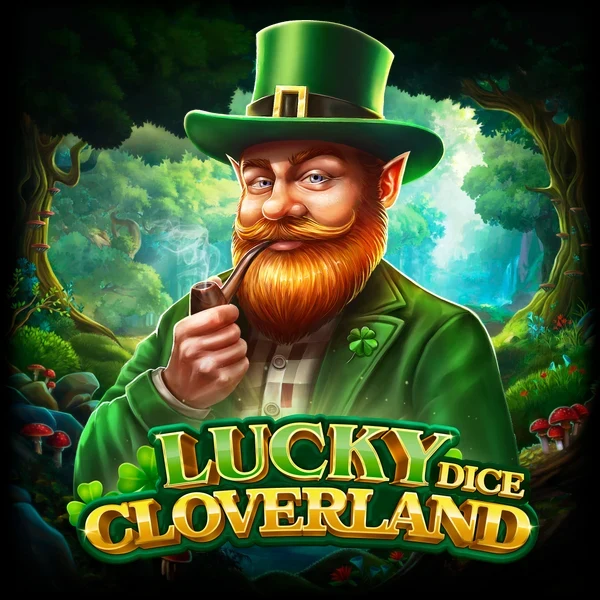
Lucky Cloverland Dice puts Irish folklore and gold imagery on a five-reel grid, then adds a randomly selected extra Wild symbol type in Free Games. The regular Pot of Gold Wilds remain relevant in both modes. Its seven-game starting award is easy to identify, while the exact size of a retrigger and some selection details remain open.
Lucky Cloverland Dice at a glance
| Provider | Endorphina |
|---|---|
| Genre / theme | Irish Folklore |
| Game type | Video slot |
| Reels / grid | 5×4 |
| Reference RTP | 96.03% |
| Volatility | Medium-Low |
| Payout mechanic | 40 fixed |
| Main features | Three Scatters award seven Free Games with a randomly selected extra Wild symbol type. Stacked Pot Wilds operate on reels 2, 3 and 4 in both modes; Free Games may retrigger. Conditional Bonus Pop. |
RTP and stake limits can vary by version and market. Check the information screen in the game you open. Maximum win is a ceiling, not an expected result.
Forty fixed lines and stacked Pots
The Dice version uses five reels, four rows and 40 fixed paylines. Ordinary matching symbols must land adjacent to one another from the leftmost reel. Five Leprechauns pay 25 times the base bet, and five Clovers pay 7.5 times the base bet.
Stacked Pot of Gold Wilds operate on reels two, three and four in both the main game and Free Games. They substitute for symbols other than Scatters, so they can help ordinary combinations but cannot complete a Scatter award. A stack improves coverage on its reel without guaranteeing a win.
Entering Free Games
Three or more Scatters anywhere award seven Free Games at the original stake and lines. Five Scatters also have a stated cash payout of 250 times the base bet. That listed Scatter payout should not be mistaken for a confirmed maximum win across the whole game.
The game can award Free Games again during the feature, but the exact retrigger award is not stated. Players should therefore distinguish the known starting award of seven from any later addition. The rules do not establish a specific number of games added by a retrigger.
The extra Wild symbol
In Free Games, one randomly selected symbol type gains Wild capacity and substitutes for symbols other than Scatters. The stacked Pot Wilds continue to operate on the three middle reels, giving the feature two sources of substitution for ordinary combinations.
The selection frequency and persistence procedure are not fully specified beyond the feature’s random selection. The rules do not promise that every symbol type becomes Wild or that the screen will fill with Wilds. Leprechaun’s Fortune provides a comparison of Irish folklore and gold imagery, without implying the same feature.
Risk and availability
The stated RTP is 96.03%, with Medium-Low volatility. Those figures describe the game’s theoretical return and risk profile, not a steady return or a guaranteed outcome in a session. The overall maximum win has not been confirmed.
Bonus Pop is conditional on jurisdiction, and its price and purchase RTP are unspecified. Classic Risk is a separate optional doubling feature with the possibility of loss. Neither changes the stated Scatter trigger or guarantees that the randomly selected Wild type will produce a winning combination.
Strengths and weak points
Strengths
Three or more Scatters award seven Free Games, where an extra randomly selected Wild type joins stacked middle-reel Pot Wilds. Free Games can be won again.
Weaknesses
The retrigger amount and details of the random selection are unspecified. Neither Wild type substitutes for Scatters, and the overall maximum win remains unconfirmed.
Our Editor’s View
Lucky Cloverland Dice combines a familiar gold-and-leprechaun setting with a free-games feature that changes the role of one randomly selected symbol type. Three or more Scatters award seven games, and the middle-reel Pot Wilds continue to work alongside the extra Wild type. Free Games can be won again, although the size of that retrigger is not specified. The Medium-Low volatility label gives useful context without promising regular returns. This version is best assessed on its own 40-line configuration, especially because the selection procedure and overall maximum remain unclear.
Related slot reviews

Lucky Cloverland
Shared theme: Irish Folklore

Rainbow Ray
Shared theme: Irish Folklore

Gambleman
Shared theme: Irish Folklore