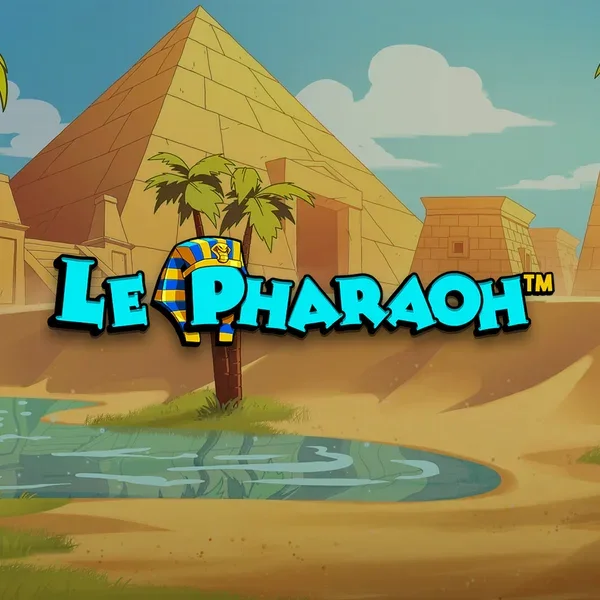
Le Pharaoh separates the creation of a feature from its collection. Winning symbols stick through repeated re-drops and mark Golden Squares, but those squares become treasure only if a Rainbow remains when the re-drop sequence ends. That two-part structure makes the board’s final state important: a long run of wins may create many marked positions, while the Rainbow determines whether their reveal sequence begins.
Le Pharaoh at a glance
| Provider | Hacksaw Gaming |
|---|---|
| Genre / theme | Ancient Egypt |
| Game type | Video slot |
| Main features | Wins stick through re-drops and mark Golden Squares; a final Rainbow triggers staged Coin, Clover and Pot reveals. Bonus Choice offers distinct free-spin or lives modes. |
RTP and stake limits can vary by version and market. Check the information screen in the game you open. Maximum win is a ceiling, not an expected result.
Wins build the squares
When a winning combination lands, its symbols stick and another drop is awarded. Paying symbols that extend an existing combination or create a new one can stick too, prompting another re-drop. This continues until neither extension nor a new win is made, at which point the accumulated wins are paid. Rainbow and FS symbols that land together with a sticky winning combination also stick, but they do not create Golden Squares. Paying symbols leave at the next spin or when Golden Riches activates; the squares and sticky feature symbols are cleared at the next spin.
A Rainbow on the grid at the end of this sequence activates Golden Riches. Every Golden Square then reveals a Bronze, Silver or Gold Coin, or may reveal a Pot of Gold or one of two Clover types. The reveal is not itself the final settlement. Coins show bet-based cash values; Green Clovers multiply Coins and Pots on adjacent squares, while Golden Clovers affect those symbols grid-wide. Their multipliers range from 2× to 20×. Pots activate after Clovers, collect Coins and other Pots, and resolve top-to-bottom then left-to-right. After collection, remaining squares can reactivate and reveal again. Reading the order matters: a Clover can change values before a Pot collects them, and a later Pot may include an earlier Pot’s stored amount.
Three routes change the feature
Three or four base-game FS scatters open a Bonus Choice menu. With three, choose Luck of the Pharaoh or Lost Treasures; with four, choose their Super versions. Luck starts with ten spins and keeps Golden Squares highlighted after activation. Super Luck grants twelve spins, improves the chances of higher-value Coins and Pots, and guarantees a Clover reveal each time Golden Riches activates. These are defined changes in reveal access and square persistence, not guarantees of a particular award.
Lost Treasures changes the game more radically. It begins with three refilling lives, spends one per spin, and restores the count to three when any non-dead symbol lands and activates. Three spins without such a refill end the bonus. Coins, Pots and Stone Tablets stick. Adding Tablets add a listed bet multiple to a random Coin on each spin; Multiplying Tablets multiply a random Coin. A full grid of Coins, Pots or Tablets also ends the feature. Five scatters instead open Rainbow Over the Pyramids for twelve spins: Golden Squares remain highlighted and a Rainbow is guaranteed each spin. The bonus preserves the familiar reveal loop but gives the activation condition a reliable presence; it does not guarantee high-value symbols or a profitable total.
An orderly but numerically incomplete design
The official page lists individual Bronze, Silver and Gold Coin values and multiplier ranges, but those possible values do not establish how often they appear or what a typical feature returns. RTP, volatility, grid size, payout geometry, maximum win and exact release date are not supplied on this detail page. Those unknowns prevent a fair numerical comparison based on the public summary alone. The chosen option also matters: the theoretical payout can vary with the bonus selected, so an operator’s game rules and available configuration are relevant.
Our editorial reading is that Le Pharaoh rewards attention to resolution order. First sticky symbols build the marked footprint; then a Rainbow opens it; Clovers adjust eligible values; Pots collect; and remaining squares can begin another cycle. Lost Treasures asks a different question, whether the feature can keep finding non-dead symbols before its lives run out. This gives the title more than a cosmetic choice of bonuses. The limitation is equally clear: a visible square or special symbol is only one condition in a chain, and the page supplies no frequencies for judging how often that chain becomes valuable.
Strengths and weak points
Strengths
The ordered Golden Riches settlement makes adjacency, global Clover reach and Pot collection distinct. Lost Treasures offers a genuinely different lives-and-sticky-symbol loop.
Weaknesses
Golden Squares need a Rainbow to resolve, while Lost Treasures can end after three unreplenished spins or a full grid. Frequencies and RTP are undisclosed.
Our Editor’s View
Le Pharaoh’s strongest feature is its order of operations. Re-drops determine which positions become Golden Squares, a Rainbow starts the reveal, Clovers modify eligible values, and Pots collect in a defined reading order. Bonus Choice then lets the player select between a persistent-square version of that loop and Lost Treasures’ life counter, sticky Coins and Stone Tablets. Our editor finds the distinction substantive and easy to explain. The numbers still have limits: listed symbol values are possible values, not typical outcomes, and public rules omit RTP and appearance rates. Treat the feature descriptions as mechanics, not a forecast.
Related slot reviews

Rise Of Egypt
Shared theme: Ancient Egypt
3 Pharaoh Treasure
Shared theme: Ancient Egypt
Eye Strike
Shared theme: Ancient Egypt