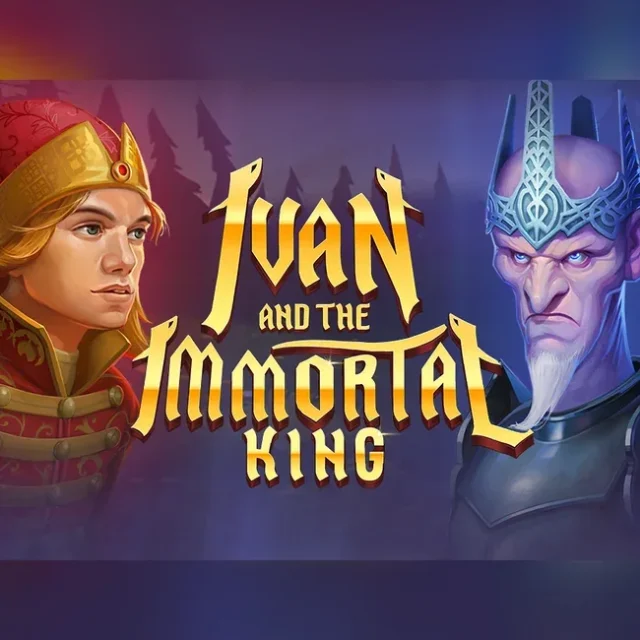
Ivan and the Immortal King turns a Russian fairy-tale quest into a slot about being one symbol short. Its Baba Yaga feature can rewrite a small patch of the reels, while the free spins build through a second Scatter type and successive multiplier levels. That gives the game a clear narrative mechanic: the witch can help establish a feature, and the bonus asks you to keep collecting progress symbols once inside it. The appeal lies in those linked interventions, rather than in a publicly specified layout or return figure.
Ivan and the Immortal King at a glance
| Provider | Quickspin |
|---|---|
| Genre / theme | Adventure & Exploration, Fantasy |
| Game type | Video slot |
| Volatility | Extremely volatile |
| Main features | Baba Yaga replaces four adjacent symbols with Scatter progress or one paying symbol; Scatters start tiered free spins and Progress Scatters advance multipliers. |
RTP and stake limits can vary by version and market. Check the information screen in the game you open. Maximum win is a ceiling, not an expected result.
A witch who changes four neighboring spaces
Quickspin’s description centers the game on Koschey’s hidden soul and the nested objects that protect it, but the practical hook is Baba Yaga. Whenever she appears, she selects four randomly chosen adjacent symbols. In the base game, between one and three of those covered positions can become Bonus Scatters. During free spins, the equivalent replacements are Progress Scatters. The distinction matters: one set can help open the feature, while the other set advances it after entry.
The alternate outcome is more direct. One randomly selected paying symbol can replace all four hidden spaces, guaranteeing a win. That promise applies to this particular mystery event, not to every appearance of the witch or every spin. The player is not choosing the symbols or their locations; the appeal is the chance that a compact rearrangement either improves the scatter count or turns the covered patch into a paying group. The rules do not identify the reel dimensions or line count, so a precise layout should be checked in the casino’s game information rather than guessed from the theme.
Three entry levels, then a separate progression track
Three or more Bonus Scatters start free spins. Three award ten spins at Chest level, four award fourteen at Hare level, and five award eighteen at Duck level. The opening scatter count therefore affects both the starting spin allowance and the named level. It does not, by itself, tell us the multiplier value: the official rule describes a progression that happens during the feature when Progress Scatters are collected.
Collecting three Progress Scatters activates the next multiplier level and awards four additional free spins for each level activated. This creates a useful cause-and-effect loop. Baba Yaga can replace covered symbols with Progress Scatters during the bonus; reaching the three-symbol requirement then moves the multiplier up and adds spins. Those awards connect the current feature’s progress to its future length, but the page does not publish the multiplier values or describe a maximum number of levels. The review can explain when the upgrade occurs without inventing how large it becomes.
The two Scatter families also keep entry and continuation conceptually separate. Bonus Scatters establish the starting tier before the feature begins; Progress Scatters are the in-bonus collection target. A player who tracks only the total number of scatter-like symbols may miss that they serve different jobs. The unusual adjacent-symbol replacement gives the theme a mechanical role, but its random selection means neither the scatter route nor the guaranteed-pay-symbol route can be planned in advance.
What the published configuration leaves open
Quickspin calls the game extremely volatile, but the observed page does not state an RTP model, reel and row count, paylines, maximum win or release date for this standard version. Those gaps matter when comparing it with another slot: volatility is not a substitute for an RTP, and a feature that can add spins does not establish a payout ceiling. The exact operating configuration should be verified in the game’s information panel where available.
For a contrast in the same adventure genre, Lost Relics uses cluster wins and hidden-chest features, while Ivan and the Immortal King makes adjacency part of Baba Yaga’s four-symbol intervention. One asks the player to read connected winning groups; the other asks whether a small neighboring patch becomes scatter progress or a paying symbol. The comparison is about how each game uses a local board area, not a claim that their payout structures match.
Strengths and weak points
Strengths
Baba Yaga gives adjacent symbols two distinct possible jobs, and the bonus links a three-Scatter progress threshold to both multiplier advancement and four extra spins.
Weaknesses
The selected symbols are random, multiplier values and level limits are not stated, and the published page leaves the standard game’s layout and RTP unspecified.
Our Editor’s View
Ivan and the Immortal King has a distinctive feature relationship: Baba Yaga can help produce the symbols needed to enter free spins, then shift from Bonus Scatter replacements to Progress Scatter replacements once the bonus is underway. Three collected progress symbols activate another multiplier level and add four spins, giving the feature a clear advancement threshold even though its multiplier values are not published in the observed rules. The random four-position selection and missing layout and return details are real limits for players who want a fully quantified ruleset before play. Those who enjoy a fairy-tale bonus with two linked but distinct collection goals should find the structure readable; anyone comparing precise risk or payout settings will need the casino’s configuration details.
Related slot reviews

Thai River Wonders
Shared theme: Adventure & Exploration
Jurassic Kingdom
Shared theme: Adventure & Exploration
Asgardian Rising
Shared theme: Fantasy