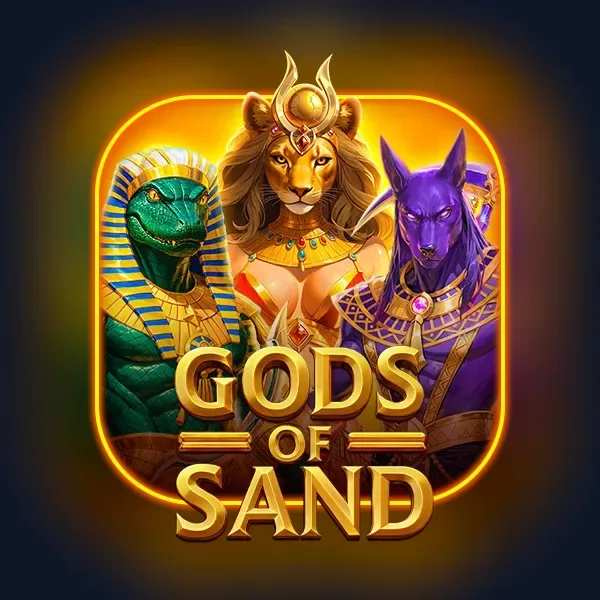
Gods of Sand ties its Egyptian setting to three gods who each lead a different Wild mode. Sobek attracts green Ancient Stones for expanding Wilds, Bastet draws red Stones for sticky Wilds, and Anubis uses purple Stones for multiplier Wilds. The Pile Collector connects those colors to ten Free Games, so the feature system has a readable structure even though the timing is random. This is a bonus-led slot: the central question is which god’s mode arrives, and how its Wild behavior changes the free-spin grid.
Gods of Sand at a glance
| Provider | Amigo Gaming |
|---|---|
| Genre / theme | Ancient Egypt |
| Game type | Video slot |
| Reels / grid | 5 reels x 3 rows |
| Volatility | High |
| Payout mechanic | 25 fixed paylines |
| Main features | The Pile Collector links green Sobek Stones to ten Expand Games, red Bastet Stones to ten Sticky Games, and purple Anubis Stones to ten Multi Games; each mode uses its named Wild behavior. |
RTP and stake limits can vary by version and market. Check the information screen in the game you open. Maximum win is a ceiling, not an expected result.
A 3×5 grid with a collector overhead
Amigo Gaming specifies five reels, three rows and 25 fixed paylines. Sobek, Bastet and Anubis attract Ancient Stones of different colors through the Pile Collector. Stones can gather toward a god and its feature may activate, but the announcement gives no numeric threshold or fixed collection sequence. The colored display is therefore not a predictable countdown. The short official description also omits a full paytable, so ordinary symbol values are not inferred.
Three Wild behaviors across ten Free Games
Each god’s mode grants ten Free Games with a distinct Wild type. Green Sobek Stones may start Expand Games, where Expanding Wilds help complete combinations. Red Bastet Stones may start Sticky Games, using Sticky Wilds; purple Anubis Stones may start Multi Games, where Multiplier Wilds raise winning combinations. Expansion changes Wild coverage, stickiness preserves Wilds within the feature, and multipliers affect wins. Exact multiplier values, Wild duration and overlap rules are not stated, so the modes are kept separate here.
Why the color mapping matters
The Pile Collector is a shared entry point, while color determines the mode. A matching Stone may activate its feature, but no guaranteed threshold is stated. Each mode’s ten spins provide a bounded session to see its Wild behavior. The public rules do not explain retriggers or how multiple Multiplier Wilds resolve, limiting any estimate of how one event changes another.
Configuration and limits of the listing
The listing reports high volatility, a 5×3 layout, 25 paylines and labels 3,500x as Multiplier. RTP is unstated, and the label is not verified as a maximum win. Three named modes do not imply frequent triggers or steady results. Colored Stones make the Wild effects distinct, but absent thresholds, exact multiplier values and a paytable, readers cannot estimate likely feature value from the public rules.
Strengths and weak points
Strengths
The color-coded Pile Collector links three gods to three meaningfully different Wild behaviors: expanding coverage, sticky persistence and multipliers. Each mode is described as ten Free Games, keeping the feature premise easy to follow.
Weaknesses
The public rules omit Stone thresholds, precise multiplier values, overlap and retrigger conditions, and RTP. High volatility makes the timing uncertain, while the feature summaries do not support a detailed value estimate.
Our Editor’s View
Gods of Sand makes the three-god theme functional by assigning each deity a particular Wild behavior. Expansion, persistence and multiplication are distinct ways to alter a ten-game feature, and the color-coded Pile Collector gives the player a coherent way to understand how those modes relate to the base game. The limitation is disclosure rather than complexity: the official material does not set out Stone thresholds, exact multiplier values, overlap rules or RTP. High volatility further means a tidy feature map should not be mistaken for regular access. Readers who enjoy comparing different Wild treatments may find the structure worthwhile; readers who want detailed mathematical rules before choosing a game will have to accept that the public description leaves several practical questions unanswered.
Related slot reviews
Lost
Shared theme: Ancient Egypt

Legend of the Nile
Shared theme: Ancient Egypt
Lost: Mystery Chests
Shared theme: Ancient Egypt