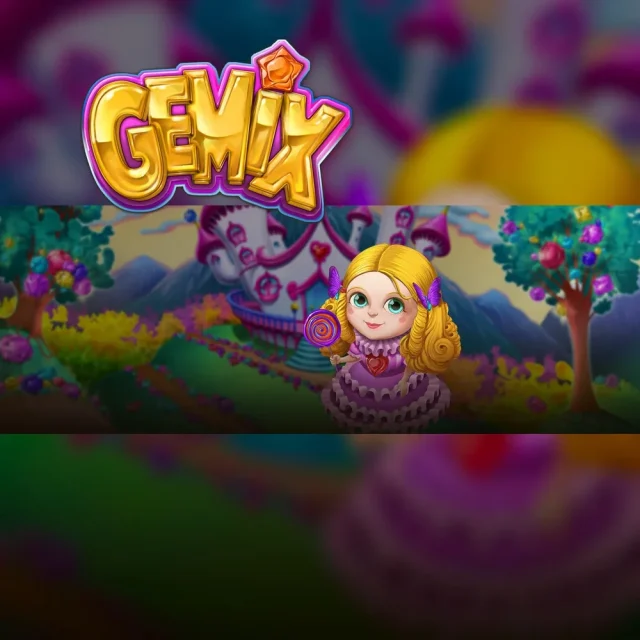
Gemix turns a seven-by-seven grid into a sequence of connected objectives. Clusters remove symbols and create cascades, those removals charge a crystal meter, and marked positions contribute to world patterns. The game is therefore easier to understand as several systems sharing the same cleared symbols than as a list of unrelated bonus names.
Gemix at a glance
| Provider | Play’n GO |
|---|---|
| Genre / theme | Fantasy |
| Game type | Video slot |
| Reels / grid | 7 x 7 |
| Payout mechanic | Cluster pays |
| Release date | 1 December 2014 |
| Main features | When Crystal Charge fills and the cascade sequence has ended, one of four effects changes the board. Chain Lightning links opposite corners and transforms symbols on its path; Light Beam affects a row and column; Crystal Warp changes all copies of a selected symbol; Nova Blast removes adjacent symbols before creating a matching core. If enough extra symbols are collected before activation, Super Charge multiplies the round’s accumulated and subsequent wins by three, and it can occur only once in that round. A second progression layer sits behind the symbols. Clearing all marked positions completes a pattern; three completed patterns move the game into another world and award a World Bonus. Each world has a different wild behaviour: falling Miner wilds, an edge-spreading Princess wild, or Wizard sticky wilds. These wild events appear on no |
RTP and stake limits can vary by version and market. Check the information screen in the game you open. Maximum win is a ceiling, not an expected result.
How Gemix sets up the base game
Five or more matching gems form a cluster when they touch horizontally or vertically. Winning symbols disappear and replacements fall into the spaces, allowing the round to continue until no further cluster forms. Every winning symbol contributes to Crystal Charge. A cascade is still part of the current paid round, not a new spin, and the falling replacements do not guarantee another cluster. The official page confirms the 7×7 grid and cluster model but does not publish an RTP, volatility label or maximum win in its public description.
The main feature rules
When Crystal Charge fills and the cascade sequence has ended, one of four effects changes the board. Chain Lightning links opposite corners and transforms symbols on its path; Light Beam affects a row and column; Crystal Warp changes all copies of a selected symbol; Nova Blast removes adjacent symbols before creating a matching core. If enough extra symbols are collected before activation, Super Charge multiplies the round’s accumulated and subsequent wins by three, and it can occur only once in that round.
How the mechanics interact
A second progression layer sits behind the symbols. Clearing all marked positions completes a pattern; three completed patterns move the game into another world and award a World Bonus. Each world has a different wild behaviour: falling Miner wilds, an edge-spreading Princess wild, or Wizard sticky wilds. These wild events appear on non-winning rounds, so they can restart activity rather than merely amplify a cluster already present. That division between charge, pattern and world explains why the same grid supports several kinds of progress.
Configuration, strengths and limitations
Play’n GO dates Gemix to 1 December 2014 and labels it a Fantasy and Jewels grid slot. Configuration figures absent from the official public page remain unknown here. The design’s strength is the way one cluster can advance both the immediate cascade and longer pattern objectives. Its limitation is cognitive load: a reader must distinguish the Crystal Charge effect from World Wilds and the World Bonus. Reactoonz and its Gargantoon charge offers a useful same-provider comparison with a different destination for cluster progress.
Gemix remains distinctive because the board is doing more than paying clusters. Removed gems feed a meter, marked spaces track patterns and the current world determines the wild intervention. The relationships are coherent once each layer is identified, but the game is less immediate than a simple line slot. Its strongest quality is that visual progress has a mechanical purpose; its main drawback is the number of simultaneous objectives a newcomer must learn. Exact return and limit figures should come from the active game rules rather than an unrelated reference page.
Strengths
Play’n GO dates Gemix to 1 December 2014 and labels it a Fantasy and Jewels grid slot Configuration figures absent from the official public page remain unknown here The design’s strength is the way one cluster can advance both the immediate cascade and longer pattern objectives Its limitation is cognitive load a reader must distinguish the Crystal Charge effect from World Wilds…
Weaknesses
Gemix remains distinctive because the board is doing more than paying clusters Removed gems feed a meter marked spaces track patterns and the current world determines the wild intervention The relationships are coherent once each layer is identified but the game is less immediate than a simple line slot Its strongest quality is that visual progress has a mechanical purpose its main…
Our Editor’s View
Gemix remains distinctive because the board is doing more than paying clusters Removed gems feed a meter marked spaces track patterns and the current world determines the wild intervention The relationships are coherent once each layer is identified but the game is less immediate than a simple line slot Its strongest quality is that visual progress has a mechanical purpose its main drawback is the number of simultaneous objectives a newcomer must learn Exact return and limit figures should come from the active game rules rather than an unrelated reference page