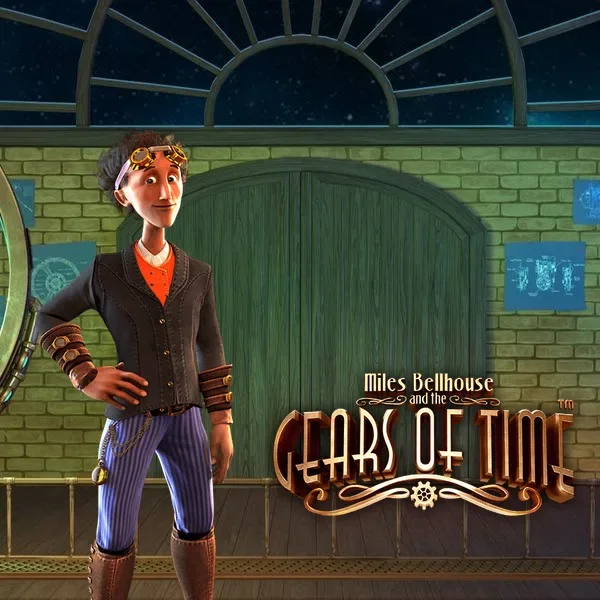
Gears of Time gives its 5×5 cluster game a temporal layer: five random positions are watched during each spin, and cascades covering them raise the chance of a Time Traveling event. That event can look backward, alter the present result or change the next respin. The three outcomes do not do the same job, which gives the feature a useful internal logic. The challenge is that the official summary describes their effects but leaves some probabilities and the free-spin award count unspecified.
Gears of Time at a glance
| Provider | Betsoft |
|---|---|
| Genre / theme | Space & Sci-Fi |
| Game type | Video slot |
| Reels / grid | 5×5 grid |
| Reference RTP | 96.98% |
| Volatility | Medium |
| Payout mechanic | Cluster payouts |
| Release date | 5 November 2020 |
| Main features | Five random positions are tracked; cascade coverage raises the chance of a time event. Past replays the last spin, Present multiplies initial-spin wins by 2×–20×, and Future boosts a chosen symbol for a free respin. |
RTP and stake limits can vary by version and market. Check the information screen in the game you open. Maximum win is a ceiling, not an expected result.
Clusters and tracked positions
The game uses a five-by-five grid and cluster payouts, rather than a listed line count. Betsoft says five positions are selected at random and tracked for each spin. When winning cascades cover those positions, the chance of a Time Traveling event increases. The wording links coverage to an increased chance; it does not establish a guaranteed trigger, nor does it disclose the probability curve or explain whether all five positions must be covered. Those details should not be filled in by assuming that each covered cell contributes an equal increment.
The time mechanic responds to the cluster sequence rather than a named symbol landing. Cascades can alter the board and cover watched cells, adding a second layer to the match-and-clear structure. The source gives no full cascade sequence, symbol values or event frequency.
Three different time effects
Past replays the last spin. Present applies a random multiplier from 2× to 20× to wins from the initial spin. Future boosts the presence of one chosen symbol on a free respin. These are materially different interventions: Past repeats a prior result, Present modifies qualifying initial-spin wins, and Future changes symbol representation before another result. The explicit scope of Present is important; the description attaches its multiplier to initial-spin wins, so it should not be casually applied to every later cascade or replay.
Present has a stated random range, while Future gives no numerical boost amount. Past uses the last spin, but the summary does not say whether a replay can trigger time again. Free spins offer a Past, Present or Future emphasis without stating the award count, persistence or retrigger rules.
Configuration and fit
Gears of Time is dated November 5, 2020. The listed configuration is 96.98% RTP, Medium volatility, a 19.89% hit rate and a 5×5 grid with cluster payouts. The official page does not state a maximum win. It also does not give event odds, tracked-position probabilities, the Future boost amount, detailed paytable values or the free-spin count. RTP and hit rate are configuration descriptors, not predictions for a given session, and neither supplies the missing odds for the Time Traveling events.
Past, Present and Future make distinct rule changes rather than cosmetic multiplier variants. The trade-off is that cascade coverage raises event chance without a stated amount. The structure is readable, but exact bonus counts and trigger probabilities remain unavailable.
Strengths and weak points
Strengths
Tracked grid positions connect cascade outcomes to feature chance, while Past, Present and Future produce clearly differentiated replay, multiplier and respin effects.
Weaknesses
The event probability, free-spin count, Future boost amount and maximum win are not supplied, limiting comparisons of feature frequency and total prize scale.
Our Editor’s View
Gears of Time joins cluster clears to five positions whose coverage raises the chance of a time event, then gives that event three distinct possible roles. Replaying the prior spin, multiplying initial-spin wins and boosting a chosen symbol for a respin are meaningfully different outcomes. The free-spin choice preserves that three-way distinction, although its award count and several probabilities are not stated. The result is a game with an intelligible concept and incomplete quantitative detail: its cause-and-effect is clearer than its frequency or overall prize scale. Its conditional trigger is more informative than a bare feature label, but remains unquantified.
Related slot reviews
Arrival
Shared theme: Space & Sci-Fi

The Curious Machine
Shared theme: Space & Sci-Fi

Event Horizon
Shared theme: Space & Sci-Fi