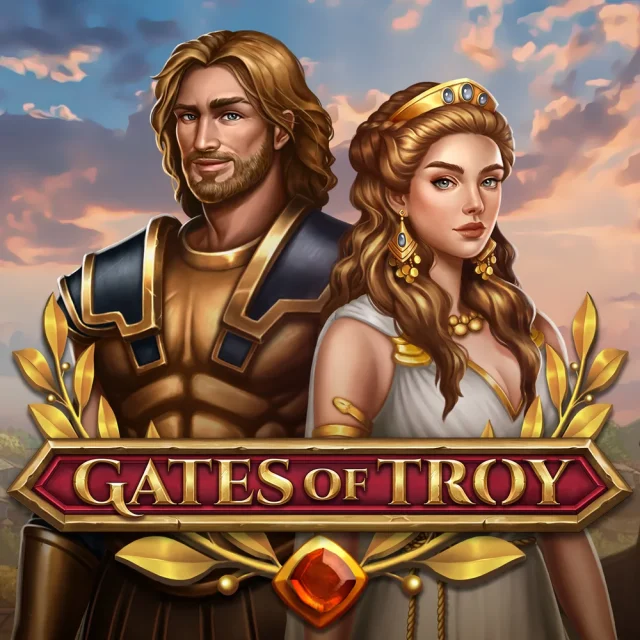
Gates of Troy builds its siege around Free Spins triggered by three Scatters. During the bonus, landed Wilds receive a fiery frame and return to the reels, while the Trojan Horse displays how many spins remain.
Gates of Troy at a glance
| Provider | Play’n GO |
|---|---|
| Genre / theme | Greek Mythology |
| Game type | Video slot |
| Reels / grid | 5 x 4 |
| Reference RTP | 96.2% |
| Volatility | 6/10 |
| Payout mechanic | 30 paylines |
| Maximum win | 3000x the bet |
| Release date | 15 September 2022 |
| Main features | Gates of Troy is a classic slot with recognisable characters and innovative features built around the game’s narrative. During the game, the player focuses on getting inside the gates to the Free Spins by landing three Scatters. During the Free Spins, Wilds that land are highlighted with a fiery frame and are added back to the reels at the end of the reels upping the potential. The number of Free Spins is tracked by the Trojan Horse at the top of the reels. For Gates of Troy, the checked rules leave the next outcome independent after the main trigger. A visible setup can therefore continue, improve or end without guaranteeing a higher return. The practical boundary in Gates of Troy is the end of its named feature state. Once that state closes, retained values and temporary modifiers no longer describe the following base-game result. |
RTP and stake limits can vary by version and market. Check the information screen in the game you open. Maximum win is a ceiling, not an expected result.
What the regular game asks you to read
Gates of Troy is a 5×4, 30-payline siege whose Free Spins require three Scatters. In practical terms, the regular result should be read from the documented layout and win model before any special animation is given extra meaning. Wilds landing in Free Spins are framed and returned to the reels, while the Trojan Horse tracks the remaining spins This is a useful starting point because it separates an observed game rule from an attractive but non-binding display.
The documented feature route
Free Spins begin with three Scatters, then the Wild-return rule gives later spins their connection to earlier ones. A Wild that lands is highlighted with a fiery frame and added back to the reels. The Trojan Horse displays the remaining spin count alongside that process. Returning Wilds enrich what can appear during the round; they should not be confused with a guarantee that every later screen will pay.
Where the mechanic can stop or change direction
The return rule is the central carry-over: it can build a richer board, but only after a Wild has first landed and before the tracked spins run out. That limitation is not a defect in the description; it is the part of the structure that keeps the feature from being read as a promise. A reader can follow the state on screen, but the next qualifying symbol, cascade, wheel result or re-spin still has to occur.
Recorded configuration for this version
The saved reference for the standard Gates of Troy release lists 96.2% RTP, 6/10 volatility, 5 x 4, 30 paylines, and a maximum win of 3000x. It records the release date as 2022-09-15. These are configuration facts, not estimates of a session; the live help panel remains the sensible check where an operator offers alternative settings.
Strengths and weak points
Strengths
Returning landed Wilds gives later bonus spins a connection to earlier ones, and the Trojan Horse counter keeps the round’s remaining opportunities visible alongside that development.
Weaknesses
The return rule first requires Wilds to land. A short or unproductive round may offer little useful buildup before the remaining spin counter runs out.
Our Editor’s View
Gates of Troy’s strongest idea is the relationship between returning Wilds and a finite bonus counter. The board can become more promising as Wilds enter the feature, but the displayed time remaining puts a limit on that development. Readers who like bonuses that visibly change during play have something concrete to follow here. The important evidence is the Wilds actually returned and the results they support, not the expectation that every round will build equally. Related review: Rise of Olympus 100.
Related slot reviews
Medusa’s Madness
Shared theme: Greek Mythology
Rise of Athena
Shared theme: Greek Mythology
Athena Ascending
Shared theme: Greek Mythology