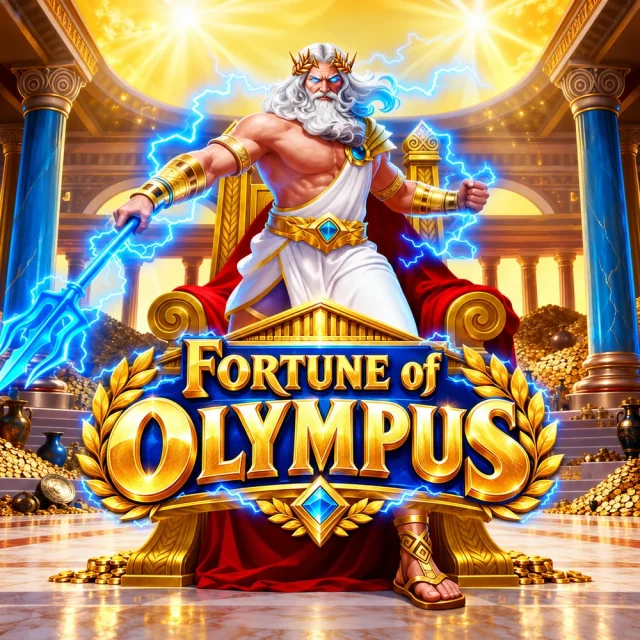
Fortune of Olympus moves Zeus from a 6×5 pays-anywhere layout to a 7×7 cluster grid. Five or more matching symbols must connect horizontally or vertically, after which the winning cluster disappears and new symbols drop into its spaces.
Fortune of Olympus at a glance
| Provider | Pragmatic Play |
|---|---|
| Genre / theme | Greek Mythology |
| Game type | Video slot |
| Reels / grid | 7×7 |
| Reference RTP | 96.55% |
| Volatility | High |
| Payout mechanic | Cluster pays; 5+ orthogonally connected symbols |
| Maximum win | 10,000x the bet |
| Release date | 15 December 2025 |
| Main features | Tumbles; multiplier symbols up to 500x; 15–30 free spins; persistent free-spin multiplier total |
RTP and stake limits can vary by version and market. Check the information screen in the game you open. Maximum win is a ceiling, not an expected result.
Multipliers at the end of a tumble
Multiplier symbols can arrive with values up to 500x. When several are present during a tumbling sequence, their values combine and apply to the final eligible win. A multiplier symbol is therefore part of the settlement of a sequence, not a separate guaranteed prize merely for landing.
Four to seven scatters award 15, 20, 25 or 30 free spins. In the feature, each multiplier that appears is added to a persistent total used on wins across the round. That is the major change from a temporary tumble total: early multiplier symbols can remain relevant to later free spins.
The published campaign lists a 96.55% reference RTP, high volatility and a 10,000x maximum. Special bets can alter feature access or guaranteed multiplier conditions in selected markets, so their costs and RTP must be read in the active version.
Despite the shared Olympus setting, the grid and feature should not be read as identical to Gates of Olympus. Comparing the two makes the role of Fortune’s persistent bonus total easier to separate from the theme.
The larger cluster board gives Fortune of Olympus its own identity within the Zeus series. Its strength is the visible persistence of the bonus multiplier; its constraint is that the base game does not bank the same progress. A familiar character should not obscure that structural difference.
A cluster system asks readers to look for connections rather than reel-line paths. Five matching symbols have to touch horizontally or vertically, so a board can display many copies of one symbol without making a single qualifying cluster. The tumble then removes a winning group and lets new symbols occupy its cells. Multipliers are considered in that settlement sequence; their printed size alone is not a separate result. This makes the exact arrangement of the 7×7 board as important as its larger number of positions.
The free-spin total changes that emphasis. Once a multiplier contributes to the persistent feature value, later eligible wins can benefit from progress established earlier in the round. A 15-spin opening and a 30-spin opening provide different periods in which such progress might matter, but neither guarantees a useful cluster or a particular multiplier. Special-bet options should also be treated as separate paid configurations, not as ordinary rules of every spin. Fortune of Olympus is most clearly understood through that division between temporary base tumbles and the bonus’s carried total. The number on the meter still needs a later paying cluster to matter.
Strengths
The 7×7 cluster layout gives Fortune of Olympus a distinct structure, and multiplier symbols collected during free spins add to a persistent total. Early bonus multipliers can therefore influence eligible wins on later spins in the same round.
Weaknesses
Base-game tumbles do not bank the same multiplier progress, and a multiplier symbol does not pay independently just for landing. Special bets can also change cost or feature access by market, so one configuration should not be treated as universal.
Our Editor’s View
Fortune of Olympus is more than a Zeus reskin: its connected clusters and persistent free-spin total change how progress is read. The benefit is a bonus with visible accumulation; the limit is that this persistence belongs to the feature, not ordinary play.
Related slot reviews

Gods Gone Wild
Shared theme: Greek Mythology
Pots of Power: Zeus
Shared theme: Greek Mythology

Cupid
Shared theme: Greek Mythology