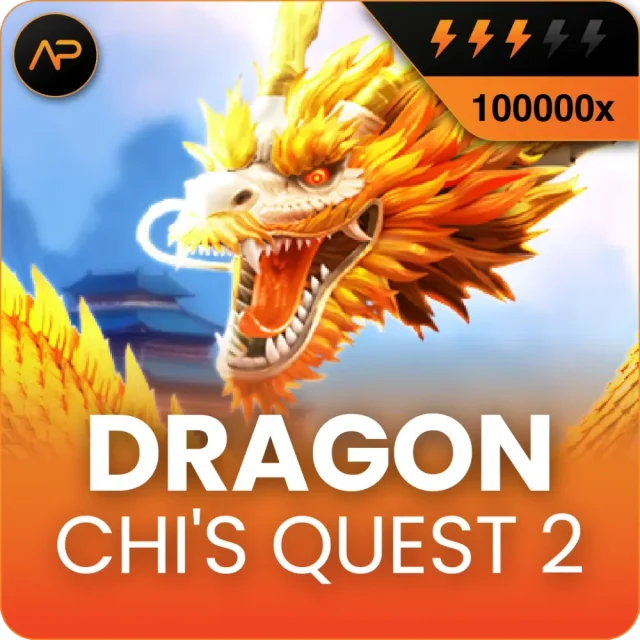
Dragon Chi’s Quest 2 makes the pairing of two symbols its defining idea. A Dragon Head alongside a Lotus can turn the Lotus into an instant reward, while the Lotus may instead blossom into a Tai-Chi symbol and open a Bonus Game. Add a Mighty Dragon Head to that Tai-Chi symbol and the route upgrades to the Power Bonus Game. That tiered relationship gives the 3×5 slot a clear central question: which dragon-and-lotus combination has appeared?
Dragon Chi’s Quest 2 at a glance
| Provider | AdvantPlay |
|---|---|
| Genre / theme | Asian, Fantasy |
| Game type | Video slot |
| Reels / grid | 5 reels x 3 rows |
| Reference RTP | 97.01% |
| Volatility | Medium |
| Payout mechanic | 25 paylines |
| Maximum win | 100,000x the bet |
| Release date | 30 January 2026 |
| Main features | Dragon Head and Lotus together reveal instant rewards; Lotus may become Tai-Chi and trigger Bonus Game; Tai-Chi with Mighty Dragon Head triggers Power Bonus Game. |
RTP and stake limits can vary by version and market. Check the information screen in the game you open. Maximum win is a ceiling, not an expected result.
A compact fixed-line base game
The official description specifies three rows, five reels and 25 paylines. This is a fixed-line format, not a cluster or ways game. Its theme places a dragon, lotus and Tai-Chi imagery at the center of play, but the available rules do not give symbol values, line direction, Wild behavior or the detailed paytable. Readers should therefore treat the 25 lines as the stated base structure, rather than assume how any particular symbol combination pays. The review can explain the feature relationships with confidence; it cannot reconstruct the full ordinary-spin mathematics from the published description.
The Lotus creates two possible outcomes
The official rule description says a Dragon Head and Lotus must appear together for the Lotus to reveal instant rewards. The Lotus can also blossom into a Tai-Chi symbol, which triggers the Bonus Game. A separate combination matters inside that feature logic: when a Tai-Chi symbol appears alongside a Mighty Dragon Head, the game enters the enhanced Power Bonus Game. The announcement does not state exact positions, symbol counts, or whether the first pair guarantees a reward before any transformation, so those specifics remain open. What is documented is a hierarchy: a symbol pairing can produce a direct prize, a Tai-Chi symbol can start the standard bonus, and the Mighty Dragon Head can mark the more powerful version.
This makes the game’s feature story more legible than a list of unrelated bonus names. Players can watch for the Dragon Head and Lotus relationship, then distinguish the appearance of Tai-Chi from the stronger Mighty Dragon Head combination. However, the source does not explain what happens after either bonus begins: no pick sequence, spin count, multiplier rule, prize collection method or ending condition is provided. The trigger logic is known; the round-by-round play is not.
What the listed configuration tells us
AdvantPlay lists Dragon Chi’s Quest 2 at 97.01% RTP, medium volatility, 25 lines and a 100,000x maximum win, released January 30, 2026. These figures are for this sequel, not another series entry. The maximum is a ceiling; medium volatility does not disclose Lotus-pairing frequency or award distribution. RTP configuration may vary by operator, so check the local paytable.
A feature hierarchy with missing steps
Dragon Chi’s Quest 2 offers a useful distinction between its normal Bonus Game and the upgraded Power Bonus Game. The trigger language gives the two modes a relationship instead of presenting them as interchangeable labels. Yet the central uncertainty is substantial: once a bonus starts, a reader cannot tell from the available rules how it plays or what determines its finish. The game may suit someone who enjoys spotting symbol combinations and understanding feature tiers, while players who want a fully explained bonus before choosing may find this description incomplete. The unusually high stated ceiling sits alongside that lack of detail; it should be read as a specification, not a prediction.
Strengths and weak points
Strengths
The Lotus and Dragon Head pairing gives the game an identifiable feature path, while the Tai-Chi and Mighty Dragon Head combinations distinguish the standard bonus from its enhanced tier.
Weaknesses
The available rules stop at the bonus triggers: they do not explain round length, prize resolution, multipliers or the ending condition, leaving the main feature difficult to evaluate step by step.
Our Editor’s View
The strongest part of Dragon Chi’s Quest 2 is its compact trigger ladder. Dragon Head plus Lotus can reveal a reward; a Tai-Chi symbol opens the Bonus Game; adding the Mighty Dragon Head changes the destination to Power Bonus. That gives the theme a mechanical role and makes the symbols worth distinguishing. The limitation is that the published explanation stops as the bonus begins. It does not show the player what decisions, spins or counters follow, so the most important part of the experience remains hard to assess in advance. Medium volatility and the listed 100,000x maximum do not fill that gap. This is a better fit for readers drawn to symbol-triggered feature tiers than for anyone seeking fully documented bonus rules or a predictable session profile.
Related slot reviews
Enchanted
Shared theme: Fantasy
Once Upon A Time
Shared theme: Fantasy
Genie’s Fortune
Shared theme: Fantasy