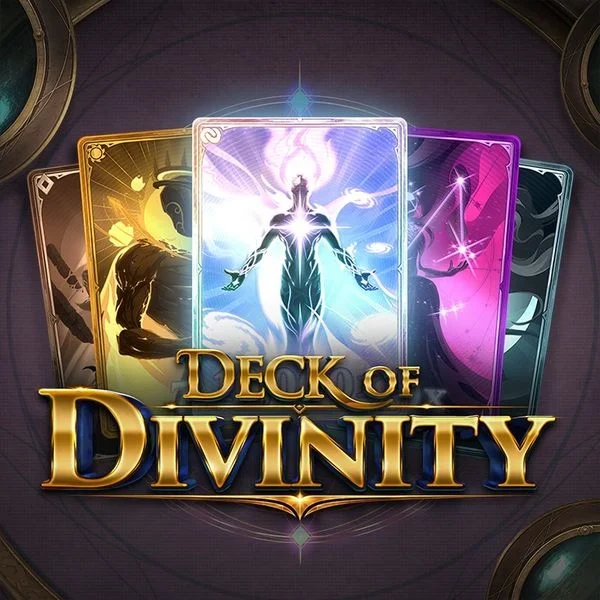
Deck of Divinity puts visible prize cards beneath a cluster-and-cascade game. Five or more matching Symbol Cards anywhere on its 5×4 board produce a win; winning cards are swept away and replacements fall, allowing a cascade to continue. Prize Cards sit beneath symbols and show their value before they are revealed. In the Divine Deck Bonus, the collection itself changes: prizes can upgrade and return to the deck, while progress unlocks packs with higher-value cards. The central appeal is being able to see a prize hierarchy and then watch the deck evolve.
Deck of Divinity at a glance
| Provider | Print Studios |
|---|---|
| Genre / theme | Fantasy |
| Game type | Video slot |
| Reels / grid | 5×4 |
| Reference RTP | 96.22% |
| Volatility | 9 out of 10 |
| Maximum win | 20,000x the bet |
| Release date | 25 August 2026 |
| Main features | 5+ matching Symbol Cards anywhere cascade; 25 Prize Cards across five energies and tiers can stack three deep; 3+ Bonus Cards award up to 10 Free Spins, where won cards upgrade, progress unlocks packs and hidden prizes remain in the deck. |
RTP and stake limits can vary by version and market. Check the information screen in the game you open. Maximum win is a ceiling, not an expected result.
Clusters reveal a layered prize deck
The source describes 25 unique Prize Cards arranged across five divine energies and five tiers. Each card displays its value, and the top-tier cards can award up to 10,000×. Prize Cards can stack as many as three deep beneath a Symbol Card; once uncovered, they immediately award the displayed value. This creates a layered prize position: a symbol match can expose a stack rather than a single hidden amount. The page does not describe the order in which multiple stacked prizes resolve during a cascade, so the review does not assume a particular sequence. For another cluster game where wins lead to changes on the grid, see Midnight Marauder ClusterBreaker.
The base game uses a cluster condition, not paylines: five or more matching Symbol Cards anywhere on the board trigger a win. Winning cards are removed, then new cards fall into the vacant spaces. A new match can therefore continue the same cascade sequence. The prize layer sits underneath this symbol-matching cycle, giving a win two kinds of relevance: it resolves the cluster and may uncover one or more visible-value Prize Cards. The rules explain that revealed cards pay immediately, but do not give a cascade limit or say how often a particular tier appears.
How the Divine Deck changes in Free Spins
Three or more Bonus Cards award up to ten Free Spins. Prize Cards remain in the deck for the entire bonus. Whenever one is won, it upgrades before returning, so a later reveal may draw on a more valuable version of that card. Separately, every winning Symbol Card fills a progress meter. Reaching a new level unlocks a Card Pack, adds Prize Cards of higher value to the deck and awards extra spins. Those mechanics connect base cluster wins inside the bonus to both card value and bonus duration.
Hidden Prize Cards add another way for the deck to grow. They are placed beneath Symbol Cards before each spin; when revealed, they turn into regular Prize Cards and remain permanent additions to the deck. If five Bonus Cards land, the entire grid is filled with Hidden Prize Cards on every spin. That condition intensifies the addition mechanic, but the source does not explain the exact placement distribution or whether a full grid removes other symbol behavior. The overall loop is supported: win, upgrade or add cards, and continue with a changing deck.
Configuration and limits
The listed standard RTP is 96.22%, volatility is 9 out of 10, and maximum win is 20,000×. The source gives an August 25, 2026 release date and a 5×4 grid. It separately says top-tier Prize Cards can award up to 10,000×; that card-level figure is not the same as the full-game maximum. Keeping the two claims separate avoids treating one prize tier as the overall cap. The page also lists a separate bonus-buy RTP, which is not substituted for the standard RTP.
The rules explain how the deck changes but not its exact growth pace. They do not state individual upgrade increments, pack composition, Bonus Card count-to-spin mapping beyond “up to ten,” or the odds of uncovering a particular prize. Those omissions limit how precisely one can compare expected bonus trajectories. A high volatility label is not a frequency table, and a maximum payout is a ceiling rather than a typical result. The strongest reading is structural: the deck persists, cards can upgrade, and progress adds higher-value cards and spins.
Strengths and weak points
Strengths
5+ matching Symbol Cards anywhere cascade; 25 Prize Cards across five energies and tiers can stack three deep; 3+ Bonus Cards award up to 10 Free Spins, where won cards upgrade, progress unlocks packs and hidden prizes remain in the deck.
Weaknesses
Prize Cards upgrade after wins, but the source does not state the meter thresholds or upgrade amounts, so the pace of deck improvement cannot be calculated.
Our Editor’s View
Deck of Divinity makes its prize system unusually legible by displaying card values and by explaining how the bonus deck persists, upgrades and expands. Cluster wins and cascades give ordinary play a clear trigger for uncovering cards, while the progress meter connects winning symbols to packs and extra spins. That is a coherent bridge between base-game outcomes and bonus development. Its limitation is that the numerical pace remains unknown: card upgrade increments, pack contents and prize odds are not detailed. Players who like tracking a changing collection of visible prizes may find the structure satisfying to follow; those who want exact probabilities or a fully specified bonus timetable will need more information than the source provides.