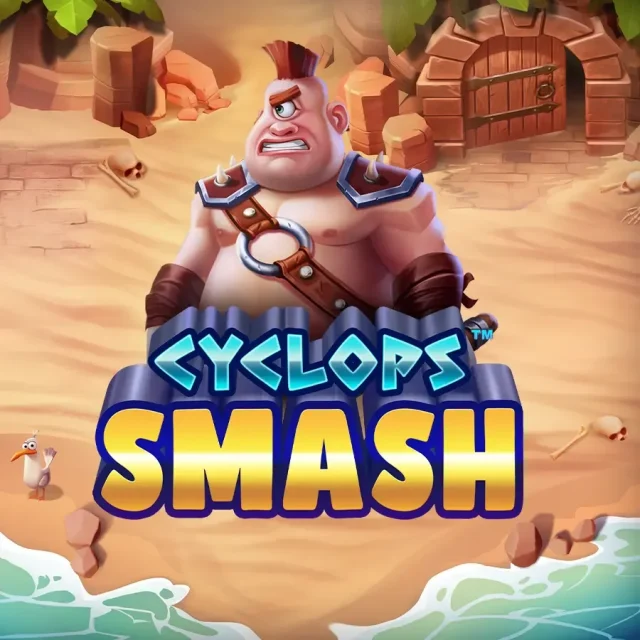
Cyclops Smash uses a 7×7 Cluster Pays board where a win changes the arrangement for another evaluation. Five or more adjacent matching symbols form a paying cluster, then tumble away as replacements fall into the open spaces. A separate random Smash feature rearranges selected symbols, affecting the board’s geography before settlement. This makes position central to the game: tumbling creates new symbol groupings after a win, while Smash can alter selected locations without itself guaranteeing a payout.
Cyclops Smash Review: Clusters, Tumbles and the Smash Feature at a glance
| Provider | Pragmatic Play |
|---|---|
| Genre / theme | Fantasy |
| Game type | Video slot |
| Reels / grid | 7 x 7 |
| Reference RTP | 96.05% |
| Volatility | High |
| Payout mechanic | Cluster Pays |
| Maximum win | 10,000x the bet |
| Release date | 4 September 2023 |
| Main features | Clusters of five or more pay on a 7×7 grid. Winning symbols tumble away, while the random Smash feature rearranges selected symbols; four scatters trigger free spins. |
RTP and stake limits can vary by version and market. Check the information screen in the game you open. Maximum win is a ceiling, not an expected result.
Clusters clear space for new results
Five or more matching adjacent symbols make a paying cluster. Once those symbols settle, they leave the 7×7 grid and replacements fall into the cleared spaces. One paid spin can therefore produce successive evaluations as the board changes. The cluster condition depends on adjacency, not merely on having the same icon somewhere on the large screen. A wide grid offers room for groups, but it does not mean every repeated symbol contributes to one win.
The tumble sequence gives a win a direct consequence for the next board state: the winning symbols are removed and replacements occupy their positions. If those replacements form another qualifying cluster, another result can follow. The saved rules do not give symbol awards, so the value of a particular cluster cannot be calculated from size alone. Nor do they establish how often long sequences occur. The mechanic supports an explanation of how the board evolves, not a prediction of cascade length.
Smash changes placement, not prize value
The random Smash feature rearranges selected symbols. Its documented effect is spatial: a move can bring matching symbols together, enlarge a potential cluster, or separate symbols that might otherwise connect. Smash is not described as a multiplier, a guaranteed removal or a win by itself. Its importance is that it changes the arrangement on which the cluster rule operates. A rearrangement can create a useful pattern, but it can also end without five adjacent matching symbols.
Four scatters trigger free spins. The number awarded, whether they can retrigger and whether Smash behaves differently during the feature are not specified. The evidence confirms the entry condition but not a special bonus sequence beyond that. It would be unsupported to transfer a multiplier, persistent meter or other feature rule from a similarly named grid game. Free spins are a distinct phase, but the available description does not define its detailed settlement.
A broad grid with a high-variance profile
The 4 September 2023 provider version records 96.05% RTP, high volatility and a 10,000x maximum. Bet limits and individual cluster awards are not listed. High volatility describes the saved profile but does not reveal the probability of a Smash event, a long tumble sequence or a result near the maximum. Likewise, the 7×7 size gives the board’s dimensions, not the frequency of qualifying groups.
The appeal is a close connection between the feature and the basic win condition. Both tumbling and Smash act on symbol geography, so the reader can follow how positions change relative to the five-symbol adjacency requirement. The limitation is the random nature of rearrangement and the lack of free-spin details. The board may be altered without producing a cluster, and the source supplies no basis for claiming that Smash reliably improves a result.
Putting the features together
Cyclops Smash is a game about changing cluster geography. Winning groups clear from the broad grid and replacements fall into their spaces; the random Smash feature can rearrange selected symbols before another evaluation. That pairing makes board position matter throughout play, while preserving a clear distinction between movement and payment. Four scatters start free spins, but their allocation and retrigger rules remain unknown. The recorded high volatility and 10,000x ceiling frame the 2023 version without explaining how often useful rearrangements or extended tumble sequences occur.
Strengths
The 7×7 board gives tumbling and Smash meaningful spatial roles, while the five-adjacent-symbol threshold keeps the cluster condition explicit and trackable.
Weaknesses
Smash rearrangements do not guarantee a cluster, and free-spin allocation, retriggers, symbol awards and event frequencies remain undocumented.
Our Editor’s View
Cyclops Smash makes the board itself the main event: winning clusters clear space, replacements fall, and Smash can change which symbols sit beside each other. That creates a coherent link between the intervention and the cluster rule. The limitation is that spatial change is only an opportunity; it does not promise a qualifying group. With the free-spin details and symbol awards missing, the best-supported reading stays focused on board evolution rather than imagined bonus outcomes.