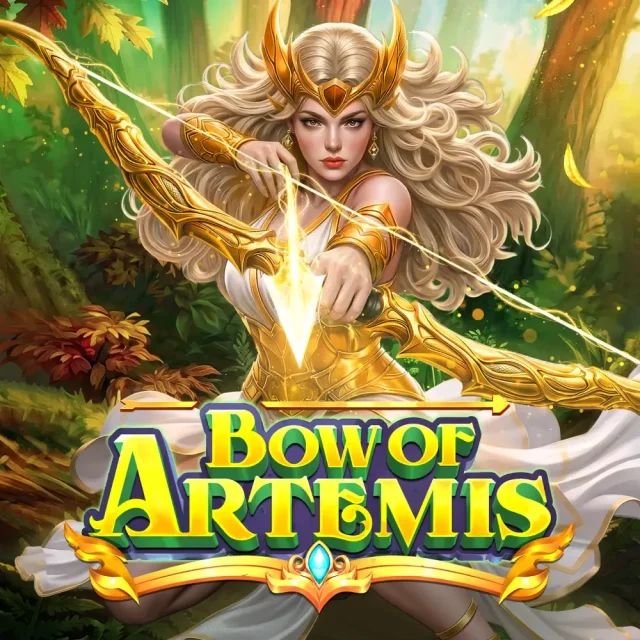
Bow of Artemis fills an 8×8 field with animal symbols and asks for connected groups of five or more. Winning clusters tumble away, but the coloured spots behind some cells make particular wins more consequential: a marked winning position can activate a board modifier. Removed winning symbols also feed a feature meter. That link between location, tumbling and progression gives the game its character, although the provider’s public accounts disagree on some feature labels and numbers.
Bow of Artemis at a glance
| Provider | Pragmatic Play |
|---|---|
| Genre / theme | Greek Mythology |
| Game type | Video slot |
| Reels / grid | 8 x 8 |
| Reference RTP | 96.05% |
| Volatility | Medium |
| Payout mechanic | Cluster Pays |
| Maximum win | 10000x the bet |
| Release date | 29 July 2024 |
| Main features | Clusters of five tumble away. Marked cells may create wilds, colossal symbols or a fresh board. The filled meter opens Hunt level one at 1x–5x, and progress through five levels raises the total multiplier. |
RTP and stake limits can vary by version and market. Check the information screen in the game you open. Maximum win is a ceiling, not an expected result.
Why the winning position matters
A cluster requires at least five matching symbols connected on the grid. Wilds can help complete one. When a cluster pays, its winning symbols are removed and new ones can fall into place; a further cluster may then form in the same spin sequence. A coloured marked spot matters only when it participates in a winning combination. Merely seeing a mark behind an idle symbol is not the same as activating its modifier.
The provider describes several possible modifiers after marked wins, including changing symbols into wilds, bringing in colossal symbols and refreshing the board with new icons. The exact result depends on which marked position was included in the win. This makes a tumble more than a replacement animation: the new layout may produce another cluster and may also bring a marked cell into play. It does not follow that every tumble will activate a modifier.
A meter built from winning symbols
The launch description says winning symbols removed during tumbles are counted toward a meter that opens The Hunt. It describes five levels and multipliers that can rise as more symbols are collected. The current official game page likewise links collected winning symbols to a multi-level feature, but calls it Gold Fever and gives a different starting threshold and multiplier scale. The two accounts agree on the broad cause and effect: paid tumbles supply progress, and higher feature levels change the multiplier applied to wins.
Because the published descriptions conflict, it would be misleading to present one exact level table as settled for every playable version. The useful way to read the mechanic is to follow whether a cluster paid, how many winning symbols were removed and whether the meter advanced. A large visible group can contribute more symbols than a minimal five-symbol cluster, yet it still needs to qualify and tumble. The actual in-game rules should settle the thresholds for the version on screen.
Scope of the specification
Pragmatic Play’s launch announcement gives a 10,000x top win. The site’s inventory records a 96.05% RTP and Medium volatility, which the accessible official descriptions do not independently show. None of those figures supplies the probability of hitting a marked-cell modifier or reaching a later meter level.
The game’s strongest idea is the connection between the position of a cluster and a second effect. A win can clear symbols, expose a fresh board, trigger a modifier and feed the meter. Its limitation is that those steps are conditional; an isolated marked cell or unconnected symbols cannot start the chain. The source conflict adds a practical reason to inspect the active game’s help screen before relying on precise level numbers.
Strengths and weak points
Strengths
Marked winning positions make cluster location meaningful, while tumbling symbols provide a visible path into meter progress. The modifier layer can change the board within the same winning sequence.
Weaknesses
The chain requires qualifying clusters at the right marked cells. Official descriptions disagree on the feature name and multiplier progression, so precise thresholds cannot be treated as universal.
Our Editor’s View
Our Editor’s View: Bow of Artemis is most coherent as a game about the consequences of a cluster. The first payment removes symbols; a marked position may reshape the grid; the removed symbols contribute to a longer feature track. That sequence is richer than a simple eight-by-eight cluster count, but its outcomes remain conditional on where wins occur. The conflicting official level descriptions prevent a dependable numerical walkthrough from the public material alone. Readers should value the board interaction and verify the current version’s meter table in its rules.
Related slot reviews

Gods Gone Wild
Shared theme: Greek Mythology
Pots of Power: Zeus
Shared theme: Greek Mythology

Cupid
Shared theme: Greek Mythology