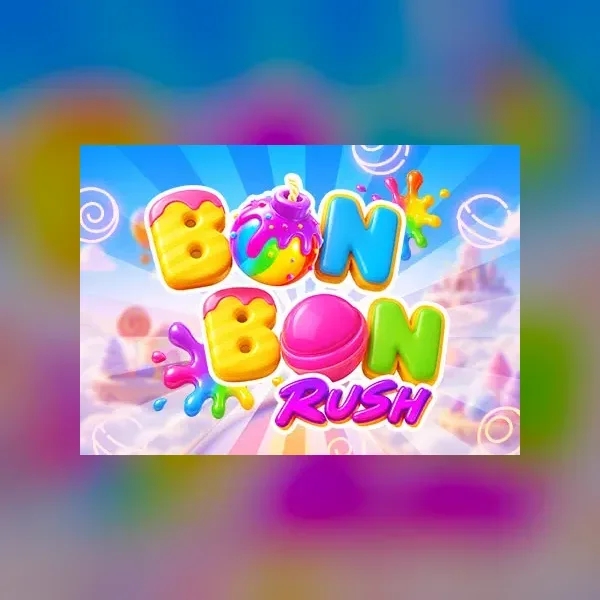
Bon Bon Rush gives its candy theme a mechanical counterpart in the Sugar Bomb. On a 6×6 grid, the bomb detonates across random cells and turns ordinary treats into a guaranteed chain reaction of winning combinations. Those wins then feed Avalanche Reels: winning symbols disappear and new symbols tumble in, allowing further cascades. The design is built around a sequence rather than a single static arrangement. PopOK’s page explains this central interaction but says little about bonus entry, Scatter rules or the exact scoring thresholds.
Bon Bon Rush at a glance
| Provider | PopOK Gaming |
|---|---|
| Genre / theme | Candy |
| Game type | Video slot |
| Reels / grid | 6 reels, 6 rows |
| Reference RTP | 96.88% |
| Volatility | High |
| Maximum win | x15,000 the bet |
| Main features | 6×6 grid; Sugar Bomb transforms random cells to start winning combinations; Avalanche Reels remove winners and refill for further cascades; page also lists Scatters, Free Spins, Multipliers and Buy feature. |
RTP and stake limits can vary by version and market. Check the information screen in the game you open. Maximum win is a ceiling, not an expected result.
A six-by-six board built for chain reactions
Bon Bon Rush uses a 6×6 grid, which gives each spin a broad field of symbols. The provider describes continuous tumbling cascades: after winning symbols are removed, new symbols fall into the open spaces. Each cascade can fuel another payout. This makes a spin a sequence of board states rather than one final arrangement. The page does not specify a pay-anywhere threshold, paylines, minimum matching cluster, or how symbol groups are evaluated. Those rules should not be guessed from the grid size or from the phrase “winning combinations.” The important confirmed behavior is that winning symbols clear and replacement symbols can support subsequent cascades.
The Sugar Bomb introduces a more dramatic change. When it hits the reels, a fuse burns and the bomb detonates across random cells, transforming ordinary treats into what the page calls a guaranteed chain reaction of winning combinations. This is more specific than a generic Wild: the bomb changes random cells, and those changes start a series of wins. However, the description does not state how many cells are transformed, whether the transformation selects particular symbol types, or how many cascades the chain can produce. The guaranteed language applies to the chain reaction from the bomb, not to any particular payout size or maximum result.
How the two cascade systems connect
Sugar Bomb and Avalanche Reels work in sequence. First the bomb’s detonation changes random cells into winning combinations; then the regular cascade process removes winning symbols and drops new ones, potentially creating further payouts. This gives a reason for the board to continue changing after the bomb: the initial conversion can open spaces and set up another evaluation. The official text says the bomb sparks a guaranteed chain reaction, while the cascades fuel subsequent payouts. It does not specify an exact termination rule, so the chain should not be described as endless or as a fixed number of stages.
The feature list also includes Scatter symbols, Free Spins, Multipliers and a Buy feature. These categories are confirmed by PopOK, but the description does not say what triggers Free Spins, how many spins are awarded, what multipliers do, or what the Buy feature costs and activates. Keeping these mechanics separate from the detailed Sugar Bomb sequence avoids inventing rules. The candy grid and bomb-cascade interaction are sufficiently explained to define the game’s identity; the other feature labels signal additional systems whose practical rules must be checked in the game itself.
Published configuration and reading the ceiling
PopOK lists 96.88% RTP, high volatility, a maximum multiplier of x15,000 and bets from €0.10 to €100. The volatility classification appears in the official slot catalog, while the exact-title detail page provides the other values. High volatility describes an uneven outcome profile, not a promise of large wins. The x15,000 figure is the game-level ceiling; the page does not tie it to Sugar Bomb, cascades or a named multiplier mechanic. Reel dimensions are explicitly 6×6, but paylines and release date are not stated.
Bon Bon Rush’s strongest point is the relationship between its two main board effects. Sugar Bomb converts random cells to initiate wins; Avalanche Reels then clear winners and refill positions so the result can continue. That sequence makes the large grid feel functional rather than decorative. Its limitation is uneven documentation: the exact group rule is absent, and the listed Free Spins, multipliers and Buy feature receive no prose explanation. Readers who enjoy watching a board transform and cascade have a clear central loop to follow. Anyone comparing feature-buy value or bonus odds will need the in-game rules, since the official page gives no cost, trigger or probability information for those secondary features.
Strengths and weak points
Strengths
Sugar Bomb has a defined role: random cells transform into winning combinations, after which Avalanche Reels can continue the sequence. The 6×6 layout supports a visibly changing board.
Weaknesses
The page omits the base match threshold, paylines, bomb cell count, cascade stop rule and all Free Spins and Buy Feature conditions. The game maximum is not tied to a payout path.
Our Editor’s View
Bon Bon Rush builds its identity around a 6×6 board where Sugar Bomb detonations transform random cells into winning combinations, then Avalanche Reels can extend the sequence by dropping in new symbols. That is a specific, readable interaction, even though the provider does not state the group threshold or exact stopping rule. Free Spins, multipliers and a Buy feature are listed but not explained on the page. PopOK gives 96.88% RTP, high volatility, x15,000 maximum and €0.10–€100 bets. Readers who enjoy board transformations and cascades have a clear reason to explore the game; those comparing bonus mechanics need the in-game rules for trigger conditions, feature costs and payout calculations.
Related slot reviews

Sugar Pop
Shared theme: Candy
Sugar Pop 2: Double Dipped
Shared theme: Candy
Super Sweets
Shared theme: Candy