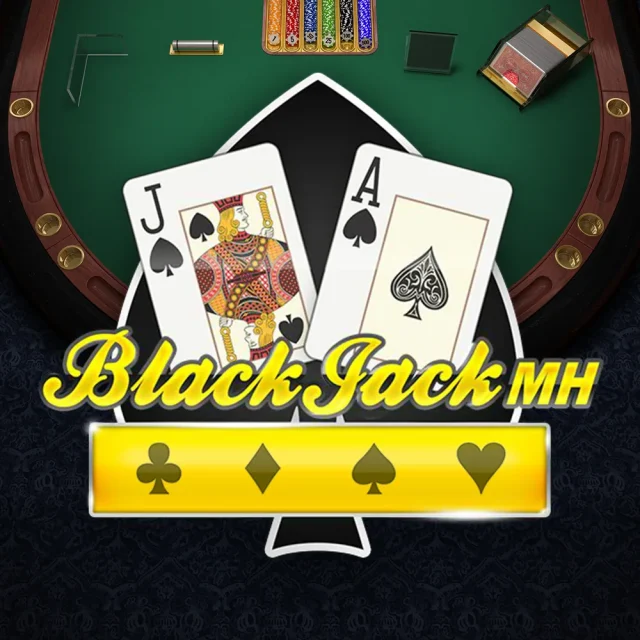
BlackJack MH is presented by Play’n GO as a simple table game for players who are new to cards. The official description gives one central objective: build a hand closer to 21 than the dealer’s. It also states the two decisive outcomes that are documented on the saved page—going over 21 loses the bet, while a dealer bust produces a win.
BlackJack MH at a glance
| Provider | Play’n GO |
|---|---|
| Genre / theme | Table Games |
| Game type | Video slot |
| Release date | 25 October 2012 |
| Main features | The player aims for a hand closer to 21 than the dealer; a hand over 21 busts and loses the bet; if the dealer busts, the player wins. |
RTP and stake limits can vary by version and market. Check the information screen in the game you open. Maximum win is a ceiling, not an expected result.
The documented aim is straightforward
BlackJack MH does not present itself as a reel-based slot in the saved official material. It is labelled a Table Game, with a Classic theme, and its stated aim is to get a hand with a value closer to 21 than the dealer’s. That gives a new player the basic comparison immediately: your total is judged against the dealer’s total, rather than against a paytable of symbols. The page calls the game simple, which is consistent with the short rule summary, but simplicity should not be mistaken for a complete ruleset.
Bust is the clearest losing boundary
The page explicitly says that a hand exceeding 21 busts and loses the bet. This is the firmest tactical boundary supplied by the source: once the player’s total passes 21, being closer to the dealer is no longer relevant. The same description says that if the dealer busts, the player wins. Together, those statements establish the basic tension of the game: remain at or below the limit while trying to finish nearer to 21, and benefit if the dealer crosses the limit. The saved page does not document how cards are dealt or what actions are available, so those details cannot be filled in here.
What the source does—and does not—tell us
The official page does not specify a reel count, paylines, RTP, volatility, maximum win, bonus round, side bet, payout schedule, or tie resolution. It also does not set out a complete dealer procedure. Those details can differ between blackjack versions, so familiar rules from another table do not settle them here. BlackJack MH can therefore be assessed on its published objective and bust logic, but not on an assumed standard ruleset. Cash Chips is a different published review built around cash awards and free-spin choices; it may interest readers comparing casino-style clarity with slot mechanics, but it is not evidence for BlackJack MH’s missing rules.
Release and practical expectations
The saved page records BlackJack MH as released on 25 October 2012, with Classic theme and Table Game type. The source does not provide a numerical configuration to quote. Its strongest practical quality is accessibility: a newcomer can understand the target and the bust condition without learning a feature-heavy interface first. The corresponding limitation is the narrow public description. Anyone needing exact dealing, action, payout or tie rules must consult the game’s own information screen or jurisdiction-specific help rather than relying on this page alone.
Strengths and weak points
Strengths
The published objective is unusually accessible: compare the hand with the dealer, respect the 21 boundary, and understand the dealer-bust outcome without learning a feature-heavy slot interface.
Weaknesses
Because the saved source never states whether BlackJack MH permits a hit, stand, double, split or insurance, its 21-versus-dealer objective cannot support a complete gameplay or payout assessment.
Our Editor’s View
BlackJack MH is a useful example of a game whose appeal comes from a familiar objective rather than a large feature package. The saved Play’n GO page makes the core comparison readable: beat the dealer by finishing closer to 21, avoid exceeding 21, and win when the dealer busts. That is enough to explain why the title may suit a first-time card player. It is not enough to certify every rule normally associated with blackjack. The missing dealing sequence, available decisions, payout details and tie treatment are genuine boundaries, not editorial gaps to cover with assumptions. Readers should approach it as a plainly described classic table game and verify the complete rules in the exact build they play.
Related slot reviews
GO CRAPS
Shared theme: Table Games
European BlackJack MH
Shared theme: Table Games

Legacy of Undead Dragon ABYSSWAYS
More from Play’n GO