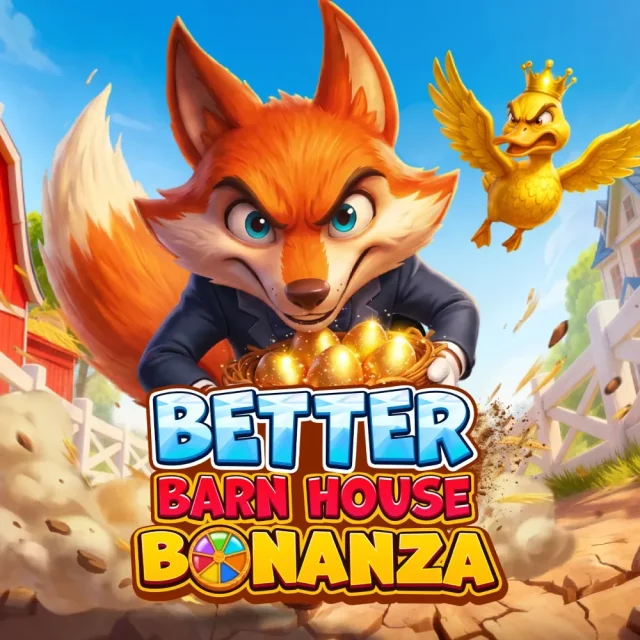
Better Barn House Bonanza builds its free-spin feature through visible changes to individual positions. Six or more scatters award six spins and mark their landing cells with straw; later scatters can upgrade those same cells to wood and then brick. Three wheel levels can also change the entry state, awarding jackpots, advancing to another wheel or starting an enhanced feature on a larger grid. The reviewed configuration is 5×3 with Ways evaluation, 96.5% RTP, medium volatility and a 35,000x maximum win.
Better Barn House Bonanza at a glance
| Provider | Pragmatic Play |
|---|---|
| Genre / theme | Animals |
| Game type | Video slot |
| Reels / grid | 5 x 3 base; 5 x 6 enhanced feature |
| Reference RTP | 96.5% |
| Volatility | Medium |
| Payout mechanic | Ways |
| Maximum win | 35,000x the bet |
| Release date | 22 June 2026 |
| Main features | 6+ scatters award 6 free spins; scatter positions upgrade from straw to wood and brick; 3 eggs add a spin; marked positions reveal cash prizes; three wheel levels can award jackpots or enhanced features. |
RTP and stake limits can vary by version and market. Check the information screen in the game you open. Maximum win is a ceiling, not an expected result.
The wheels shape the starting conditions
Wheel symbols in the 5×3 base game can activate the Bonus Wheel, Bigger Wheel or Better Wheel. Their outcomes are not interchangeable: a wheel can award a jackpot, move play to a higher wheel, or start an enhanced feature on a 5×6 grid. That makes the wheel result an early branch in the game, capable of changing what follows rather than merely adding a prize after the ordinary feature.
The available rules do not state how often each wheel appears, how often an advance occurs, or how frequently the enlarged grid affects a result. The medium volatility label and 96.5% RTP describe the listed configuration, while 35,000x is the game maximum. None of these figures supplies probabilities for the three wheel outcomes, so the levels are best understood by their documented functions rather than ranked by assumed frequency.
Scatter positions develop from straw to brick
Six or more scatters begin six free spins. Their landing positions receive straw frames, creating a map that remains relevant during the round. A later scatter on a marked cell upgrades it from straw to wood, then from wood to brick. A scatter that lands on an existing brick position marks another random position instead. The progression is local: where the scatter lands determines whether it advances a cell or starts a new one.
Three additional egg symbols award one extra free spin. That extension gives the feature another chance to place or upgrade a frame, but the spin itself is not a cash prize. The rounds’ development depends on scatter locations and on how many useful opportunities occur before the counter ends. No trigger frequency or position probability is specified, so the rules establish what an event changes without predicting when it will happen.
Settlement converts completed positions
When the free spins finish, marked cells reveal nests or houses with cash values. Wooden houses can pay up to 40x, while brick houses can reach 5,000x. This makes the straw-to-wood-to-brick path consequential: repeated hits can improve the type of object revealed at settlement. The bonus therefore has separate stages—wheel entry conditions, position marking and upgrading, then prize revelation—rather than one event that immediately defines the final amount.
Progress at one stage does not guarantee progress at the next. A higher wheel does not ensure that the right cells receive scatters, and a brick position is not the same as completing every marked opportunity. The 35,000x game maximum should remain distinct from the stated house values; it is an overall ceiling, not a typical feature result.
Putting the features together
Better Barn House Bonanza gives its feature a visible chain of cause and effect: wheels can alter the entry route, scatters mark specific cells, repeated hits upgrade those cells, and settlement reveals their prizes. That makes position history the most useful thing to follow. The trade-off is that several conditional stages separate a trigger from a developed brick position, and extra eggs add time without ensuring progress. The game’s appeal is this legible build-up, while its maximum remains only a boundary on what the full configuration can award.
Strengths and weak points
Strengths
Straw, wood and brick preserve the history of individual scatter positions, while the three wheel levels can alter the feature route itself. Settlement then ties upgraded cells to distinct house-value ranges.
Weaknesses
Six spins begin the feature, and later scatters must revisit useful cells to upgrade them. Wheel frequencies and outcome rates are unspecified, so neither an enhanced entry nor a brick position is assured.
Our Editor’s View
The most satisfying part of Better Barn House Bonanza is that progress stays visible on the board: each repeated hit can change a marked cell, and the settlement stage pays according to what that cell became. The wheel levels add a separate decision in the sequence by changing the starting route. Readers should keep those stages distinct. More spins or a stronger wheel can create opportunity, but neither guarantees that scatters develop the positions needed for larger house values.
Related slot reviews

Lucky Neko
Shared theme: Animals

Jurassic Kingdom
Shared theme: Animals

Win Win Won
Shared theme: Animals