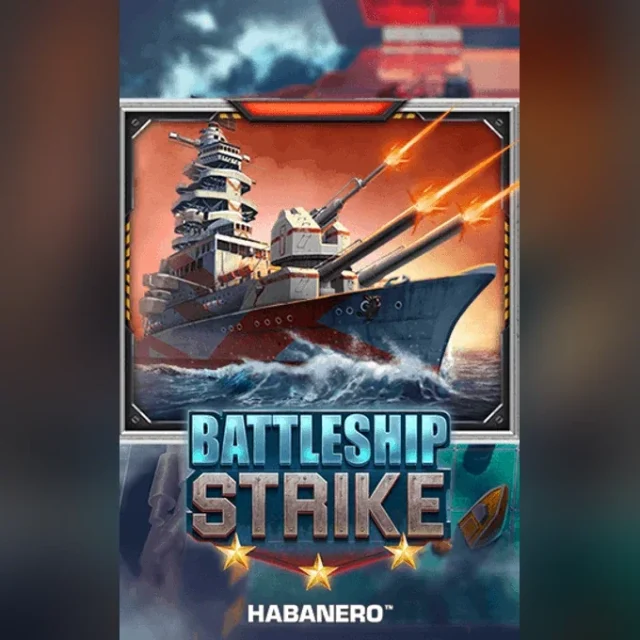
Battleship Strike makes Radar Strike the centre of its 25-line naval slot. Habanero lists a 13,272x maximum multiplier; launch coverage explains ship-to-Wild changes, accumulating multipliers, Free Games and a separate Hunt & Destroy grid. The features offer two distinct routes, though the official public page gives no RTP or volatility.
Battleship Strike at a glance
| Provider | Habanero |
|---|---|
| Genre / theme | Action & Combat |
| Game type | Video slot |
| Reels / grid | 5 x 3 |
| Payout mechanic | 25 paylines |
| Maximum win | 13,272x the bet |
| Release date | 1 September 2026 |
| Main features | Random Radar Strike turns hit ships into Wilds and adds a growing multiplier; three Scatters trigger Free Games where each winning spin brings another strike; Hunt & Destroy searches a hidden grid for ships, prizes and extra attempts. |
RTP and stake limits can vary by version and market. Check the information screen in the game you open. Maximum win is a ceiling, not an expected result.
A conventional line frame with a radar intervention
Habanero lists 25 lines, and launch coverage specifies a 5×3 board. Ordinary results use familiar lines, then a random Radar Strike may intervene on a winning base-game spin. It targets ship symbols, turns those hit into Wilds and adds a multiplier. Since the changed board is evaluated again, an initial win can become a different combination rather than merely receiving a static extra award.
Radar Strike is a random event, not a player-selected action. The report does not say every ordinary win triggers it. Ships and lines form the base game; radar is an extra event that may transform a win. Habanero’s catalogue names Buy Feature and Super Bet, but their exact availability and price should be checked in the local build.
Free Games turn wins into further strikes
Three Scatters activate Free Games. Each winning spin then triggers another Radar Strike: struck ships become Wilds and multipliers accumulate. A win is therefore both a payout event and the condition for another pass of the signature mechanic. This concentrates the feature’s potential in a run of consecutive winning spins; the reviewed launch details do not promise a strike after a non-winning spin.
Hunt & Destroy is separate: players search a hidden grid for ships, prizes and extra attempts. The public account omits grid size, pick count, stopping rule and prize ladder, so those details belong to the game’s help panel. The distinction is still useful: Radar Strike modifies reel outcomes, while Hunt & Destroy is a search-and-reveal round.
Configuration and what the ceiling means
Habanero lists 25 lines and a 13,272x maximum multiplier, but publishes no RTP or volatility value on the official page. A secondary RTP figure may reflect a different operator configuration, so it cannot establish the value for every build. Mechanically, the supported comparison is clearer: random base-game radar can reshape wins, while each winning Free Game spin brings another strike. The maximum is a ceiling, not an ordinary outcome forecast.
Buy Feature and Super Bet appear among Habanero’s feature labels, but the product page does not give their price or math effects. Check the local help screen for controls and wager limits before using an optional purchase or stake increase.
A layered feature set with a real trade-off
Its strongest design link is cause and effect: a radar hit turns ships into Wilds, recalculates the win and may grow the multiplier. Free Games make the chain more dependable by calling another strike after each winning spin. Duck Hunters: Happy Hour offers a different animal-themed follow-on feature for comparison.
Access to the headline mechanic remains uneven. Base Radar Strike is random and attached to wins; Hunt & Destroy’s pick rules are not fully described publicly. Free Games still need winning spins to keep strikes coming, so multiple feature routes do not guarantee a multiplier-building sequence in every session.
Strengths and weak points
Strengths
Radar Strike turns ships into Wilds, recalculates wins and grows a multiplier; each winning Free Game spin triggers another strike.
Weaknesses
Base radar is random and tied to wins; public details omit Hunt & Destroy’s pick count, stopping rule and prize ladder.
Our Editor’s View
Battleship Strike connects one result to the next: a base win may call Radar Strike, Free Games repeat it after every winning spin, and Hunt & Destroy adds a separate search round. That gives the naval theme a distinct identity and keeps the features easy to tell apart. The limit is random access to the base mechanic and incomplete public detail about the pick game. Readers who enjoy visible symbol changes have a clear interaction to follow; check the local rules for configuration and Hunt & Destroy specifics.
Related slot reviews
Double O Dollars
Shared theme: Action & Combat

Bombs Away
Shared theme: Action & Combat
Coyote Crash
Shared theme: Action & Combat