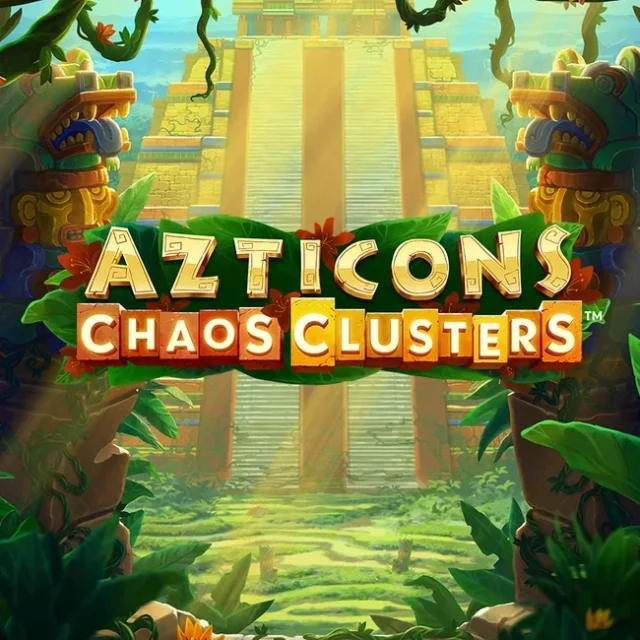
Azticons Chaos Clusters™ is a cluster slot whose defining interaction happens after a win rather than at the instant symbols land. Following an avalanche, the game checks for two symbols of the same value and size aligned horizontally. When it finds a pair, symbols between them may convert, wholly or partly, into a Twin symbol. This Turning Twin process can help create new clusters and longer chains, but the source describes a chance, not a guaranteed conversion. Free Spins add another layer: four Scatters start the round, and a progressive multiplier rises by one with every win. The mechanics reward watching how a board changes across successive evaluations, while the precise RTP model depends on which of Quickspin’s listed configurations is selected.
Azticons Chaos Clusters™ at a glance
| Provider | Quickspin |
|---|---|
| Genre / theme | Ancient Civilizations |
| Game type | Video slot |
| Main features | Turning Twin can convert symbols between matching horizontal pairs after a win and Avalanche. Four Scatters award 7 Free Spins; extras add spins. Wins raise the bonus multiplier; retrigger Scatters add spins. Bonus Buy costs 150x bet. |
RTP and stake limits can vary by version and market. Check the information screen in the game you open. Maximum win is a ceiling, not an expected result.
Cluster wins and the post-win check
Quickspin identifies Azticons as a cluster game and says its Chaos Clusters mechanic is intended to open more winning combinations and longer win chains. The available public rules do not specify an exact grid size, minimum cluster count, or whether adjacency is orthogonal or diagonal. Those details should be checked in the in-game rules instead of supplied from another cluster title. What is documented is the event order around Turning Twin: first there is a win, then an Avalanche, and only afterward does the game inspect the remaining arrangement for matching symbols. Two symbols with the same value and size must be aligned horizontally to form the relevant pair. If the pair is present, the symbols lying between them may be converted into Twins. The official wording allows a full or partial conversion, so neither conversion nor a full row of Twins is assured on every qualifying check.
Turning Twin can affect later outcomes
The conversion rule connects the current board state to what may happen next. A horizontal pair acts as the anchors; symbols between those endpoints may change into the Twin symbol, potentially helping to form a cluster and continue the chain. That makes the mechanic conditional on both the preceding win-and-Avalanche sequence and the positions, values and sizes of symbols left afterward. It is not simply a Wild that substitutes whenever it appears, and the page does not state that Twins themselves have a fixed value or guarantee a winning cluster. The word “Chaos” in the title should not obscure this order of operations: the official description gives a specific check, then a possible conversion. Because it says the conversion may be partial, a reader should not assume the whole interval changes. The published rules do not say whether one board can receive multiple pair checks in the same evaluation or how overlapping pairs are resolved.
Free Spins build a win-by-win multiplier
Four or more Scatter symbols award Free Spins. Four start the bonus with seven spins, and every additional Scatter on the triggering spin adds three more starting spins. During the feature, the progressive multiplier increases by one with each win. The bonus can retrigger: four Scatters award three extra spins, and each additional Scatter adds one more. This gives the feature two separate progression routes. Scatters determine the number of turns entering or returning to the bonus, while wins increase the multiplier. A spin that does not win is not described as adding to that multiplier. The source does not state its starting value, maximum, or whether it resets after each bonus, so those values cannot be inferred. A Bonus Buy is listed at 150 times the bet for immediate entry; purchasing entry does not remove the same spin and win conditions once play begins.
RTP models need an exact selection
Quickspin lists RTP models of 87%, 94% and 96%, and advertises a maximum of 25,000 times the bet. The published details do not associate the standard entry in this packet with one selected RTP model or establish a precise maximum for that configuration. The official page also gives no exact volatility rating, reel/row dimensions or calendar release date in the available feature description. Accordingly, the three RTP values belong to the game’s available model range, not to a single verified configuration here. Players comparing versions need the selected game-client information before assigning one of those figures to their session.
Strengths and weak points
Strengths
Turning Twin has a documented sequence and a concrete horizontal matching condition, while the Free Spins multiplier advances only on wins. Scatter awards and retriggers are also stated in exact counts.
Weaknesses
The public summary omits cluster geometry, the Twin conversion resolution for overlapping pairs, and the bonus multiplier’s start or cap. Three RTP models are listed without identifying the packet’s selected configuration.
Our Editor’s View
Azticons is most distinctive when read as a chain of conditional changes: a win allows an Avalanche, the post-Avalanche board may contain a horizontally aligned pair, and that pair can turn intervening symbols into Twins. The Free Spins multiplier then advances on wins, while Scatters govern the starting and retriggered spin counts. These are separate systems with clearly stated triggers, but some boundaries remain absent from the public summary, including the exact cluster geometry and multiplier cap. The listed 87%, 94% and 96% RTP models also cannot be collapsed into one figure without selecting the exact configuration. Readers who enjoy board-state mechanics and evolving clusters have a substantial interaction to follow; readers focused on precise math should identify the chosen model and consult the game’s rules for the missing grid details.
Related slot reviews
Fortune of Aztec
Shared theme: Ancient Civilizations

GLORY OF ROME
Shared theme: Ancient Civilizations

TREASURE RAIDERS
Shared theme: Ancient Civilizations