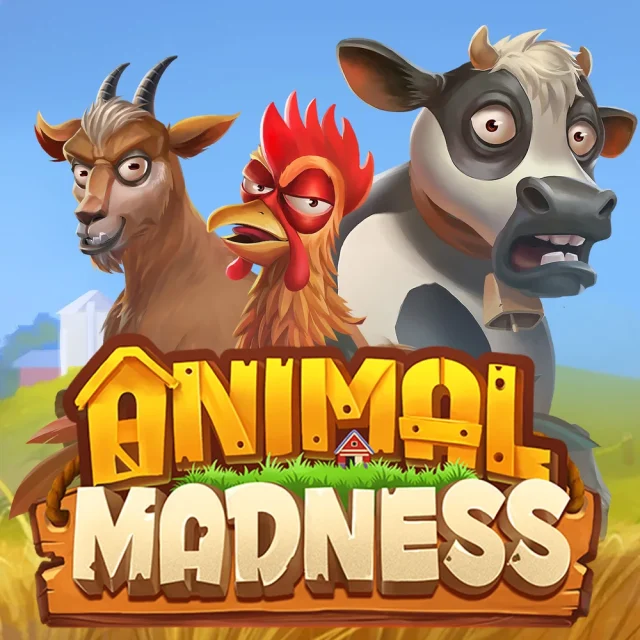
Animal Madness is a 5×5 cascading cluster game with a farmyard charge meter. Winning clusters illuminate and grow petals on a Sunflower; each completed quarter awards a different Wild, progressing from Chicken to Goat, Sheep and Cow. The Rabbit offers a separate base-game disruption by removing a row, a column or low-value symbols on a random non-winning spin. These are distinct ways of changing a grid rather than one generic bonus. The observed standard version lists 96.2% RTP, 6/10 volatility and a 2,250x cap.
Animal Madness at a glance
| Provider | Play’n GO |
|---|---|
| Genre / theme | Animals |
| Game type | Video slot |
| Reels / grid | 5 x 5 |
| Reference RTP | 96.2% |
| Volatility | 6/10 |
| Payout mechanic | Cluster pays |
| Maximum win | 2250x the bet |
| Release date | 19 May 2022 |
| Main features | This fun farm-themed grid slot is perfect for enthusiasts and newcomers to grid slots. Features tie closely with the narrative and the goals are clear to follow as the symbols cascade. Spin. Match. Clear. The Sunflower serves as a Charge Metre, with Wins petals will become highlighted and grow, each quarter of the Sunflower achieved will award a new Wilds on the grid starting with a Chicken, then a Goat, then a Sheep and finally the Cow. For Animal Madness, the checked rules leave the next outcome independent after the main trigger. A visible setup can therefore continue, improve or end without guaranteeing a higher return. The practical boundary in Animal Madness is the end of its named feature state. Once that state closes, retained values and temporary modifiers no longer describe the following base-game result. |
RTP and stake limits can vary by version and market. Check the information screen in the game you open. Maximum win is a ceiling, not an expected result.
Clusters feed the Sunflower
The game uses a five-by-five grid and cluster pays, so a reader should look for matching groups rather than lines. Winning symbols clear and the grid cascades, while the Sunflower Charge Metre records progress through its petals. The colourful crops and animals fit the farm theme, but the functional distinction is between a paid cluster and the subsequent meter growth it contributes. A petal display is not itself a win; it is the route through which successful clusters can unlock later Wild effects.
Quartering the meter unlocks new Wilds
Each time wins add enough highlighted petals to complete a quarter of the Sunflower, the grid receives a new Wild. The stated sequence is Chicken first, then Goat, Sheep and finally Cow. This makes the progression readable: it is based on accumulated winning-cluster activity, not on a themed animation appearing at random. The source does not claim that a new Wild immediately creates a fresh cluster, so it is best understood as an added tool on the grid whose value depends on the symbols supplied by the next cascade.
The Rabbit disrupts a losing grid
The Rabbit operates under a different condition: on random non-winning base-game spins it may remove a row, a column or low-paying symbols. It is therefore a rescue-style board change, not a reward for a completed cluster or a Sunflower threshold. Removing symbols can open space for replacements, but it does not make those replacements match. The meter and Rabbit work at different moments—one follows wins, the other may intervene after a non-win—so their effects should not be combined into an assumed guaranteed cascade. Wolf Gold 4 Pack has no verified reason to share this farm-grid logic.
Configuration and scope
The observed page records 96.2% default RTP, 6/10 volatility, a 2,250x maximum win and a 19 May 2022 release date. RTP is a long-run configuration number, not a schedule for Sunflower quarters or Rabbit interventions. The maximum is an upper limit rather than a prediction for a particular chain of cascades. A live instance may display a different approved RTP profile, which is the configuration that governs that version.
Strengths and weak points
Strengths
Animal Madness separates its grid changes cleanly: winning clusters grow the Sunflower through four animal Wild unlocks, while the Rabbit can remove a row, column or low-value symbols only after a non-winning spin.
Weaknesses
Neither a completed Sunflower quarter nor a Rabbit removal supplies matching replacements. The game can expose extra Wilds or clear space without producing the cluster needed to turn that altered grid into a win.
Our Editor’s View
Animal Madness is a good example of a grid game where the theme helps explain the rules. Clusters grow the Sunflower, completed quarters introduce a specific order of animal Wilds, and the Rabbit can alter a non-winning board in a separate way. Readers who like seeing why a grid changed will have meaningful states to follow. The limitation is that every step still needs favourable replacements: a new Wild or Rabbit removal does not automatically form a winning cluster. The 2,250x headline is a ceiling, not an expected cascade.
Related slot reviews
Cashosaurus
Shared theme: Animals

Jungle Rumble
Shared theme: Animals
Barnstormer Bucks
Shared theme: Animals