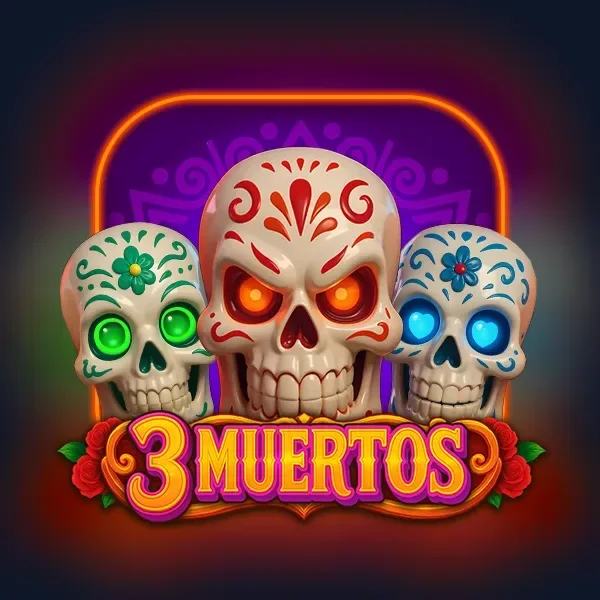
3 Muertos uses three colored skulls as a map to three different bonus formats. Coins can fill the skulls and lead to 24 Free Games, a bottle-reveal Pick’Em round, or a flower-covered Pin Win grid; the important distinction is that these are separate destinations, not three names for the same prize feature. The 5×3, 30-line base game keeps the familiar slot framework, while the changing bonus objective supplies most of the game’s identity. High volatility and random activation make that structure easier to understand than it is to predict.
3 Muertos at a glance
| Provider | Amigo Gaming |
|---|---|
| Genre / theme | Mexican Festivals |
| Game type | Video slot |
| Reels / grid | 5 reels x 3 rows |
| Volatility | High |
| Payout mechanic | 30 |
| Main features | Matching Coins feed colored skulls that can activate one of three bonuses: 24 Free Games, a 20-bottle Pick’Em requiring three same-color Awards, or a 5×3 Pin Win board with three attempts reset by a Flower landing. |
RTP and stake limits can vary by version and market. Check the information screen in the game you open. Maximum win is a ceiling, not an expected result.
A left-to-right game with a second layer above it
The standard game has five reels, three rows and 30 paylines. The independent review describes wins as three or more matching symbols on adjacent reels, starting at the left. A flowered-skull Wild substitutes for paying symbols; Coins feed the colored skulls, while Chests can start a Random Bonus. A spin can therefore build a line and potentially advance a bonus marker at once. The official listing does not provide a full paytable, so symbol values are not inferred here.
Three colors, three different rounds
Coins are attracted to the skull of the matching color. The independent review says skulls can fill randomly, with only one feature activating at a time. Green leads to 24 Free Games, where Coins can continue feeding the skulls and may trigger another bonus or extend play. Red opens Pick’Em: 20 bottles conceal cash prizes or Award symbols, and reveals continue until three Awards of the same color are collected. This is a matching objective, not a reel payout.
Pin Win and its finite board
The blue skull opens Pin Win on a separate 5-by-3 board. Five Flowers are held at the start, and three attempts to land another reset the counter when successful. Filling all 15 positions awards the feature’s Ultra Jackpot; if attempts run out first, displayed values and smaller jackpots determine the result. New Flowers extend the round, while empty attempts use up its limited counter. The three routes thus ask for different tasks: play spins, match picks, or fill a respin board.
Configuration and what remains uncertain
Amigo Gaming lists high volatility, a 5×3 layout, 30 paylines and a 1,400x Multiplier; this is not verified as an overall maximum win. The official listing does not state RTP. The independent review gives a feature-specific 1,000x Ultra Jackpot and reports a 98-times-bet Buy Bonus price, which may vary by market. The design’s strength is variety under one visual system. Its limit is random Coin progression: high volatility gives no assurance when a mode will appear.
Strengths and weak points
Strengths
The three skull colors lead to genuinely different tasks: collect spins, reveal bottles until Awards match, or extend a respin board by landing Flowers. Coins connect those distinct rounds to the reels.
Weaknesses
Coin collection and feature activation are random, and the game is labelled high volatility. RTP is not stated in the exact official listing, so neither feature timing nor return expectations can be established from it.
Our Editor’s View
3 Muertos makes its bonus system legible by assigning each color a distinct task. Green opens a longer spin session, red changes the game into a reveal-and-match choice, and blue starts a board where new Flowers can restore attempts. Coins connect those modes to the base reels without making their timing controllable. That gives the game more structural variety than a single bonus round, while keeping the route into each one uncertain. The clearest trade-off is between variety and predictability: players can learn what each skull does, but the high-volatility label and random activation do not make the features frequent or their results dependable. Readers interested in switching between reel play, picks and respins may find the layout coherent; anyone who wants transparent timing or steady progression should treat the unknown RTP and chance-based triggers as meaningful limits.
Related slot reviews
Paco and the Popping Peppers
Shared theme: Mexican Festivals
Double Chilli
Shared theme: Mexican Festivals
Piñata Smash
Shared theme: Mexican Festivals